Estate Planning Checklist for NRIs
NRI Wealth Partners - Comprehensive Estate Planning Guide
Table of Contents
- Why Estate Planning is Critical for NRIs
- Key Components of Estate Planning
- India vs Foreign Jurisdiction
- Succession Laws in India
- Probate Process in India
- Taxation on Inheritance
- Step-by-Step Guide to Create a Will
- Sample Will Template Structure
- How to Register a Will in India
- Nominee vs Legal Heir
- Joint Accounts and Survivorship
- Trusts for HNIs
- Common Mistakes NRIs Make
- Comprehensive Estate Planning Checklist
- Frequently Asked Questions
Why Estate Planning is Critical for NRIs {#why-estate-planning}
Estate planning is one of the most critical yet overlooked aspects of financial management for Non-Resident Indians (NRIs). As an NRI, you face unique challenges that domestic residents do not encounter. Your assets are often scattered across multiple jurisdictions—some in India and others in foreign countries—making it essential to have a clear, legally binding plan for how these assets should be distributed after your lifetime.
Without proper estate planning, your loved ones may face severe legal complications, prolonged probate proceedings, and significant financial losses. The absence of a valid will can lead to intestate succession laws applying to your estate, which may not align with your wishes or family circumstances. Additionally, the complexity of managing assets across different legal systems—Indian laws for domestic properties and foreign laws for overseas assets—requires meticulous planning. NRIs often underestimate the tax implications and regulatory requirements of their cross-border estates, resulting in unnecessary inheritance taxes, delays in asset transfer, and family disputes.
Estate planning for NRIs also provides peace of mind and ensures that your intentions are clearly documented and legally enforceable. A well-structured estate plan protects your family's financial security, minimizes tax liability, prevents legal disputes among heirs, and ensures efficient asset transfer according to your wishes. Whether you have substantial wealth or modest savings, whether you have dependents or charitable intentions, estate planning is not a luxury—it is a necessity for every NRI seeking to leave a legacy that reflects their values and protects their family's future.
Key Components of Estate Planning {#key-components}
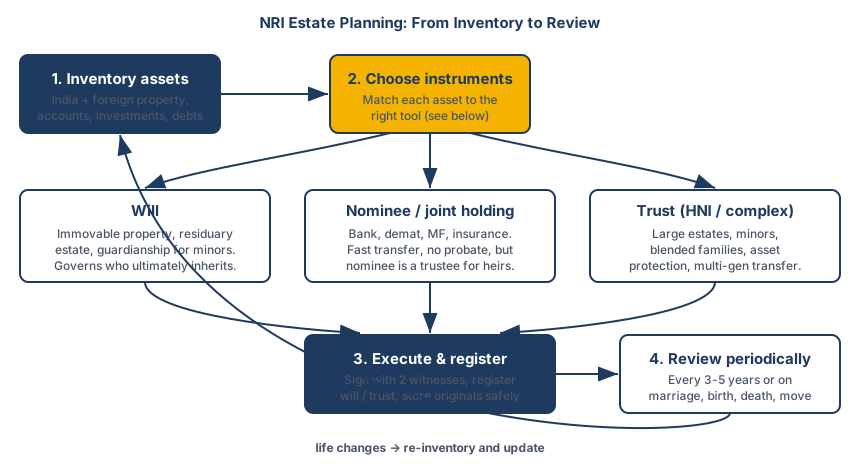
At a high level, estate planning follows the same four stages regardless of how complex your estate is: take stock of everything you own, match each asset to the right instrument (a will, a nominee designation, or a trust), formally execute and register those documents, then revisit the plan as your life changes. The diagram below shows how these stages fit together.
1. Will
A will is the cornerstone of estate planning. It is a legal document that specifies how your assets should be distributed after your death. For NRIs, it's crucial to understand that you may need separate wills for different jurisdictions.
For India Assets:
- Create a will under the Indian Succession Act, 1872
- Include all immovable property (land, buildings, apartments)
- Include movable property (vehicles, jewelry, cash deposits)
- Specify bank account distributions
- Ensure compliance with Indian tax laws
For Foreign Assets:
- Create a will complying with the laws of that jurisdiction
- Include property, investments, bank accounts, and retirement accounts
- Consider tax implications in the foreign country
- Ensure recognition and enforcement in India
2. Nominee Designation
Nominee designation is a quick method to transfer certain assets without going through the probate process. It is essential to nominate beneficiaries for:
Bank Accounts:
- Savings, current, and fixed deposit accounts
- Nomination prevents freezing of accounts during probate
- Ensure nominees are clearly listed with full names and addresses
Demat and Trading Accounts:
- Securities held in demat form
- Mutual fund investments
- Stock holdings
Mutual Funds:
- Direct scheme holdings
- Nomination provisions for each folio
- Update nominees regularly as per life changes
Insurance Policies:
- Life insurance policies (term, endowment, whole life)
- Health insurance policies (if applicable)
- Ensure beneficiary clauses are current and accurate
3. Power of Attorney (POA)
A Power of Attorney is a legal document granting someone authority to act on your behalf. For NRIs, this is particularly important given the distance from India.
General Power of Attorney (GPA):
- Grants broad authority to the attorney-in-fact
- Valid for managing general affairs and transactions
- Useful for ongoing property and financial management
- Should be registered with the Sub-Registrar
Special/Limited Power of Attorney:
- Grants authority for specific transactions only
- Examples: selling a property, managing investments, filing taxes
- Provides more control and security
- Recommended for specific, time-bound tasks
4. Living Will
A living will is a legal declaration about medical decisions if you become incapacitated.
- Specifies medical treatment preferences
- Designates a healthcare proxy or medical attorney-in-fact
- Important in foreign countries; gaining recognition in India
- Complements your estate planning by addressing health directives
India vs Foreign Jurisdiction {#india-vs-foreign}
| Aspect | India | Foreign Countries |
|---|---|---|
| Legal Framework | Indian Succession Act, 1872; Hindu/Muslim Personal Laws | Varies by jurisdiction (Common Law, Civil Law, etc.) |
| Will Validity | Requires testamentary capacity; needs witnesses | Requirements vary; typically 2-3 witnesses; notarization common |
| Probate/Succession Certificate | Probate for immovable property; Succession Certificate for movable property | Probate/Estate Administration process varies |
| Time to Complete | 1-3 years for simple estates; 3-7 years for complex ones | 6 months to 2 years on average; can be longer for contested estates |
| Cost | 2-5% of estate value (court fees, attorney fees, stamp duty) | 1-3% in most jurisdictions; can be higher in complex cases |
| Succession Rules | Intestate succession laws specify distribution by gender, relationship | Depends on jurisdiction; many follow equal distribution |
| Taxation | No inheritance tax; wealth tax implications may apply | Estate/inheritance tax varies; can be 5-55% depending on jurisdiction |
| Foreign Assets | Must be handled separately under foreign law | Indian-situs assets may require Probate in India |
Succession Laws in India {#succession-laws}
Hindu Succession Act, 1956
For Hindu, Sikh, Buddhist, and Jain testators:
- Testamentary Succession: Property passes as per the will
- Intestate Succession: If no will exists, property is distributed among heirs in a prescribed order
- Daughter's Rights: Post-2005 amendment, daughters have equal coparcenary rights as sons
- Widow's Rights: Widow has limited ownership; property passes to next class of heirs upon her death
Order of Succession (without will):
- Widow and children (equal shares)
- Parents
- Siblings and their descendants
- Grandparents, uncles, aunts
Muslim Personal Law
For Muslim testators (Sharia law applies):
- One-third Rule: Testator can only distribute 1/3 of property by will; remaining 2/3 goes to legal heirs
- Quranic Shares: Specific proportions for wives, daughters, and sons
- No Taker Rule: If no heirs exist, property escheats to the State
- Gender Differentiation: Sons typically receive double the share of daughters (unless modified by will)
Christian Succession Act, 1925
For Christian testators:
- Freedom to dispose of all property by will
- If no will, intestate succession follows the Act
- Preference given to children, widow, and parents in succession
Probate Process in India {#probate-process}
Probate is the legal process of validating a will and administering the estate. Here's the 5-step process:
Step 1: Filing the Petition
- Action: Executor files probate petition with the appropriate District Court
- Documents Required:
- Original will
- Death certificate of testator
- Affidavit by executor stating facts
- ID and residential proof of executor
- Deed of self-identification (if required)
- Jurisdiction: Court where the testator was domiciled at death or where property is located
- Timeline: 1-2 weeks for initial review
Step 2: Examination of Petition
- Action: Court examines the petition for completeness and authenticity
- Process:
- Judge reviews the will's validity
- Verifies executor's qualifications
- Checks all required documents are in place
- Possible Outcomes: Petition accepted, rejected, or returned for corrections
- Timeline: 2-4 weeks
Step 3: Acceptance and Grant of Probate
- Action: If petition is accepted, court grants probate
- Grant Effect:
- Declares the will as valid
- Authorizes executor to administer the estate
- Provides legal authority to sell/transfer properties
- Probate Fee:
- First ₹1 lakh: ₹500
- ₹1-5 lakh: ₹2,000
- ₹5-10 lakh: ₹5,000
- ₹10-20 lakh: ₹10,000
- Above ₹20 lakh: ₹15,000
- Timeline: Immediate upon grant
Step 4: Advertisement and Claims
- Action: Estate is advertised for outstanding claims
- Purpose: Allow creditors and claimants to come forward
- Process:
- Published in government gazette and newspapers
- Waiting period: Usually 4 weeks
- Executor settles valid claims against the estate
- Timeline: 4-6 weeks
Step 5: Distribution and Closure
- Action: Executor distributes assets to beneficiaries per the will
- Process:
- Pays all debts, taxes, and claims
- Distributes remaining assets per will instructions
- Files final accounts with the court
- Obtains discharge from the court
- Documents Required:
- Final accounts and statement
- Beneficiary receipt acknowledgments
- Tax clearance certificate (if applicable)
- Timeline: 2-4 weeks after claims period ends
- Total Timeline: 1-3 years for simple estates; 3-7 years for complex ones
Taxation on Inheritance {#taxation-inheritance}
Current Indian Tax Laws
Good News for Heirs: India does not have an inheritance tax. Property inherited by heirs is not subject to income tax.
However, consider the following:
1. Wealth Tax (Abolished from 2016)
- Wealth tax on inherited property was discontinued
- Existing inherited properties are not subject to wealth tax
2. Income from Inherited Assets
- Interest earned on inherited bank accounts: Taxable to heir
- Rental income from inherited property: Taxable to heir
- Dividend income from inherited securities: Taxable to heir
- Capital gains on selling inherited property: Taxable (depends on holding period)
3. Capital Gains on Sale of Inherited Property
Long-Term Capital Gains (LTCG):
- Property held for >2 years (indexation benefit available)
- Tax rate: 20% on indexed gains
- Cost base: Fair market value on date of death (for computing gain)
Short-Term Capital Gains (STCG):
- Property held for ≤2 years
- Tax rate: Taxed as per slab rate (10-30%)
- Cost base: Acquisition cost to testator (but with benefit of step-up in basis to FMV on death)
4. Gift Tax and Inheritance
- No gift tax on inherited property
- Gifts received from relatives within defined limits are exempt
- However, inherited property itself is not a "gift" and thus no gift tax applies
5. Stamp Duty on Inherited Property
- Stamp duty is not payable on property transfer by inheritance
- However, if you sell inherited property, stamp duty applies on the sale deed
6. Property Tax and Municipal Taxes
- Successor liable to pay property tax from date of death onwards
- Arrears typically continue to be responsibility of estate
7. Foreign Inheritance Tax
- Tax on inherited foreign assets depends on the jurisdiction
- US: Federal estate tax can be 40% on estates >$13.61 million (2024)
- UK: Inheritance tax 40% on estates >£325,000
- Canada: No inheritance tax; capital gains apply on death (50% inclusion rate)
- Australia: No inheritance tax
Step-by-Step Guide to Create a Will {#step-by-step-will}
Step 1: Assess Your Assets
- List all assets: immovable (property), movable (vehicles, jewelry, cash), financial (bank accounts, investments)
- Obtain valuations for significant assets
- Identify assets in India and abroad
- Note outstanding debts and liabilities
- Determine which assets should be in the will (vs. designated nominees)
Step 2: Identify Your Beneficiaries
- List family members and dependents
- Note any non-family beneficiaries (friends, charities)
- Determine each beneficiary's share
- Consider special needs of dependents
- Decide on conditional bequests if appropriate
Step 3: Appoint an Executor
- Choose someone trustworthy and competent
- Consider appointing a family member or professional (chartered accountant, lawyer)
- Confirm their willingness to serve
- Appoint alternate executors in case primary executor cannot serve
- Consider appointing a professional trustee for complex estates
Step 4: Decide Distribution of Assets
- Specify which assets go to which beneficiaries
- Allocate shared assets fairly
- Consider tax implications of distributions
- Decide on residuary estate (remaining assets not specifically mentioned)
- Note any specific conditions or contingencies
Step 5: Plan for Minor Children
- Appoint guardians for minor children (separate guardians for person and property if desired)
- Designate trustees to manage inherited property until they reach adulthood
- Specify age at which they should receive assets
- Consider staggered distributions
Step 6: Prepare the Will
Options:
- Do-It-Yourself: Using online templates (risky; not recommended for complex estates)
- Hire a Will Drafting Service: Legal platforms offering pre-drafted wills
- Hire a Lawyer: Most recommended, especially for NRIs with complex assets
Content Elements:
- Testator's full name, address, and identifiers
- Declaration as the last will
- Revocation clause (revokes all previous wills)
- Appointment of executor
- Appointment of guardians (if applicable)
- Specific bequests
- Residuary clause
- Signature of testator
- Attestation by witnesses
Step 7: Execute the Will Properly
Formalities for Validity:
- Testamentary Capacity: Testator must be of sound mind
- Free Will: No undue influence or coercion
- In Writing: Handwritten, typed, or printed
- Signature: Testator must sign the will
- Witnesses: Typically 2-3 witnesses (in India, at least 2)
- Witnesses must sign in the presence of testator and each other
- Witnesses should not be beneficiaries (or their spouses)
- Witnesses should be persons of sound mind and sufficient age
Best Practices:
- Have the will notarized or registered (not mandatory but recommended)
- Keep a copy in a safe location
- Inform executor and key beneficiaries of its existence
- Store original in a safe deposit box or with a lawyer
Step 8: Register and Store Safely
-
Registration (Optional but Recommended):
- File with the Sub-Registrar of the district where testator resides
- Cost: Nominal stamp duty (typically ₹100-500)
- Benefit: Creates official record; reduces probate disputes
- Process: Submit will with application and fee
-
Safe Storage:
- Bank safe deposit box (provide access details to executor)
- With a lawyer (they can store and produce it after death)
- With the Sub-Registrar (if registered)
- Never store at home (risk of loss or tampering)
Sample Will Template Structure {#sample-will-template}
A basic will should include the following sections:
[1] OPENING DECLARATION
    This is the Last Will and Testament of [Full Name],
    [Address], domiciled in [City, Country].

[2] TESTATOR DECLARATION
    I hereby declare that I am of sound mind and executing
    this will of my own free will, without any undue influence.

[3] REVOCATION CLAUSE
    I hereby revoke all previous wills and codicils made by me.

[4] APPOINTMENT OF EXECUTOR
    I appoint [Name], [Address] as my Executor.
    Alternate: [Name], [Address]

[5] APPOINTMENT OF GUARDIANS (If applicable)
    For minor children: [Guardian Name], [Address]
    For property management: [Trustee Name], [Address]

[6] SPECIFIC BEQUESTS
    I bequeath:
    - Property at [Address] to [Beneficiary Name]
    - Vehicle [Details] to [Beneficiary Name]
    - Bank account [Details] to [Beneficiary Name]
    - Jewelry and personal effects to [Beneficiary Name]

[7] RESIDUARY CLAUSE
    All remaining assets not specifically mentioned shall be
    distributed as follows: [Distribution details]

[8] POWERS TO EXECUTOR
    I grant my executor authority to:
    - Sell/mortgage property
    - Invest in securities
    - Pay debts and taxes
    - Manage estate affairs

[9] SIGNATURE BLOCK
    Signed by [Testator Signature]
    Date: [Date]
    Witness 1: [Signature], [Name], [Address]
    Witness 2: [Signature], [Name], [Address]

[10] NOTARIZATION (Optional)
    Notarized on [Date] by [Notary Details]
How to Register a Will in India {#register-will}
While registration of a will is not mandatory in India, it is highly recommended as it provides legal authenticity and prevents disputes.
Registration Process
Step 1: Prepare the Will
- Ensure will is properly executed with signatures and witness attestations
- Obtain 2-3 copies
- Original will should be clean and legible
Step 2: Locate the Sub-Registrar's Office
- Find Sub-Registrar jurisdiction where testator resides
- Sub-Registrars are part of the Revenue/Land Records Department
- Contact details available on State Revenue Department website
Step 3: Prepare Required Documents
- Original will
- Copies of will (2-3)
- Testator's ID proof (Aadhaar, PAN, Passport)
- Testator's address proof (utility bill, voter ID)
- Form 1-A (Application for Will Registration, if required in your state)
Step 4: Submit Application
- Visit Sub-Registrar's office with documents
- Submit application and will with fee (₹100-500, varies by state)
- Pay stamp duty (nominal)
- Obtain receipt and date of registration
Step 5: Record in Register
- Sub-Registrar records will details in the Will Register
- Assigns a registration number
- Maintains record for reference
Step 6: Obtain Certified Copy
- After registration, obtain certified copy from Sub-Registrar
- Useful for probate proceedings
- Cost: ₹50-100 per copy
Timeline: 1-2 weeks for registration
Benefits of Registration:
- Creates official government record
- Reduces probate disputes
- Proves authenticity at time of probate
- Simplifies succession proceedings
- Provides peace of mind
Nominee vs Legal Heir {#nominee-vs-legal-heir}
This distinction is crucial for NRIs and often misunderstood. Here's the key difference:
Nominee
Definition: A person designated by the account holder or insurance policyholder to receive the benefit upon death.
Key Characteristics:
- Designated during account/policy opening or lifetime
- Receives asset directly without going through probate
- Acts as a representative, not always as an owner
- Limited rights; cannot claim beyond the nominated amount
- Fast transfer of assets (within 2-3 weeks typically)
- No need to prove relationship
Applicable To:
- Bank accounts
- Insurance policies
- Demat and trading accounts
- Mutual funds
- Fixed deposits
Advantages:
- Quick transfer without probate delays
- Clear documentation
- No legal disputes (if properly nominated)
- Direct payment to nominee
Example: You nominate your wife as nominee for a ₹10 lakh bank account. Upon your death, the bank releases ₹10 lakh directly to your wife without probate proceedings.
Legal Heir
Definition: A person recognized by law as entitled to inherit your estate when you die.
Key Characteristics:
- Determined by succession laws (Hindu Succession Act, Muslim Personal Law, etc.)
- Has rights to entire estate (not just specific assets)
- Obtains ownership through probate or succession proceedings
- Can claim against the estate for any entitlement
- Longer process; may take months/years
- Must prove relationship to the deceased
Applicable To:
- Immovable property (land, buildings)
- Vehicles
- Any asset not covered by nominee designation
- Residuary assets in the will
Advantages:
- Legally recognized entitlement
- Comprehensive coverage of all assets
- Protection against challenges
- Recognized by courts
Example: You pass away without nominating anyone for your ₹50 lakh flat. Your wife is recognized as your legal heir under the Hindu Succession Act and must go through probate to obtain ownership.
Important Distinction with Example
Scenario: Mr. Sharma, an NRI, has:
- Bank account (₹20 lakh) with wife as nominee
- Flat in Mumbai (₹50 lakh) with no nominee
- Insurance policy (₹25 lakh) with children as nominees
Upon Mr. Sharma's death:
| Asset | Nominee | Legal Heir Process | Timeline |
|---|---|---|---|
| Bank Account | Wife receives ₹20 lakh directly | No probate needed | 2-3 weeks |
| Flat | No nominee; must go through probate | Wife is legal heir; must obtain probate | 1-3 years |
| Insurance | Children receive ₹25 lakh directly | No probate needed | 2-3 weeks |
Key Takeaway: Every asset should have either a clear nominee designation OR be covered by a valid will to avoid delays and complications.
The single biggest practical difference is how long heirs wait to access an asset. Nominated assets and insurance pay out in weeks; anything left to flow through probate can take years. The chart below shows the typical upper-bound transfer time for each route.
Typical time for heirs to access an asset, by transfer route
Probate shown at ~3 years (156 weeks) for a simple-to-moderate estate; complex estates can take longer. Timelines are illustrative, not legal guarantees.
Joint Accounts and Survivorship {#joint-accounts}
Joint accounts are a common estate planning tool for NRIs, but they have specific implications you must understand.
Types of Joint Accounts
1. Joint Tenancy (Right of Survivorship)
- Both account holders have equal rights during lifetime
- Upon death of one owner, account automatically passes to surviving owner
- Surviving owner becomes sole owner immediately
- No probate required
- Available for bank accounts, safe deposit boxes, investments
How It Works:
Account: ₹50 lakh (Mr. & Mrs. Sharma - Joint Tenancy)
Upon Mr. Sharma's death:
→ ₹50 lakh automatically passes to Mrs. Sharma
→ No probate proceedings required
→ Mrs. Sharma becomes sole owner immediately
2. Tenancy in Common
- Each owner has defined share (may be equal or unequal)
- Upon death, owner's share passes per will or succession laws
- Probate required for deceased's share
- More flexibility in asset distribution
- Can name different beneficiaries for each share
How It Works:
Account: ₹50 lakh (Mr. Sharma 50%, Mrs. Sharma 50% - Tenancy in Common)
Upon Mr. Sharma's death:
→ His 50% share (₹25 lakh) must go through probate
→ Passes to his heirs as per will or succession laws
→ Mrs. Sharma retains her 50% (₹25 lakh)
Advantages of Joint Accounts
- Avoids Probate: Asset transfers directly to survivor
- Quick Access: Surviving owner can access funds immediately
- Simplicity: No need for court proceedings
- Cost Savings: Lower legal and administrative costs
- Management: Allows easier management during lifetime (NRI can authorize spouse in India)
Disadvantages and Risks
- Loss of Control: Cannot direct asset to different beneficiary
- Tax Implications: May trigger tax liability for deceased's estate
- Creditor Access: Creditors of deceased may attempt to claim from joint account
- Unequal Distribution: Doesn't work if you want to leave assets unequally to children
- Gift Tax: May be viewed as gift of ownership share
Best Practices for NRIs
- Strategic Use: Joint accounts with spouse for liquid assets; will for others
- Clarity: Understand the type of joint account in each bank
- Documentation: Maintain written records of contribution to joint accounts
- Nomination: Add nominee even to joint accounts for additional security
- Separate Accounts: Keep separate accounts for assets meant for specific beneficiaries
Trusts for HNIs {#trusts-hnis}
For High Net Worth Individuals (HNIs), trusts offer sophisticated estate planning solutions beyond simple wills.
What is a Trust?
A trust is a legal arrangement where you (settlor/grantor) transfer property to a trustee, who manages it for the benefit of beneficiaries. It's a powerful tool for wealth management and asset protection.
Key Parties in a Trust
- Settlor/Grantor: The person creating the trust (you)
- Trustee: Person/entity managing the trust assets
- Beneficiary: Person who receives benefits from trust
- Protector: Optional; oversees trustee and protects beneficiary interests
Types of Trusts for NRIs
1. Revocable Living Trust
- Can be modified or revoked during lifetime
- Avoids probate (assets pass directly to beneficiaries)
- Maintains privacy (not part of public probate record)
- Useful for managing assets if you become incapacitated
- Requires transferring assets into trust name
2. Irrevocable Trust
- Cannot be modified or revoked once created
- Removes assets from your taxable estate
- Provides asset protection from creditors
- May attract gift tax (if applicable)
- Useful for wealth transfer to next generation
3. Charitable Trust
- Assets managed for charitable purposes
- Attracts tax deductions
- Useful for philanthropic HNIs
- Creates lasting legacy for social causes
4. Discretionary Trust
- Trustee has discretion in distributing income/capital
- Useful for managing assets for minors or spendthrift heirs
- Allows trustee to manage distribution based on need
- Avoids fixed distribution that may cause problems
Trust Registration and Administration
Registration (India):
- Trusts are registered with Revenue Department or as per State rules
- Registration creates legal validity
- Trustee appointed and documented
- Beneficial interests recorded
Estate Duty and Taxes:
- Trust assets may be subject to estate duty (if re-introduced)
- Income generated by trust is taxed to beneficiary or trust (depending on distribution)
- Discretionary trusts have tax planning benefits
Administration:
- Trustee maintains accounts and records
- Annual tax filings required
- Beneficiary statements issued regularly
- Proper documentation of all transactions
When Trusts Make Sense for HNIs
- Large Estates: ₹5 crore or more
- Multiple Properties: Immovable and movable assets across jurisdictions
- Minor Beneficiaries: Management of assets until they mature
- Spendthrift Heirs: Control distribution to prevent misuse
- Complex Family Situations: Multiple marriages, blended families
- Asset Protection: Shielding assets from creditors
- Wealth Succession: Multi-generational wealth transfer
Common Mistakes NRIs Make {#common-mistakes}
Mistake 1: Not Having a Will
Risk: Intestate succession laws apply; assets don't go to intended beneficiaries; prolonged disputes and delays.
Impact: Family conflict, loss of ₹5-15 lakhs in unnecessary legal fees, assets frozen for 2-5 years.
Solution: Create a will immediately, specifying how each asset should be distributed. Update it every 3-5 years or upon major life changes.
Mistake 2: Only Having a Foreign Will
Risk: Foreign will may not be recognized in India for Indian assets; requires re-probate proceedings in India; delays and complications.
Impact: Legal uncertainty, multiple probate proceedings, higher costs, family disputes.
Solution: Create separate wills for Indian and foreign assets, or create a comprehensive will following Indian law (preferably with legal advice).
Mistake 3: Not Updating Nominee Designations
Risk: Nominees become outdated (ex-spouses, estranged children); assets go to wrong people; family disputes.
Impact: Assets distributed contrary to wishes; family conflict; possible litigation.
Solution: Review nominee designations annually; update after marriage, divorce, births, or death of nominees. Maintain a record of all nominated beneficiaries.
Mistake 4: Ignoring Joint Account Implications
Risk: Unaware of survivorship rights; may not realize automatic transfer rules; conflicts with will intentions.
Impact: Assets pass to joint account holder despite different will instructions; cannot be rectified after death.
Solution: Understand joint account type in each bank; consider separate accounts for assets meant for specific beneficiaries; document intention clearly.
Mistake 5: Not Appointing Guardians for Minor Children
Risk: No designated guardians; court appoints guardians for minors; may not align with your wishes.
Impact: Children raised by court-appointed guardians you wouldn't choose; possible family disputes; traumatic for children.
Solution: Appoint guardians explicitly in your will; name alternate guardians. Discuss with guardians beforehand to ensure they accept.
Mistake 6: Underestimating Tax Implications
Risk: Not considering capital gains tax on inherited property sale; not planning for foreign tax obligations; unexpected tax bills.
Impact: Heirs face larger tax liability than anticipated; loss of a portion of inheritance to taxes; possible tax penalties.
Solution: Consult a tax advisor; understand tax implications of assets in different jurisdictions; plan capital gains tax for inherited properties. Consider setting up family office for HNIs.
Mistake 7: Keeping Estate Plans Secret
Risk: Family doesn't know of will's existence; misses deadline to claim probate; executors not identified; valuable assets unclaimed.
Impact: Assets may escheat to government; family disputes over estate; prolonged uncertainty and financial hardship.
Solution: Inform executor, spouse, and key beneficiaries of will's existence and location. Keep a list of all assets and their locations with trusted family member or lawyer.
Mistake 8: Not Registering the Will
Risk: Will disputed after death; authenticity questioned; probate proceedings delayed; increased litigation costs.
Impact: Probate proceedings become contentious and lengthy; additional legal fees of ₹2-5 lakhs; family disputes worsen.
Solution: Register will with Sub-Registrar (cost minimal: ₹100-500); also have it notarized for added authenticity. Maintain certified copy.
Comprehensive Estate Planning Checklist {#comprehensive-checklist}
Use this checklist to ensure you've covered all aspects of estate planning. Tick off each item as you complete it.
Documentation and Wills
-
Create or Update Will: Have a valid, properly executed will
- Identify all assets (India and foreign)
- List all beneficiaries with full names and addresses
- Appoint executor and alternate executor
- Specify asset distributions clearly
- Include residuary clause for remaining assets
- Have will drafted by a lawyer (recommended for NRIs)
- Execute with 2-3 witnesses (non-beneficiaries)
- Have will notarized or certified
- Register will with Sub-Registrar
- Store original in safe deposit box or with lawyer
-
Create Separate Wills (if needed): For major foreign assets
- Research laws of foreign jurisdiction
- Create will following foreign country's requirements
- Ensure it's recognized in India and foreign country
- Register in foreign jurisdiction if possible
Nominee Designations
-
Bank Accounts: Nominate beneficiaries for all accounts
- Savings account
- Current account
- Fixed deposit accounts
- Recurring deposit accounts
- NRE/NRO accounts
- Obtain nomination forms from all banks
- Ensure nominees are current and accurate
- Maintain copies of nomination forms
-
Demat Accounts: Nominate for securities holdings
- Demat account through DP (Depository Participant)
- Trading account
- Obtain nomination forms from DP
- Ensure nominees match your intentions
-
Mutual Funds: Designate nominees for all folios
- Direct mutual fund investments
- Mutual fund through bank/broker
- SIPs and regular investments
- Obtain nomination form from fund house/advisor
-
Insurance Policies: Review and update beneficiary designations
- Life insurance policies (term, endowment, whole life)
- Group insurance from employer
- Health insurance policies (if available)
- Policy documents available at home
-
Employee Benefits: Update beneficiaries where applicable
- Gratuity nominations
- Pension scheme beneficiaries
- Stock options and ESOP beneficiaries
- Employer group insurance
-
Safe Deposit Box: Nominate for bank locker access
- Bank safe deposit box/locker
- Ensure nominee can access contents
- List valuable items stored (documents, jewelry, cash)
Power of Attorney
-
General Power of Attorney (GPA):
- Identify trusted person to manage affairs
- Draft GPA document with lawyer
- Have GPA registered with Sub-Registrar
- Ensure GPA covers needed authorities
- Maintain certified copy
- Inform attorney-in-fact of their powers
-
Special/Limited Power of Attorney:
- Identify specific transactions needing POA
- Examples: selling property, accessing safe deposit box
- Draft specific POA for each purpose
- Register if property transfer is involved
- Maintain copy with relevant documents
Asset Inventory and Documentation
-
Immovable Property in India:
- List address and property description
- Obtain property deed and registration details
- Document property value/market assessment
- Note outstanding loans or mortgages
- Property tax assessment details
- Insurance details and policies
- Location of original documents
-
Foreign Real Estate:
- Property address and legal description
- Title deeds and ownership documents
- Property valuation and insurance
- Outstanding mortgage or loans
- Property tax details
- Foreign country-specific documentation
-
Bank Accounts (India):
- List all bank accounts (savings, current, deposits)
- Account numbers and branch details
- Account balances (approximate)
- Nominee information
- Online access passwords (in secure location)
- Standing instructions (if any)
-
Bank Accounts (Foreign):
- Bank name, country, and branch
- Account numbers and account type
- Account balance and currency
- Nominee/beneficiary information
- Online banking credentials (secured)
-
Investments and Securities:
- Demat account details and holdings
- List of stocks and their quantity
- Mutual fund investments and folio numbers
- Bonds and fixed income securities
- Exchange-traded funds (ETFs)
- Digital assets and cryptocurrency (if any)
- Latest account statements
-
Insurance Policies:
- Policy number and provider
- Type of policy (term, endowment, etc.)
- Sum assured and maturity date
- Premium amount and payment mode
- Beneficiary designations
- Policy documents location
- Contact details for insurance company
-
Vehicles and Valuable Assets:
- Vehicle registration details (cars, bikes)
- Loan details and outstanding amount
- Insurance policy information
- Jewelry, watches, and art valuations
- Antiques or collectibles documentation
- Storage location and insurance
-
Retirement Accounts:
- Pension scheme details (if any)
- NPS (National Pension System) account
- Gratuity entitlement details
- Employer retirement benefits
- Withdrawal/beneficiary rules
-
Liabilities and Debts:
- Home loans (outstanding amount, terms)
- Personal loans (lender details, amount due)
- Credit card liabilities
- Any other outstanding debts
- Contact details for lenders
Guardianship and Succession Planning
-
Minor Children Protection:
- Identify guardians for person and property (separately if desired)
- Discuss with prospective guardians beforehand
- Name alternate guardians in case primary cannot serve
- Designate trustee to manage inherited assets until age of majority
- Specify age/milestone when children receive assets
- Include in will or separate guardianship document
-
Dependent Care:
- Identify elderly or disabled dependents
- Plan for their financial needs post-death
- Designate caregiver(s)
- Ensure adequate funds set aside
- Specify healthcare instructions and preferences
Tax Planning
-
Income Tax:
- Document PAN details and tax filing history
- Ensure all tax returns are current
- Assess any outstanding tax liabilities
- Plan for stepped-up basis on inherited property (under current law)
-
Foreign Tax Compliance:
- Understand tax obligations in foreign jurisdictions where you have assets
- FATCA reporting (US citizens/residents)
- CRS reporting (in participating countries)
- Foreign income disclosure and reporting
-
Inheritance Tax Planning:
- Review current inheritance tax laws in your countries
- Estimate potential tax burden on estate
- Consider tax-efficient distribution methods
- Evaluate charitable giving opportunities for tax benefits
Living Will and Healthcare Directives
- Living Will/Advance Directive:
- Create document specifying medical preferences
- Designate healthcare proxy or medical attorney
- Specify preference for life support, organs donation, etc.
- Ensure compliance with country where you reside
- Store copy with doctor and family
- Have family aware of preferences
Professional Advisors
-
Lawyer:
- Identify estate planning lawyer in India
- Lawyer with NRI/cross-border expertise (preferred)
- Contact details and retainer arrangement if applicable
-
Chartered Accountant:
- Identify CA for tax planning
- Ensure expertise in inheritance tax and capital gains
- Discuss tax-efficient estate distribution
-
Financial Advisor:
- Identify wealth advisor or financial planner
- Ensure they understand cross-border wealth management
- Coordinate with other advisors
-
Insurance Agent/Broker:
- Review insurance coverage (life, property, health)
- Ensure coverage is adequate for estate obligations
- Update beneficiary designations on all policies
Communication and Storage
-
Inform Family:
- Discuss estate plans with spouse (if applicable)
- Inform executor of their role and location of documents
- Brief key beneficiaries (general outline, not detailed disclosure)
- Update family about major asset changes
-
Document Storage:
- Will: Safe deposit box or with lawyer
- Property deeds: Safe deposit box or home safe
- Financial account details: Secure location (encrypted file or safe)
- Insurance policies: Home file or safe deposit box
- Passwords and credentials: Secure password manager or envelope with lawyer
-
Create a Master Document:
- List of all assets and their locations
- Names and contact details of key people (executor, guardians, advisors)
- Account numbers and access information
- List of professional advisors
- Location of important documents
- Copy with trusted family member or lawyer
-
Digital Assets:
- List of digital accounts (email, social media, cloud storage)
- Usernames and secured passwords
- Instructions for account closure or memorial
- Digital currency or cryptocurrency holdings
- Online business or domain names
- Digital photos and documents stored online
Review and Update
-
Regular Review Schedule:
- Review will and estate plan every 3-5 years
- Update after major life events (marriage, divorce, birth, death)
- Update upon significant asset acquisition or disposal
- Review after tax law changes affecting your situation
- Review after relocation to new country/state
-
Annual Checkup:
- Verify nominee designations are still current
- Confirm executor and guardians are still willing to serve
- Update asset inventory
- Review insurance coverage adequacy
Frequently Asked Questions {#faqs}
Q1. Do I need a separate will for Indian and foreign assets?
Answer: It depends on the complexity and value of your estates. A single comprehensive will following Indian law can cover both Indian and foreign assets. However, separate wills may be advisable if:
- Foreign assets are substantial (₹1 crore+)
- You reside in a jurisdiction with specific will requirements
- Foreign jurisdiction laws are significantly different from Indian law
- You want to avoid potential conflicts of law issues
A lawyer with cross-border expertise can advise whether separate wills are needed. Many NRIs successfully use a single primary will (Indian law) with supplementary provisions for foreign assets.
Q2. What happens to my NRE and NRO accounts after death?
Answer:
NRE Accounts (Non-Resident External):
- Funds revert to India after death
- Nominee can withdraw funds
- No restrictions on repatriation post-death
- Account may be transferred to legal heir or nominee
NRO Accounts (Non-Resident Ordinary):
- Funds cannot be repatriated unless beneficiary becomes resident
- Nominee/legal heir can withdraw for personal use in India
- Asset transfer may require probate for immovable property
- Investments from NRO can be transferred to nominee
Best Practice: Clearly nominate beneficiaries for both accounts and specify distribution in your will.
Q3. Will I face inheritance tax on assets inherited in India?
Answer: No. India abolished inheritance tax and does not levy tax on inherited property. However:
- Income from inherited assets: Interest on inherited bank accounts, rental income, and dividend income are taxable
- Capital gains: If heirs sell inherited property, capital gains tax applies
- Long-term capital gains (>2 years): 20% with indexation benefit
- Short-term capital gains (≤2 years): Taxed at slab rate
- Wealth tax: Abolished in 2016; not applicable to inherited property
Q4. Is a registered will better than an unregistered will?
Answer: Registration is not mandatory in India but is highly recommended. Benefits of registered wills:
- Creates official government record
- Proves authenticity and reduces disputes
- Simplifies probate proceedings
- Reduces litigation risks
- Cost minimal: ₹100-500 in most states
- No disadvantages to registration
Both registered and unregistered wills are legally valid, but registration provides additional credibility and protection.
Q5. Can I name someone other than family as executor?
Answer: Yes. An executor doesn't have to be a family member. You can appoint:
- Spouse or adult child: Most common; trusted family members
- Professional trustee: Bank, trust company, or financial institution
- Lawyer or Chartered Accountant: Professional with expertise
- Friend: If you trust them with financial responsibilities
The executor should be:
- Of sound mind and legal age
- Not unduly burdened with other responsibilities
- Willing to serve (should be discussed beforehand)
- Preferably residing in the jurisdiction of your assets
Many NRIs appoint a professional trustee along with a family member to ensure impartial and competent administration.
Q6. What is the difference between a will and a living will?
Answer:
Will:
- Document specifying distribution of assets after death
- Comes into effect only after death
- Covers property and financial matters
- Requires probate to be enforced
- Executed once; can be amended via codicil
Living Will:
- Document specifying medical treatment preferences if incapacitated
- Comes into effect if you're alive but unable to communicate
- Covers healthcare and life support decisions
- Does not require probate; family implements immediately
- Designates healthcare proxy to make medical decisions
Both are important: Will protects assets; living will protects health interests. Both should be part of comprehensive estate planning.
Q7. If I die without a will, how is my estate distributed in India?
Answer: Without a will, intestate succession laws apply. Distribution depends on your religion:
Hindu/Sikh/Buddhist/Jain:
- Class 1 Heirs (highest priority): Widow/Widower, children (sons and daughters equally since 2005), mother
- Class 2 Heirs: If no Class 1 heirs exist: Father, siblings, grandparents, aunts, uncles
- Distribution: Equal shares typically; widow may get limited interest in some property
Muslim (Under Muslim Personal Law):
- 1/3 Rule: Only 1/3 can be distributed by will; 2/3 goes to legal heirs
- Quranic Shares: Specific proportions for wives (1/8 or 1/4), daughters (share of 1/2), sons (double daughters' share)
- Distribution: As per Islamic law and personal status
Christian:
- Indian Succession Act, 1865: Intestate succession follows prescribed order
- Distribution: Widow, children, parents; equal distribution among equal class heirs
Advantages of having a will: You control distribution; avoids lengthy legal proceedings; aligns with your wishes rather than law.
Q8. How long does probate typically take in India?
Answer: Probate timelines vary:
Simple Estates (assets <₹20 lakh, no disputes):
- 6-12 months to 1.5 years
- Minimal documentation; few claimants
- Straightforward asset distribution
Moderate Estates (₹20 lakh to ₹5 crore):
- 1.5-3 years
- Some complexity; multiple assets in different locations
- Normal number of heirs
Complex Estates (>₹5 crore, multiple jurisdictions):
- 3-7 years or more
- Multiple properties; foreign assets; numerous beneficiaries
- Potential for disputes requiring additional time
Factors Affecting Duration:
- Clarity of will (clear wills = faster process)
- Number of claimants and beneficiaries
- Asset types (immovable property takes longer)
- Pending tax disputes or liabilities
- Court case backlog
- Presence of disputes among heirs
Tip: Clear, registered will with minimal ambiguity significantly reduces probate duration.
Q9. Can I change my will after it's registered?
Answer: Yes. You can change or revoke a registered will through:
1. Codicil:
- Document amending specific provisions of existing will
- Simpler and less costly than creating new will
- Should be executed with same formalities as original will (signature, witnesses)
- Registered separately
- Useful for minor changes
2. New Will:
- Create entirely new will with revocation clause
- Completely supersedes previous will
- Recommended for major changes or complex revisions
- Should be registered
- Recommended approach for clarity
Best Practices:
- Any change should be dated and executed formally
- New/amended will should reference previous will and status
- For NRIs, inform executor of any changes
- Consider registering amended will
- Update beneficiary information to be consistent with new will
Q10. How do I ensure my family gets quick access to funds after my death?
Answer: Use a combination of strategies to ensure quick fund access:
1. Nominee Designations:
- Nominate spouse/children for bank accounts
- Avoids probate; direct transfer to nominee
- Funds available within 2-3 weeks
- Fastest method for liquid assets
2. Joint Accounts (with survivorship rights):
- Joint ownership automatically transfers to survivor
- No probate required
- Immediate access to funds
- Works well for accounts with spouse
3. Operating Instructions:
- Leave detailed instructions for account access
- Document list of all accounts with bank details
- Store with executor or trusted family member
- Include online banking passwords in secured location
4. Life Insurance:
- Nominee receives life insurance payout quickly
- Doesn't go through probate
- Within 2-3 weeks typically
- Provides immediate liquidity for family needs
5. Liquid Assets:
- Maintain reasonable emergency fund in readily accessible accounts
- Avoid tying up all money in illiquid assets
- Consider emergency fund = 6-12 months family expenses
6. Master Document:
- Create comprehensive list of all accounts and assets
- Include access instructions and contact details
- Executor can access quickly without delays
Recommended Approach: Combine nominee designations for liquid assets with a valid will for remaining assets. This ensures quick access for immediate family needs while proper probate proceeds for long-term asset transfers.
Final Notes and Next Steps
Remember:
- Estate planning is not about death; it's about protecting those you love
- Start estate planning now, regardless of age
- Review and update your plans every 3-5 years
- Consult with professionals: lawyers, tax advisors, financial planners
- Communicate your plans to key family members
- Keep documents organized and accessible to your executor
Immediate Action Items:
- Create or update your will within the next month
- Review and update all nominee designations
- Identify and appoint an executor
- Create a master asset inventory document
- Consult with an estate planning lawyer
- Register your will with the Sub-Registrar
- Inform executor and key beneficiaries of document locations
About NRI Wealth Partners
NRI Wealth Partners is dedicated to helping Non-Resident Indians build, manage, and protect their wealth across borders. Our comprehensive resources, guides, and checklists are designed to simplify complex financial and legal matters for the global Indian community.
For personalized estate planning assistance, tax consulting, or legal advice, we recommend engaging qualified professionals in your jurisdiction.
Last Updated: December 2025
Disclaimer: This document is for informational purposes only and does not constitute legal, tax, or financial advice. Laws and regulations are subject to change. Readers are advised to consult with qualified legal, tax, and financial professionals before making decisions based on this information.
End of Document