NRI Annual Compliance Checklist: Complete Guide for FY 2026-27 (Tax Year 2026-27)
Updated: June 2026
Note — Income Tax Act 2025: Effective 1 April 2026, the Income Tax Act 2025 replaces the "Previous Year" + "Assessment Year" concepts with a single "Tax Year" (1 April–31 March). References below to "Tax Year 2026-27" correspond to what was previously called Assessment Year 2027-28. Filing of FY 2025-26 returns still occurs in 2026 under the transitional cycle; dates labelled below indicate which financial year they apply to.
Executive Summary
As an NRI, annual compliance involves tax filing, FEMA reporting, investment reviews, and documentation maintenance. This checklist ensures you stay compliant with Indian regulations and optimize your financial position.
Key Annual Obligations:
- Income Tax Return (ITR) filing by July 31
- FEMA compliance for foreign assets and transactions
- FATCA/CRS reporting to Indian banks
- Bank account reviews and KYC updates
- Investment portfolio review and rebalancing
- Document maintenance and updates
Penalties for Non-Compliance:
- Late ITR filing: ₹5,000-10,000 + interest
- Non-disclosure of foreign assets: Up to ₹10 lakh
- FEMA violations: ₹10,000-₹2 lakh per day
- Non-compliance with KYC: Account freezing
1. Income Tax Compliance (April - July)
1.1 ITR Filing Requirements
Who Must File:
- ✅ Total income > ₹2.5 lakh (basic exemption limit)
- ✅ Income from India (salary, rental, interest, capital gains, business)
- ✅ Foreign income if you're Resident or RNOR (for some cases)
- ✅ To claim TDS refund (even if income below limit)
- ✅ If you hold signing authority in foreign accounts
Who May Skip (But Not Recommended):
- ❌ Total income < ₹2.5 lakh AND no refund AND no foreign assets
- Caution: Always file to maintain clean tax record
1.2 ITR Form Selection
| Your Income Sources | Correct ITR Form |
|---|---|
| Salary + House Property + Other Sources | ITR-2 |
| Salary + House Property + Capital Gains | ITR-2 |
| Business/Professional Income | ITR-3 |
| Presumptive Business Income | ITR-4 (if eligible) |
Most NRIs file ITR-2
1.3 ITR Filing Checklist
Before Filing (June):
- Download Form 26AS (annual tax statement)
- Collect Form 16/16A (TDS certificates)
- Gather bank statements (interest income)
- Collect investment statements (dividends, capital gains)
- Get rental agreement and property tax receipts
- Prepare list of foreign assets (Schedule FA)
- Calculate capital gains (property, mutual funds, stocks)
- Compile deduction proofs (80C, 80D, home loan interest)
Filing Process (July):
- Login to e-filing portal (incometaxindiaefiling.gov.in)
- Choose correct ITR form (usually ITR-2 for NRIs)
- Fill income from all sources
- Salary (if worked in India)
- House property (rental income)
- Capital gains (property, MF, stocks)
- Other sources (interest, dividends)
- Claim deductions (80C, 80D, 24b, etc.)
- Report TDS as per Form 26AS
- Fill Schedule FA (foreign assets disclosure)
- Fill Schedule AL (if assets > specified limits)
- Validate and submit
- Verify ITR (e-verify using Aadhaar OTP, net banking, or send ITR-V)
- Deadline: July 31 (can be extended to Oct/Dec in some cases)
After Filing (August onwards):
- Track processing status
- Check intimation under Section 143(1)
- Claim refund (if applicable)
- Respond to notices (if any)
- Keep ITR acknowledgment safe (7 years)
1.4 Common ITR Mistakes
Mistake #1: Not Filling Schedule FA
- Foreign assets not disclosed
- Penalty: ₹10 lakh
Solution:
- Report all foreign bank accounts (even zero balance)
- Report foreign investments (stocks, bonds, MF)
- Report foreign property
- Report foreign pension/retirement accounts
Mistake #2: Wrong Residential Status
- Claiming Resident when you're NRI (or vice versa)
Solution:
- Calculate days in India (use passport)
- NRI if in India <182 days in FY
- RNOR if you meet specific criteria (benefit: foreign income not taxed)
Mistake #3: Not Reporting Capital Gains
- MF redemptions, stock sales not reported
Solution:
- Get capital gains statement from platform (Zerodha, Groww, etc.)
- Report all sales, even if loss
- Use losses to offset gains
Mistake #4: Form 26AS Mismatch
- TDS claimed different from Form 26AS
Solution:
- Download latest Form 26AS (after June 10)
- Match with Form 16/16A
- Report discrepancies to deductor
2. FEMA Compliance
2.1 Reporting Requirements
To RBI (Not Required for Most NRIs):
- Foreign Currency accounts above specified limits
- Large investments abroad (through LRS)
To Income Tax (Mandatory in ITR):
- Schedule FA: Foreign assets
- Schedule AL: High-value assets
2.2 Schedule FA Checklist
What to Report:
- Foreign bank accounts (current account, savings, deposit)
- Account number, bank name, country
- Peak balance during the year
- Closing balance
- Foreign custodial accounts (stocks, brokerage)
- Foreign equity/debt investments
- Foreign cash value insurance/annuity
- Foreign immovable property
- Address, date of acquisition, cost
- Current value
- Foreign retirement accounts (401k, IRA, pension)
- Other capital assets
- Account in which signing authority
Not Required to Report:
- Accounts in NRE/FCNR (these are in India, though foreign currency)
Deadline: With ITR filing (July 31)
2.3 LRS (Liberalized Remittance Scheme) Compliance
If You Remitted >$250,000 in FY:
- Bank reports to RBI automatically
- You must report in ITR
Purpose Codes:
- S0001: Education
- S0002: Medical treatment
- S0003: Overseas tour/travel
- S1301: Investment in equity/debt
- S1302: Investment in property
Checklist:
- Keep LRS form copies (from bank)
- Report in Schedule FA if investment
- File Form 15CA/15CB if required
3. FATCA & CRS Compliance
3.1 What is FATCA/CRS?
FATCA (Foreign Account Tax Compliance Act):
- US law requiring disclosure of foreign accounts by US persons
- Indian banks report accounts of US persons to US IRS
CRS (Common Reporting Standard):
- Global standard for automatic exchange of financial account information
- India exchanges info with 100+ countries
3.2 Annual Checklist
Bank Reporting (Automatic):
- Banks report your NRE/NRO account details to your country of tax residence
- You don't need to do anything (bank handles)
- But ensure your bank has correct info
Your Action:
- Verify tax residency details with bank (annual review)
- Update if you changed country of residence
- Provide TIN (Tax Identification Number) of foreign country
- USA: SSN/ITIN
- UK: UTR (Unique Taxpayer Reference)
- Canada: SIN
- UAE: TRN (if applicable)
Self-Declaration Form:
- Some banks ask for annual self-declaration
- Confirm tax residency status
- Update if changed
Penalties for Wrong Info:
- Mismatch can trigger audit
- Ensure consistency between your ITR and bank declaration
4. Bank Account Reviews
4.1 Quarterly Bank Account Checks
Q1 (Apr-Jun):
- Review account statements
- Check for unauthorized transactions
- Update contact info (email, phone)
- Review interest rates (FDs maturing? Renew at current rates)
- Check minimum balance compliance
Q2 (Jul-Sep):
- Review NRE/NRO balances
- Transfer excess funds (repatriation or investment)
- Check TDS credits in Form 26AS (NRO interest)
- Apply for lower TDS certificate (Section 197) if eligible
Q3 (Oct-Dec):
- Year-end tax planning (additional 80C, 80D investments)
- Review credit card statements and rewards
- Close inactive accounts (if any)
Q4 (Jan-Mar):
- Finalize tax-saving investments (80C, 80D, NPS)
- Pay advance tax (if applicable, by Mar 15)
- Request Form 16A (TDS on interest, rent, etc.)
- Download annual bank statements for ITR
4.2 KYC Updates (Periodic)
Update Required Every:
- High risk: Annually
- Medium risk: Every 2 years
- Low risk: Every 10 years
Check Your KYC Status:
- Login to net banking
- Check KYC compliance status
- Update if expiring soon
Documents to Update:
- Passport (if renewed)
- Address proof (if changed)
- Visa/work permit (if extended/renewed)
- PAN-Aadhaar linking (must be linked)
KYC Update Methods:
- Video KYC (fastest, 1-2 days)
- In-person at branch (if visiting India)
- Courier of documents (slower)
4.3 NRE/NRO Account Conversion
When Status Changes:
- If you return to India: Convert to Resident account
- NRE → RFC (Resident Foreign Currency)
- NRO → Regular Savings
- Do within reasonable time (1-3 months)
- If you become NRI: Convert Resident to NRE/NRO
- Submit status change form
- Provide visa, passport, residence proof
5. Investment Portfolio Review
5.1 Annual Portfolio Review (Dec-Jan)
Performance Review:
- Calculate portfolio returns (XIRR)
- Compare with benchmarks
- Equity MF: Nifty 50, Sensex
- Debt MF: CRISIL indices
- Overall: Your target return (e.g., 12%)
- Note funds lagging their benchmark over longer periods (educational observation, not a personalized recommendation to act)
Asset Allocation Check:
- Calculate current allocation
- Equity: X%
- Debt: Y%
- Gold: Z%
- Real estate: A%
- Cash: B%
- Compare with target allocation
- Rebalance if deviation >10%
Rebalancing (general concept):
- Some investors periodically review their allocation and bring it back toward a chosen mix
- An illustrative example mix might be 60% equity, 30% debt, 10% gold — this is for education only and is not personalized advice
- Any rebalancing decisions should suit your own goals, risk tolerance and circumstances
Tax-Loss Harvesting:
- Identify investments with losses
- Sell to book loss (offset against gains)
- Buy back after 1 day (avoid wash sale confusion)
- Save on capital gains tax
Example:
- Stock A: Loss of ₹1 lakh
- Stock B: Gain of ₹1.5 lakh
- Sell both: Net gain ₹50,000 (tax on ₹50k instead of ₹1.5L)
5.2 Mutual Fund Review
SIP Health Check (educational):
- Review active SIPs
- Investors sometimes reassess SIPs in funds that have lagged over time (general concept, not a directive to stop any SIP)
- Consider whether SIP amounts still match your income and goals
- Consider whether any new goals call for additional SIPs
Fund Consolidation:
- Review total number of funds (ideally 8-12 max)
- Identify overlap (same stocks in multiple funds)
- Exit funds with high overlap
- Investors sometimes review fund overlap and the overall fund mix (for example a spread across large cap, mid cap, small cap and debt) — illustrative concept, not a personalized recommendation
LTCG Tax Optimization:
- Equity MF: Book gains up to ₹1.25 lakh (tax-free)
- Immediately reinvest (reset cost basis)
- Save 12.5% tax on future gains
5.3 Real Estate Review
If You Own Property:
- Pay property tax (annually)
- Renew rental agreement (if tenant)
- Collect rent regularly (monitor)
- Review property value (compare market rates)
- Maintain property (repairs, painting)
- Review home loan (prepayment opportunity?)
If You Have Home Loan:
- Review interest rate (refinance if better rate available)
- Make prepayments (if surplus funds)
- Claim tax deductions
- Section 24: Interest up to ₹2 lakh
- Section 80C: Principal up to ₹1.5 lakh
5.4 Insurance Review
Life Insurance:
- Review coverage (a common rule of thumb cited in personal-finance education is around 10-15x annual income — general guidance, not personalized advice)
- Pay premiums on time
- Update nominees
- Understand the different product types available (e.g., term plans and ULIPs) and how their cost, cover and investment features differ, so you can choose what suits your needs
Health Insurance:
- Review coverage (commonly cited range is around ₹10-25 lakh — general guidance, not personalized advice)
- Pay premiums (claim 80D deduction)
- Update personal details
- Add family members (if needed)
6. Document Maintenance
6.1 Essential Documents to Keep (7 Years)
Tax Documents:
- ITR acknowledgments (all years)
- Form 26AS (all years)
- TDS certificates (Form 16/16A)
- Tax payment challans
- Capital gains statements
Bank Statements:
- Annual bank statements (all accounts)
- FD certificates and renewal receipts
- Loan statements
Investment Documents:
- Mutual fund statements (annual)
- Demat account statements
- Stock purchase/sale contract notes
- Dividend statements
Property Documents:
- Sale deed (original, safe deposit locker)
- Property tax receipts
- Rental agreements
- Maintenance receipts
Insurance:
- Policy documents
- Premium payment receipts
- Renewal notices
6.2 Digital Backup
Cloud Storage:
- Scan all important documents (PDF)
- Upload to Google Drive, Dropbox, or OneDrive
- Organize in folders (Tax, Bank, Investments, Property, Insurance)
- Password protect (encryption recommended)
Local Backup:
- External hard drive (physical backup)
- Update annually
Access Sharing:
- Share access with spouse/trusted family member
- In case of emergency
6.3 Physical Document Storage
Safe Deposit Locker:
- Original property documents
- Original insurance policies (term plans)
- Jewelry appraisals
- Will (copy, original with lawyer)
Home Filing:
- Current year tax documents
- Active investment statements
- Recent bank statements
- Active insurance policies
7. Deadlines Calendar (FY 2026-27 / Tax Year 2026-27)
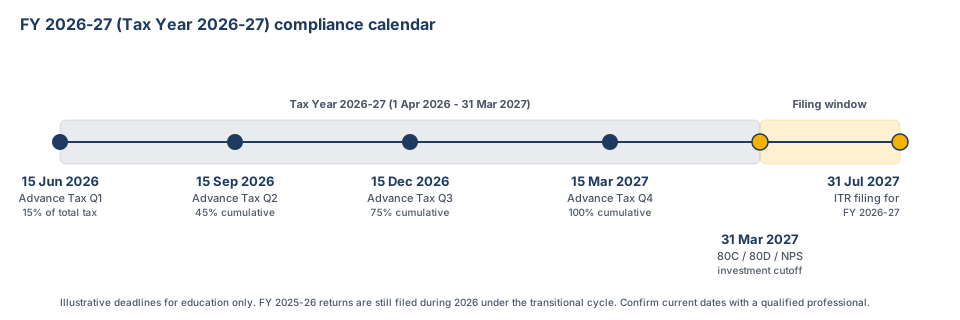
The timeline below maps the key FY 2026-27 deadlines onto a single calendar: the four advance-tax instalments (Jun, Sep and Dec 2026, plus Mar 2027), the tax-saving investment cutoff on 31 March 2027, and ITR filing for FY 2026-27 by 31 July 2027. Remember that FY 2025-26 returns are still filed during 2026 under the transitional cycle — the dates here apply to FY 2026-27 income.
7.1 Tax Deadlines
| Date | Action | Penalty for Missing |
|---|---|---|
| June 15, 2026 | Advance Tax Q1 (15% of total tax), FY 2026-27 | Interest u/s 234B/C |
| July 31, 2026 | ITR Filing for FY 2025-26 (income earned Apr 2025–Mar 2026) | ₹5,000-10,000 late fee |
| September 15, 2026 | Advance Tax Q2 (45% cumulative), FY 2026-27 | Interest u/s 234B/C |
| December 15, 2026 | Advance Tax Q3 (75% cumulative), FY 2026-27 | Interest u/s 234B/C |
| December 31, 2026 | Belated/Revised ITR for FY 2025-26 (if missed July deadline) | ₹5,000-10,000 late fee + interest |
| March 15, 2027 | Advance Tax Q4 (100%), FY 2026-27 | Interest u/s 234B/C |
| July 31, 2027 | ITR Filing for FY 2026-27 (for most NRIs) | ₹5,000-10,000 late fee |
Advance tax (where applicable) is paid in instalments that build up to 100% of your estimated FY 2026-27 liability. The chart below shows the minimum cumulative percentage due by each instalment date — illustrative only, based on the standard schedule.
Advance Tax: minimum cumulative % due by date (FY 2026-27)
Standard advance-tax schedule; applies only if advance tax is payable. Illustrative, not advice.
7.2 Investment Deadlines
| Date | Action | Why |
|---|---|---|
| March 31, 2027 | Tax-saving investments (80C, 80D, NPS) | Last day for FY 2026-27 |
| March 31, 2027 | ELSS investments (₹1.5L u/s 80C) | Lock-in 3 years |
| March 31, 2027 | Book LTCG up to ₹1.25L (equity MF) | Tax-free harvesting |
7.3 Banking Deadlines
| Frequency | Action |
|---|---|
| Quarterly | Review bank statements, FD renewals |
| Annually | KYC updates (if due) |
| As Needed | FATCA/CRS self-declaration |
8. Compliance by Country of Residence
8.1 USA NRIs
Additional Compliance:
- US Tax Return (April 15)
- FBAR (FinCEN Form 114) if foreign accounts >$10,000 (June 30)
- FATCA Form 8938 if assets >$200,000 (with US tax return)
- Claim Foreign Tax Credit (for Indian taxes paid)
India:
- Standard India ITR (July 31)
- Schedule FA (foreign assets in US)
8.2 UK NRIs
Additional Compliance:
- UK Self-Assessment (January 31 online, October 31 paper)
- Report Indian income if not remitted to UK (remittance basis)
India:
- Standard India ITR
- Claim DTAA benefits (lower TDS)
8.3 UAE NRIs
Additional Compliance:
- Generally no personal tax in UAE
- Corporate Tax if you own business (June 1, 2023 onwards)
India:
- Standard India ITR
- DTAA benefits (lower TDS on interest, dividends)
8.4 Canada NRIs
Additional Compliance:
- Canada Tax Return (April 30)
- Report worldwide income
- Claim Foreign Tax Credit
India:
- Standard India ITR
- DTAA benefits
9. Common Compliance Pitfalls
9.1 Pitfall #1: Missing ITR Deadline
Impact:
- Late fee: ₹5,000 (if income >₹5L), ₹1,000 (if <₹5L)
- Interest on unpaid tax (1% per month)
- Cannot carry forward losses
Avoid:
- Set calendar reminder (June 1)
- Start preparation in June
- File by July 15 (buffer for issues)
9.2 Pitfall #2: Not Disclosing Foreign Assets
Impact:
- Penalty up to ₹10 lakh
- Prosecution in severe cases
Avoid:
- Maintain list of foreign accounts/assets
- Update annually
- Fill Schedule FA carefully
9.3 Pitfall #3: Wrong Residential Status
Impact:
- Paying more tax (if claimed Resident when NRI)
- Or under-reporting income (if claimed NRI when Resident)
Avoid:
- Track days in India using passport
- Understand RNOR benefits
- Consult CA if unsure
9.4 Pitfall #4: Ignoring FEMA Compliance
Impact:
- Penalties for violations
- Difficulty in fund repatriation
Avoid:
- Use only NRE/NRO accounts for India transactions
- Don't use Resident accounts after becoming NRI
- File Form 15CA/15CB for large remittances
10. Annual Compliance Scorecard
Use this scorecard to track your compliance:
| Task | Due Date | Status | Notes |
|---|---|---|---|
| ITR Filed | July 31 | ☐ Done ☐ Pending | |
| Schedule FA Filled | July 31 | ☐ Done ☐ Pending | |
| Advance Tax Paid (if applicable) | Quarterly | ☐ Done ☐ Pending | |
| FATCA/CRS Updated | Annually | ☐ Done ☐ Pending | |
| Bank KYC Updated | As due | ☐ Done ☐ Pending | |
| Portfolio Reviewed | Annually | ☐ Done ☐ Pending | |
| Tax-saving Investments | March 31 | ☐ Done ☐ Pending | |
| Property Tax Paid | Annually | ☐ Done ☐ Pending | |
| Insurance Premiums Paid | As due | ☐ Done ☐ Pending | |
| Documents Backed Up | Ongoing | ☐ Done ☐ Pending |
Conclusion
Annual NRI compliance may seem daunting, but with systematic planning and this checklist, you can stay fully compliant while optimizing your taxes and investments.
Key Takeaways:
- File ITR on time (July 31) - mandatory even if low income
- Disclose foreign assets (Schedule FA) - avoid ₹10L penalty
- Review portfolio annually - rebalance, tax-loss harvest
- Keep documents safe - 7 years, digital + physical
- Track deadlines - use calendar reminders
- Engage professionals - CA for complex situations
Stay compliant, stay stress-free!
Disclaimer
This checklist is for general informational and educational purposes only, based on regulations applicable for FY 2026-27 (Tax Year 2026-27). Tax laws and compliance requirements are subject to change. Nothing here is professional tax, legal or investment advice, and any investment-related examples (such as asset allocations, fund mixes or insurance cover) are illustrative educational content, not personalized recommendations.
NRI Wealth Partners operates as an AMFI-registered Mutual Fund Distributor (ARN-360468) and through Chartered Accountant services. We are not a SEBI-registered investment adviser or research analyst and do not provide personalized investment advisory.
Consult a qualified Chartered Accountant or tax advisor for personalized guidance on your specific situation, and a SEBI-registered investment adviser for personalized investment advice.
Prepared by: NRI Wealth Partners Compliance Team Updated: June 2026 Contact: compliance@nriwealthpartners.com Website: www.nriwealthpartners.com
For personalized compliance support, ITR filing, and tax advisory, contact our expert team.