NPS for NRIs: Complete Guide to National Pension System
Updated: June 2026 | For FY 2026-27 (Tax Year 2026-27)
Note (Income Tax Act 2025): The Income Tax Act 2025 (effective 1 April 2026) replaces the old "Previous Year / Assessment Year" concept with a single "Tax Year" (1 Apr–31 Mar). References to "AY 2026-27" should be read as "Tax Year 2026-27". Several deduction sections are also renumbered (e.g. 80C → Section 123); the monetary limits and NPS deductions below are unchanged. NPS deductions under 80CCD(1)/(1B)/(2) remain available in the old regime.
Executive Summary
The National Pension System (NPS) is a government-backed retirement savings scheme that offers NRIs tax benefits, market-linked returns, and low costs. It's an excellent complement to foreign pension plans like 401(k), IRA, or workplace pensions.
Key Highlights for NRIs:
- Tax deduction up to ₹2 lakh (₹1.5L u/s 80C — Section 123 under the Income Tax Act 2025 — + ₹50K u/s 80CCD(1B); available in the old regime)
- Employer contribution deductible under 80CCD(2) (10-14% of salary)
- Low expense ratio (0.01-0.09% annually)
- Market-linked returns (10-12% historical)
- Partial withdrawal allowed after 3 years
- Mandatory annuity at retirement (40% minimum)
- NRIs eligible through Tier I and Tier II accounts
Returns (Historical, 2015-2025):
- Equity (E): 11-13% CAGR
- Corporate Bonds (C): 8-10% CAGR
- Government Securities (G): 7-9% CAGR
- Alternative Assets (A): 9-11% CAGR
1. What is NPS?
1.1 Overview
National Pension System (NPS):
- Government-regulated pension scheme
- Launched: 2004 (government employees), 2009 (all citizens)
- Regulator: Pension Fund Regulatory and Development Authority (PFRDA)
- Structure: Defined contribution (not defined benefit)
- Returns: Market-linked (not guaranteed)
For NRIs:
- Available since 2015
- Must have Indian citizenship or OCI
- Can open NRE or NRO-based NPS account
- Repatriation allowed (with conditions)
1.2 Key Features
Investment:
- Minimum: ₹500 per contribution
- No maximum limit
- Can invest lumpsum or regular
Asset Allocation:
- Four asset classes: Equity (E), Corporate Bonds (C), Government Securities (G), Alternative Assets (A)
- Auto mode: Age-based allocation
- Active mode: Choose your own allocation
Pension Funds:
- 10+ fund managers (SBI, HDFC, ICICI, UTI, LIC, etc.)
- You choose fund manager
- Can switch once per year (free)
Maturity:
- Age 60 (normal retirement)
- Early exit after 60 (anytime)
- Premature withdrawal before 60 (conditions apply)
2. NPS Eligibility for NRIs
2.1 Who Can Open NPS Account?
Eligible:
- ✅ Indian citizens residing abroad (NRIs)
- ✅ Overseas Citizens of India (OCI cardholders)
- ✅ Age: 18-70 years
- ✅ All NRIs (salaried, self-employed, business owners)
Not Eligible:
- ❌ Foreign nationals (non-PIOs)
- ❌ Persons above 70 years (cannot open new account)
2.2 Account Types
Tier I Account (Mandatory):
- Primary retirement account
- Tax benefits available
- Lock-in till age 60 (with withdrawal conditions)
- Minimum ₹500/year contribution to keep active
Tier II Account (Optional):
- Voluntary savings account (like mutual fund)
- No tax benefits
- No lock-in, full liquidity
- Requires active Tier I account
- Minimum ₹1,000 to open, ₹250 per contribution
The two accounts trade off liquidity against benefits: Tier I locks funds for retirement but unlocks tax benefits and annuity, while Tier II is fully liquid but offers neither. The relative scoring below is illustrative:
Tier I vs Tier II: Relative Feature Scores
Illustrative relative scoring of account features, not a quantitative metric.
3. NPS Account Opening for NRIs
3.1 Documents Required
Identity Proof:
- Passport (all pages copy)
- PAN card (mandatory)
- OCI card (if applicable)
Address Proof (Overseas):
- Bank statement (last 3 months)
- Utility bill
- Residence permit/visa
- Driving license
Address Proof (India):
- Aadhaar card (if available)
- Voter ID, Driving license, or passport
Bank Account Proof:
- NRE or NRO account details
- Cancelled cheque or bank statement
- Bank verification letter
Photographs:
- Passport-size photos (2-3)
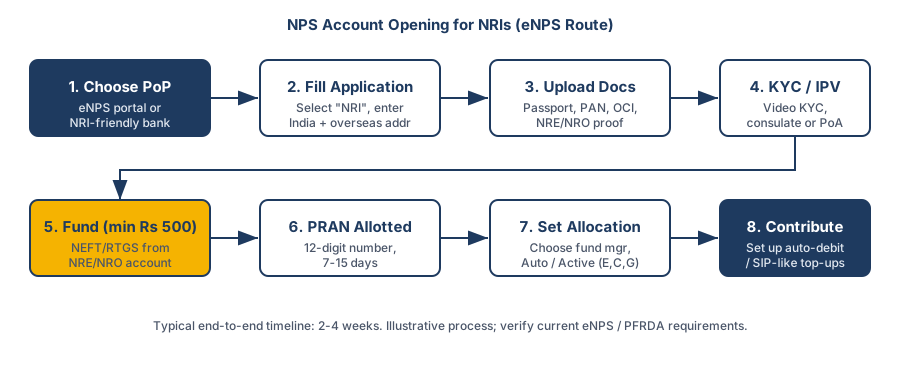
3.2 Registration Process
Step 1: Choose PoP (Point of Presence)
- Banks: HDFC, ICICI, SBI, Axis (NRI-friendly)
- Online platforms: NSDL eNPS
Step 2: Fill Application Form
- Online: eNPS portal (https://enps.nsdl.com)
- Offline: Download form, fill, submit to PoP
Step 3: Submit Documents
- Upload scanned docs (if online)
- Submit physical copies (if offline)
- Provide overseas address and Indian address
Step 4: In-Person Verification (IPV)
- Video KYC (some PoPs offer for NRIs)
- Or visit Indian consulate/embassy
- Or appoint Power of Attorney in India
Step 5: Payment
- Minimum ₹500 for Tier I
- Payment via NRE/NRO account (NEFT/RTGS/cheque)
Step 6: PRAN Allotment
- Permanent Retirement Account Number (PRAN)
- Unique 12-digit number
- Received within 7-15 days
- Physical PRAN card mailed to address
Timeline: 2-4 weeks
The eNPS route below maps these steps end to end, from choosing a Point of Presence to setting up regular contributions:
3.3 eNPS (Online Registration)
Easiest for NRIs:
- Visit: https://enps.nsdl.com
- Click "Register for NPS"
- Choose "NRI"
- Fill form online
- Upload documents
- Make payment online
- Video KYC (if available)
Advantages:
- No bank visit required
- Faster processing
- Digital PRAN (instant access)
4. Investment Options & Asset Allocation
4.1 Asset Classes
The return ranges below are historical/illustrative (broadly reflecting 2015-2025 experience), not assured or projected. NPS returns are market-linked and not guaranteed.
| Asset Class | Code | Investments | Risk | Historical Return Range (illustrative) |
|---|---|---|---|---|
| Equity | E | Indian stocks (Nifty 50, broader indices) | High | 11-13% |
| Corporate Bonds | C | AAA-rated corporate bonds | Medium | 8-10% |
| Government Securities | G | Central/State govt bonds | Low | 7-9% |
| Alternative Assets | A | REITs, InvITs, AIFs | Medium-High | 9-11% |
Limits:
- Equity (E): Max 75% (till age 50), reduces with age
- Alternative Assets (A): Max 5%
4.2 Investment Choices
Auto Choice (Age-Based):
- Conservative (LC75): Max 25% equity
- Moderate (LC50): Max 50% equity
- Aggressive (LC25): Max 75% equity
| Age | Equity (E) | Corporate (C) | Govt (G) |
|---|---|---|---|
| 18-35 | 75% | 10% | 15% |
| 36-45 | 60% | 15% | 25% |
| 46-50 | 50% | 20% | 30% |
| 51-55 | 40% | 25% | 35% |
| 56-60 | 30% | 30% | 40% |
For a younger investor in the aggressive (LC75) band, the auto-choice asset mix tilts heavily toward equity, as shown below:
Illustrative NPS Asset Mix (Age 18-35, Aggressive)
Illustrative auto-choice allocation; actual equity cap tapers with age. Not guaranteed.
Active Choice:
- Choose your own allocation
- Minimum 15% in each of E, C, G if you select them
- Maximum 75% in equity (if age <50)
- Rebalance allowed twice per year
4.3 Fund Manager Selection
NPS lets you choose among multiple PFRDA-registered pension fund managers. The figures below are a neutral, factual comparison of past 5-year CAGR across some fund managers (as reported for 2024-25), shown to illustrate how returns have varied by asset class and manager. They are not a ranking, recommendation, or pick.
Past performance, illustrative; not a recommendation. NPS returns are market-linked and not guaranteed. Past returns do not indicate future results. Fund-manager performance changes over time; review the latest published NAV/returns on the PFRDA/CRA portals and consider your own circumstances before choosing.
Equity (E) — illustrative 5-year CAGR:
- SBI Pension Fund: 12.8%
- HDFC Pension: 12.5%
- UTI Retirement: 12.2%
Corporate Bonds (C) — illustrative 5-year CAGR:
- ICICI Prudential: 9.2%
- HDFC Pension: 9.0%
- SBI Pension: 8.9%
Government Securities (G) — illustrative 5-year CAGR:
- UTI Retirement: 8.4%
- LIC Pension: 8.3%
- SBI Pension: 8.2%
You can switch fund manager once per year (free).
5. Tax Benefits for NRIs
5.1 Tax Deductions
The NPS deductions under 80CCD(1), 80CCD(1B) and 80CCD(2) below remain available in the old regime. Amounts are unchanged for FY 2026-27 (Tax Year 2026-27).
Section 80CCD(1): Your Contribution
- Up to ₹1.5 lakh per year
- Part of overall 80C limit (₹1.5L; 80C is renumbered as Section 123 under the Income Tax Act 2025)
- Choose between NPS, PPF, ELSS, EPF, life insurance, etc.
Section 80CCD(1B): Additional Deduction
- Extra ₹50,000 per year
- Over and above 80C limit
- Total NPS deduction: ₹2 lakh (₹1.5L + ₹50K)
Section 80CCD(2): Employer Contribution
- Up to 10% of salary (private sector)
- Up to 14% of salary (government/PSU)
- Over and above ₹1.5L limit
- Total potential: ₹2L (you) + ₹1-1.5L (employer) = ₹3-3.5L
5.2 Tax Calculation Example
Scenario: Salaried NRI
- Salary: ₹15 lakh per year
- NPS contribution: ₹2 lakh (Tier I)
- Employer NPS: ₹1.5 lakh (10% of salary)
Tax Savings:
- Your contribution: ₹2L deduction
- Employer contribution: ₹1.5L deduction
- Total deduction: ₹3.5 lakh
- Tax saved: ₹3.5L x 30% = ₹1.05 lakh
Effective Cost:
- Invested: ₹2 lakh (your money)
- Tax saved: ₹1.05 lakh
- Net cost: ₹95,000 (for ₹3.5L total investment)
5.3 Tax on Withdrawal
At Maturity (Age 60):
- 60% lumpsum withdrawal: Tax-free
- 40% annuity purchase: Mandatory
- Annuity income: Taxable as per slab
Before Maturity (Premature):
- 20% lumpsum: Tax-free
- 80% annuity: Mandatory
- Or exit with 80% corpus withdrawal: Fully taxable
On Death:
- Full corpus to nominee: Tax-free
6. Contributions & Withdrawals
6.1 Making Contributions
Frequency:
- Minimum: Once per year (₹500)
- Recommended: Monthly or quarterly
- Can contribute anytime via net banking
Methods:
- NEFT/RTGS from NRE/NRO account
- Online payment (debit card, net banking)
- Via employer (if working in India)
Auto-Debit:
- Set up monthly SIP-like auto-debit
- Ensure sufficient balance in bank
Contribution Limits:
- Tier I: No maximum (but tax deduction capped at ₹2L)
- Tier II: No limit, no minimum annual requirement
6.2 Partial Withdrawals (Tier I)
Allowed After 3 Years:
- Can withdraw up to 25% of your contributions
- Maximum 3 withdrawals in NPS lifetime
- Purposes:
- Child's education
- Child's marriage
- Purchase/construction of house
- Critical illness (self/spouse/children/parents)
Process:
- Submit withdrawal request
- Provide purpose proof
- Amount credited to bank in 7-10 days
Tax: Withdrawals are tax-free
6.3 Exit Options at Maturity (Age 60)
Option 1: Normal Exit (Recommended)
- Withdraw 60%: Tax-free lumpsum
- Invest 40% in annuity: Mandatory (pension income)
- Pension: Taxable as per slab
Option 2: Defer Withdrawal (Till 75)
- Continue SIPs even after 60
- Defer annuity purchase
- Corpus continues to grow
- Exit anytime between 60-75
Option 3: 100% Annuity
- Invest entire corpus in annuity
- Higher monthly pension
- No lumpsum
Annuity Options:
- Life annuity (till death)
- Joint life (you + spouse)
- Return of purchase price (to nominee on death)
- Increasing annuity (inflation protection)
Example:
- NPS corpus: ₹1 crore
- Withdraw 60%: ₹60 lakh (tax-free)
- Annuity purchase: ₹40 lakh
- Monthly pension: ₹25,000-30,000 (varies by annuity type)
6.4 Premature Exit (Before 60)
After 60 Years of Age:
- Same as normal exit (60-40 rule)
Exceptional Circumstances:
- Serious illness, disability
- Death (nominee gets full corpus, tax-free)
Normal Premature Exit:
- 20% lumpsum: Tax-free
- 80% annuity: Mandatory
- Or close account with full withdrawal: Fully taxable
7. NPS vs Other Retirement Options
7.1 NPS vs EPF
| Feature | NPS | EPF |
|---|---|---|
| Contribution | Voluntary, any amount | Mandatory for salaried (12% of basic) |
| Tax Deduction | ₹2L (u/s 80C + 80CCD1B) | ₹1.5L (u/s 80C) |
| Returns | 10-12% (market-linked) | 8.25% (fixed, 2024-25) |
| Risk | Market risk | No risk (govt guaranteed) |
| Liquidity | Partial withdrawal after 3 yrs | Limited (housing, education, medical) |
| Maturity Taxation | 60% tax-free | 100% tax-free (after 5 yrs) |
| Annuity | 40% mandatory | Not mandatory |
| NRI Eligible | Yes | Yes (if employed in India) |
How they compare: EPF tends to favour safety (fixed, guaranteed rate), while NPS carries market risk with potentially higher long-run returns. Which suits you depends on your risk tolerance and goals; this is educational, not a recommendation.
7.2 NPS vs PPF
| Feature | NPS | PPF |
|---|---|---|
| Contribution | No limit (tax deduction up to ₹2L) | Max ₹1.5L per year |
| Tax Deduction | ₹2L | ₹1.5L (80C) |
| Returns | 10-12% (market-linked) | 7.1% (fixed, 2024-25) |
| Maturity | Age 60 | 15 years |
| Maturity Taxation | 60% tax-free | 100% tax-free (EEE) |
| Liquidity | Partial withdrawal after 3 yrs | Loan/withdrawal after 6-7 yrs |
| NRI Eligible | Yes | No (cannot open new, can continue existing) |
How they compare: For NRIs, a key practical difference is access — new PPF accounts are not available to NRIs, whereas NPS is open to them. Beyond eligibility, the choice depends on your liquidity needs and risk appetite. Educational only, not a recommendation.
7.3 NPS vs ELSS
| Feature | NPS | ELSS |
|---|---|---|
| Contribution | Any amount | Any amount |
| Tax Deduction | ₹2L (80C + 80CCD1B) | ₹1.5L (80C) |
| Lock-in | Till 60 (partial withdrawal after 3 yrs) | 3 years |
| Returns | 10-12% | 12-15% (equity MF) |
| Maturity Taxation | 60% tax-free, 40% annuity (taxable) | LTCG: 12.5% (>₹1.25L) |
| Liquidity | Low | Medium (after 3 years) |
| NRI Eligible | Yes | Yes |
How they compare: ELSS typically offers more liquidity and full equity exposure, while NPS adds the extra ₹50K deduction under 80CCD(1B) but locks funds longer. They serve different needs and are not mutually exclusive. Educational only, not a recommendation.
7.4 NPS vs 401(k)/IRA (USA)
| Feature | NPS (India) | 401(k)/IRA (USA) |
|---|---|---|
| Tax Deduction | ₹2L (~$2,400) | $23,000 (401k), $7,000 (IRA) |
| Employer Match | Varies (10-14% if available) | Up to 6% typically |
| Returns | 10-12% | 8-10% (historical) |
| Withdrawal Age | 60 | 59.5 |
| Penalty for Early Withdrawal | Mandatory annuity (80%) | 10% penalty + tax |
| Taxation on Withdrawal | 60% tax-free | Fully taxable |
| Suitable for NRIs? | Yes (if returning to India) | Yes (if in USA long-term) |
Strategy: Contribute to both if possible (diversification across countries)
8. NPS Investment Strategies for NRIs
8.1 Age-Based Strategy
Age 25-35 (Aggressive):
- Equity: 75%
- Corporate Bonds: 15%
- Govt Securities: 10%
- Target: Maximize growth
- Expected return: 11-13%
Age 36-45 (Moderately Aggressive):
- Equity: 60%
- Corporate Bonds: 20%
- Govt Securities: 20%
- Target: Growth with some stability
- Expected return: 10-12%
Age 46-55 (Moderate):
- Equity: 40%
- Corporate Bonds: 30%
- Govt Securities: 30%
- Target: Balanced approach
- Expected return: 9-11%
Age 56-60 (Conservative):
- Equity: 25%
- Corporate Bonds: 35%
- Govt Securities: 40%
- Target: Capital preservation
- Expected return: 8-10%
8.2 Return-Focused Strategy
If Returning to India (Long-term NRI):
- Maximize NPS contributions (₹2L per year for tax benefit)
- Choose aggressive allocation (75% equity)
- Continue till age 60
- Retire in India with NPS pension
If Staying Abroad Permanently:
- Contribute minimum to keep account active (₹500/year)
- Or maximize if you have India income (rental, business)
- Use NPS for tax savings on India income
- Exit at 60, withdraw 60% lumpsum, invest abroad
If Uncertain:
- Moderate contributions (₹50,000-1 lakh per year)
- Balanced allocation (50% equity)
- Review annually based on return plans
8.3 Contribution Strategy
Small & Consistent:
- ₹5,000-10,000 per month
- Benefit from rupee-cost averaging
- Easier to manage (like SIP)
Lumpsum at Year-End:
- Invest ₹2 lakh in March (before FY end)
- Maximize tax deduction
- Suitable if you get bonus/lumpsum income
Combination:
- Monthly ₹10,000 (₹1.2L per year)
- Plus year-end ₹80,000
- Total ₹2 lakh
The chart below illustrates how an annual contribution can compound over time at different monthly amounts (assuming a 10% annual return). Higher, consistent contributions widen the corpus gap dramatically over a long horizon:
Illustrative NPS Corpus Growth by Monthly Contribution (10% p.a.)
Illustrative, not guaranteed. Returns are market-linked and vary.
9. NPS for NRI Scenarios
9.1 Salaried NRI Working in India
Employer NPS:
- Many companies offer NPS as employee benefit
- Employer contributes 10% of salary
- You contribute 10% (or choose amount)
- Total deduction: ₹2L (you) + ₹1.5L (employer) = ₹3.5L
Strategy:
- Maximize employer NPS (free money + tax deduction)
- Invest at least ₹2L from salary (full 80C + 80CCD1B benefit)
9.2 Self-Employed NRI/Entrepreneur
No Employer:
- You're both employer and employee
- Contribute entire ₹2L yourself
- Claim full 80CCD(1) and 80CCD(1B)
Strategy:
- Irregular income: Invest lumpsum when you have surplus
- Regular income: Monthly contributions
9.3 NRI with Rental Income
India-Sourced Income:
- Rental income from property
- NPS contributions deductible from rental income
- Reduces tax on rental income
Example:
- Rental income: ₹10L per year
- Less: Standard deduction 30%: ₹3L
- Less: Home loan interest: ₹2L
- Less: NPS contribution: ₹2L
- Taxable: ₹3L (vs ₹5L without NPS)
9.4 NRI Returning to India
Pre-Return Planning:
- Open NPS while still NRI (lock in tax benefits)
- Contribute ₹2L per year for last 2-3 years abroad
- Build corpus before returning
Post-Return:
- Continue NPS as Resident
- Increase contributions if income increases
- Benefit from employer NPS if new job offers it
10. Repatriation & Exit
10.1 Repatriation of NPS Funds
NRE-based NPS:
- Fully repatriable (lumpsum + pension)
- No limit on repatriation
NRO-based NPS:
- Subject to $1 million per year limit
- Lumpsum withdrawal (60%): Can be repatriated
- Annuity income: Can be repatriated (monthly)
Process:
- Submit Form 15CA/15CB (if >$5,000)
- Provide tax payment proof
- Bank processes remittance
10.2 Exit Process
Step 1: Submit Exit Request (Online/Offline)
- Login to CRA portal or eNPS
- Submit exit request
- Choose 60% lumpsum or higher annuity
Step 2: Select Annuity Service Provider
- Choose from PFRDA-approved insurers (LIC, SBI Life, HDFC Life, etc.)
- Select annuity plan type
Step 3: Receive Lumpsum
- 60% corpus transferred to bank account
- Within 15-30 days
Step 4: Annuity Purchase
- 40% transferred to annuity provider
- Start receiving monthly pension
Timeline: 30-45 days
11. Common Mistakes & How to Avoid
11.1 Mistake #1: Not Maximizing ₹50,000 Additional Deduction
Problem: Contributing only ₹1.5L (thinking 80C is enough)
Solution:
- Contribute ₹2L to NPS
- ₹1.5L under 80C
- ₹50K under 80CCD(1B)
- Extra tax saving: ₹50K x 30% = ₹15,000
11.2 Mistake #2: Choosing Wrong Allocation
Problem: Too conservative (all govt bonds) or too aggressive (all equity)
Solution:
- Use auto choice if unsure (age-based allocation)
- Or active choice: 50-60% equity (if age <45)
- Review and rebalance annually
11.3 Mistake #3: Not Contributing Regularly
Problem: Account becomes inactive (if no contribution for 1 year)
Solution:
- Set reminder to contribute at least ₹500 per year
- Or set up auto-debit monthly
11.4 Mistake #4: Ignoring Tier II
Problem: Missing out on flexible investment option
Solution:
- Open Tier II for short-term goals (5-7 years)
- Treat as liquid MF investment
- Withdraw anytime
11.5 Mistake #5: Not Updating Nominee
Problem: On death, family struggles to claim
Solution:
- Update nominee details annually
- Provide percentage split if multiple nominees
- Keep family informed about NPS account
12. Action Plan: Getting Started
12.1 New to NPS (First-Time)
Week 1: Research & Decide
- Understand NPS benefits and limitations
- Calculate how much to contribute (aim for ₹2L for full tax benefit)
- Choose PoP (bank or eNPS)
- Decide allocation (auto vs active)
Week 2: Register
- Gather documents (passport, PAN, address proof, bank proof)
- Fill online application (eNPS portal)
- Submit documents
- Make first contribution (₹500 minimum)
Week 3: Activate
- Receive PRAN (12-digit number)
- Login to CRA portal
- Set up online access
- Choose fund manager and allocation
Week 4: Contribute
- Make first full contribution
- Set up monthly auto-debit (if desired)
- Download contribution receipt (for tax filing)
12.2 Existing NPS Account Holder
Annual Review (December-January):
- Check portfolio performance
- Compare with benchmark (Nifty for equity, bond indices for C/G)
- Review asset allocation (rebalance if needed)
- Consider switching fund manager (if underperforming)
Year-End Action (February-March):
- Contribute balance amount for ₹2L (to maximize tax deduction)
- Update nominee details
- Download annual statement
- File ITR claiming NPS deduction
13. FAQs
Q1: Can I have both NRE and NRO-based NPS? A: No, one NPS account per PAN. Choose based on repatriation needs.
Q2: What if I become resident Indian? A: No change needed. NPS continues seamlessly. Update address to India.
Q3: Can I transfer NPS to foreign pension plan? A: No direct transfer. Must exit NPS, pay tax, then invest abroad.
Q4: What happens to my NPS if I die? A: Full corpus goes to nominee, tax-free. No annuity requirement.
Q5: Can I withdraw before 60 in an emergency? A: Yes, but 80% must go to annuity, only 20% lumpsum (or close account with full taxation).
Q6: Is NPS good for NRIs? A: Yes, especially if:
- You have India income (rental, business, salary)
- Planning to return to India
- Want extra ₹50K tax deduction
Q7: NPS or ELSS? A: Both! ELSS for ₹1.5L (80C), NPS for extra ₹50K (80CCD1B).
Conclusion
NPS is an excellent retirement planning tool for NRIs, offering tax benefits, low costs, and market-linked returns. The extra ₹50,000 tax deduction (over 80C) makes it especially attractive.
Key Takeaways:
- Maximize tax benefits: Contribute ₹2L per year (₹1.5L + ₹50K)
- Choose right allocation: Age-based auto choice or 50-60% equity if young
- Stay invested: NPS is for long-term (till 60)
- Combine with other plans: Use alongside EPF, ELSS, 401(k)
- Plan for annuity: 40% mandatory at maturity (factor in monthly pension needs)
Start your NPS journey today for a secure retirement in India!
Disclaimer
This guide is for educational and informational purposes only and is not investment advice or a recommendation to buy, sell, or hold any product. It is based on NPS regulations as of June 2026 (FY 2026-27 / Tax Year 2026-27); NPS rules, tax benefits, and returns are subject to change. NPS returns are market-linked and not guaranteed — past performance does not indicate future results, and any return figures, fund-manager comparisons, or projections shown are historical/illustrative only.
NRI Wealth Partners operates as an AMFI-registered Mutual Fund Distributor (ARN-360468) and provides Chartered Accountant (CA) services. We are not a SEBI-registered Investment Adviser or Research Analyst, and nothing here should be construed as personalised investment advice. Please consult a SEBI-registered Investment Adviser and/or a qualified Chartered Accountant for advice tailored to your individual circumstances before making any decision.
Prepared by: NRI Wealth Partners Retirement Team
Updated: June 2026
Contact: retirement@nriwealthpartners.com
Website: www.nriwealthpartners.com
For personalized NPS account opening, allocation guidance, and retirement planning, contact our advisory team.