NRI Real Estate Investment Guide: Complete Handbook for Property Investment in India
Updated: December 2025
Executive Summary
Real estate remains one of the most popular investment avenues for NRIs, offering rental yields, capital appreciation, and emotional connection to India. However, NRI property investment comes with unique legal, financial, and tax considerations.
Key Highlights:
- NRIs can freely purchase residential and commercial property
- Agricultural land, plantation property, and farmhouses are prohibited
- Financing available via NRI home loans (up to 80% LTV)
- Rental yields: 2-4% in metros, higher in tier-2 cities
- Capital appreciation: 5-8% annually (varies by location)
- Tax implications: TDS at 20% on sale, rental income taxable
Best Cities for NRI Investment (2026):
- Bangalore (Tech hub, high rentals, appreciation)
- Pune (Education, IT, affordable compared to Mumbai)
- Hyderabad (Growing IT sector, good infrastructure)
- Gurgaon/Noida (NCR, commercial and residential)
- Chennai (Stable market, good rentals)
1. Legal Framework for NRI Property Investment
1.1 What Can NRIs Buy?
Permitted:
- ✅ Residential property (apartment, house, villa)
- ✅ Commercial property (office, shop, warehouse)
- ✅ Vacant land for residential/commercial construction (in urban areas)
- ✅ Any number of properties (no limit)
Prohibited:
- ❌ Agricultural land
- ❌ Plantation property (tea, coffee, rubber, cardamom, etc.)
- ❌ Farmhouse
Exception: If you inherit agricultural land or farmhouse, you can hold it but cannot sell to another NRI. Must sell to a resident Indian.
1.2 FEMA Regulations
Foreign Exchange Management Act (FEMA) governs NRI property transactions:
Key Provisions:
- NRIs can purchase property using NRE/NRO funds (INR only, not foreign currency directly)
- Payment must be made in Indian Rupees from NRE/NRO account or via inward remittance
- No RBI permission required for permitted property types
- Sale proceeds: Repatriable (conditions apply)
Documentation:
- Sale deed must be registered
- PAN card mandatory
- Property tax receipts
- Encumbrance certificate
- Building approval (for under-construction)
1.3 PIOs and OCIs
Person of Indian Origin (PIO) - Discontinued:
- PIO scheme merged with OCI in 2015
- If you hold old PIO card, convert to OCI
Overseas Citizen of India (OCI):
- Same property rights as NRIs
- Can buy residential and commercial property
- Cannot buy agricultural land or farmhouse
- Sale proceeds repatriable (same rules as NRI)
Foreign Nationals (Non-PIO/OCI):
- Cannot purchase any property in India
- Exception: Can inherit property (cannot sell to another foreign national)
2. Types of Properties & Investment Options
2.1 Residential Property
Apartments/Flats:
- Most popular choice for NRIs
- Gated community, security, amenities
- Easier to rent out (property management)
- Appreciation: 4-7% annually
- Rental yield: 2-3% in metros, 3-4% in tier-2
Villas/Independent Houses:
- Higher investment (₹1-5 crore+)
- Privacy, space, customization
- Maintenance intensive
- Rental demand from expats, senior executives
- Appreciation: 5-8% annually
Plots/Land (Urban):
- Buy land, construct later
- Appreciation potential: 6-10% annually
- No rental income until construction
- Verify zoning, approvals, title
- Best for long-term holding
Under-Construction vs Ready:
- Under-construction: 10-15% cheaper, RERA protection, payment plans
- Ready-to-move: Immediate rental income, no construction delays
2.2 Commercial Property
Office Spaces:
- Investment: ₹50 lakh - ₹5 crore+
- Rental yield: 6-9% (higher than residential)
- Lease tenure: 3-9 years (lock-in)
- Tenants: Companies, startups, coworking spaces
- Liquidity: Lower than residential
Retail Shops:
- High street shops: ₹1-10 crore
- Mall retail: ₹50 lakh - ₹3 crore
- Rental yield: 5-8%
- Location critical (footfall)
- Risk: Retail slowdown, e-commerce
Warehouses/Industrial:
- E-commerce boom driving demand
- Investment: ₹1-10 crore
- Rental yield: 7-10%
- Long-term leases (5-10 years)
- Best locations: Near highways, ports, cities
2.3 Luxury vs Mid-Segment
Luxury Segment (₹3 Cr+):
- Prime locations (South Mumbai, Golf Course Road Gurgaon, Whitefield Bangalore)
- Premium amenities (club, pool, concierge)
- Appreciation: Slower but stable (3-5% annually)
- Rental yield: 2-3% (lower)
- Liquidity: Moderate (smaller buyer pool)
Mid-Segment (₹50 L - ₹2 Cr):
- Suburban areas, growing localities
- Good amenities (gym, security, parking)
- Appreciation: 5-8% annually
- Rental yield: 3-4%
- Liquidity: High (large demand)
Affordable (₹30 L - ₹50 L):
- Outer suburbs, tier-2 cities
- Basic amenities
- Appreciation: Variable (can be high in emerging areas)
- Rental yield: 4-5%
- Risk: Location selection critical
3. Financing: NRI Home Loans
3.1 Eligibility
Who Can Apply:
- NRIs, PIOs, OCIs
- Age: 21-65 years (some banks up to 70)
- Minimum income: ₹3-5 lakh per annum (abroad)
- Employment: Salaried or self-employed abroad
Co-Applicant:
- Resident Indian relative can be co-applicant (increases eligibility)
- Spouse, parents, children
- Co-applicant's income considered
3.2 Loan Terms
Loan Amount:
- Up to 75-80% of property value (LTV - Loan to Value)
- Maximum: ₹5-10 crore (bank-dependent)
- Minimum: ₹10-25 lakh
Interest Rates (Dec 2025):
| Bank | Floating Rate | Fixed Rate | Processing Fee |
|---|---|---|---|
| HDFC Bank | 8.75-9.25% | 9.50-10.00% | 0.50% of loan |
| ICICI Bank | 8.80-9.30% | 9.55-10.05% | 0.50% of loan |
| SBI | 8.60-9.10% | 9.40-9.90% | 0.25% of loan |
| Axis Bank | 8.90-9.40% | 9.60-10.10% | 0.50% of loan |
| Kotak Mahindra | 8.85-9.35% | 9.55-10.05% | 0.50% of loan |
Tenure:
- Maximum: 20-30 years
- Retirement age limit: 60-65 years (loan must be repaid by then)
EMI Calculation:
- Loan: ₹50 lakh, Rate: 9%, Tenure: 20 years
- EMI: ₹44,986/month
- Total interest: ₹57.97 lakh
3.3 Documents Required
Identity & Address:
- Passport (all pages)
- Visa/work permit
- OCI card (if applicable)
- PAN card
- Aadhaar card (if available)
- Overseas address proof (utility bill, bank statement)
- Indian address proof (if any)
Income Proof:
- Last 6 months salary slips
- Employment contract
- Last 2-3 years tax returns
- Bank statements (last 6-12 months)
Property Documents:
- Sale agreement
- Builder's brochure (under-construction)
- Sale deed (resale)
- Encumbrance certificate
- Property tax receipts
- Building approval
- NOC from society (if applicable)
3.4 Loan Application Process
Step 1: Pre-Qualification (1 week)
- Check eligibility online
- Submit basic documents
- Get in-principle approval
Step 2: Property Selection (2-4 weeks)
- Finalize property
- Negotiate price
- Pay token amount (₹50,000-2 lakh)
Step 3: Loan Sanction (2-4 weeks)
- Submit complete documents
- Bank verifies income, property
- Legal and technical valuation
- Sanction letter issued
Step 4: Disbursement (1-2 weeks)
- Pay down payment (20-25% of property value)
- Sign loan agreement
- Register property (pay stamp duty and registration)
- Bank disburses loan to seller/builder
Total Timeline: 6-10 weeks
The bars below show the indicative duration of each stage, using the upper end of the ranges above so you can plan a realistic worst-case timeline of about 10 weeks end-to-end.
Indicative NRI Home-Loan Timeline by Stage
Indicative upper-end durations from the stage estimates above; actual timelines vary by bank, documentation and property type.
3.5 Loan Repayment from Abroad
Options:
-
NRE Account:
- Set up auto-debit from NRE account
- Transfer funds monthly from abroad
-
NRO Account:
- If you have rental income, use it for EMI
- Auto-debit from NRO account
-
Direct Remittance:
- Send money monthly from abroad
- Can be expensive (forex fees)
Prepayment:
- Floating rate loans: No prepayment penalty (most banks)
- Fixed rate loans: 2-4% prepayment penalty
- Prepay from bonuses, lump sums to reduce interest burden
4. Property Search & Selection
4.1 Top Cities for NRI Investment
Bangalore:
- Why: IT hub, high rental demand, cosmopolitan
- Best localities: Whitefield, Electronic City, HSR Layout, Marathahalli
- Price range: ₹5,000-15,000 per sq ft
- Rental yield: 2.5-3.5%
- Appreciation: 6-8% annually
- Risk: Traffic, water scarcity
Pune:
- Why: Education, IT, auto industry, affordable
- Best localities: Hinjewadi, Kharadi, Wakad, Baner
- Price range: ₹4,000-10,000 per sq ft
- Rental yield: 3-4%
- Appreciation: 5-7% annually
- Risk: Over-supply in some areas
Hyderabad:
- Why: Growing IT sector, infrastructure, affordable
- Best localities: Gachibowli, Kondapur, Madhapur, Miyapur
- Price range: ₹4,000-12,000 per sq ft
- Rental yield: 3-4.5%
- Appreciation: 7-9% annually
- Risk: Concentrated IT demand
Gurgaon (NCR):
- Why: Corporate offices, MNCs, connectivity
- Best localities: Golf Course Road, Sohna Road, New Gurgaon
- Price range: ₹6,000-20,000 per sq ft
- Rental yield: 2.5-3.5%
- Appreciation: 4-6% annually
- Risk: Over-supply, pollution
Chennai:
- Why: Stable market, auto industry, IT
- Best localities: OMR, Velachery, Thoraipakkam, Anna Nagar
- Price range: ₹4,500-10,000 per sq ft
- Rental yield: 3-4%
- Appreciation: 5-6% annually
- Risk: Floods, cyclones
Mumbai:
- Why: Financial capital, highest rentals
- Best localities: Andheri, Powai, Thane, Navi Mumbai
- Price range: ₹10,000-50,000+ per sq ft
- Rental yield: 2-3% (lowest, but high capital appreciation)
- Appreciation: 3-5% annually (mature market)
- Risk: Very high prices, liquidity
The chart below compares the two return drivers across the top NRI cities, using the mid-points of the indicative ranges noted above. Yields tend to be highest in Hyderabad and tier-2 markets, while Mumbai trades yield for prestige and liquidity.
Indicative Rental Yield vs Annual Appreciation by City
Indicative mid-points of ranges cited above; actual yields and appreciation vary by locality, project and market cycle.
4.2 Due Diligence Checklist
Title Verification:
- Check title deed (ownership chain for 30 years)
- Encumbrance certificate (no pending loans/disputes)
- Property tax receipts (seller has paid taxes)
- Verify seller's identity and ownership
- Check for legal disputes (civil court search)
- If apartment: Check builder's title to land
Legal Clearances:
- Building approval from local authority
- Occupancy certificate (OC) for ready property
- Completion certificate
- NOC from fire department, environment (if applicable)
- Society NOC for resale flat
- RERA registration (for under-construction)
Physical Verification:
- Visit property (if possible) or appoint local representative
- Check for structural issues, seepage, cracks
- Verify carpet area vs agreement
- Check amenities promised
- Talk to neighbors (society reputation)
- Verify possession date (under-construction)
Financial Checks:
- Compare price with market rate (check MagicBricks, 99acres)
- Verify maintenance charges, property tax
- Check for pending dues (society, property tax)
- Understand additional costs (parking, club membership)
Builder Reputation (For New Projects):
- Track record of timely delivery
- Financial stability
- Quality of construction (visit other projects)
- Customer reviews and complaints
- RERA compliance
4.3 Appointment of Power of Attorney (POA)
Why POA:
- You're abroad, cannot be present for every formality
- POA can sign documents, collect keys, register property
Who to Appoint:
- Trusted family member (parent, sibling, spouse)
- Professional service (lawyer, property consultant)
Types of POA:
- General POA: Wide powers (buy, sell, rent, manage)
- Special POA: Limited purpose (only for specific transaction)
Process:
- Draft POA on stamp paper (₹100-500 depending on state)
- Notarize at Indian Embassy/Consulate in your country
- Apostille (if outside India)
- Register in India (Sub-Registrar office)
- Cost: ₹5,000-20,000 (including registration)
Risks:
- POA misuse (choose trustworthy person)
- Cannot be used to gift property to self
- Revocable at any time
5. Tax Implications
5.1 Tax on Purchase
Stamp Duty:
- State-specific: 4-7% of property value
- Mumbai: 5-6%, Bangalore: 5%, Delhi: 6%, Chennai: 7%
- Discount for women buyers: 1-2% in some states
- Payable at time of registration
Registration Charges:
- 1-2% of property value
- Bangalore: 1%, Mumbai: 1%, Delhi: 1%
GST (Under-Construction Property):
- 1% for affordable housing (< ₹45 lakh)
- 5% for non-affordable housing
- No GST on ready-to-move property (resale)
Total Cost of Purchase:
- Property price: ₹1 crore
- Stamp duty (5%): ₹5 lakh
- Registration (1%): ₹1 lakh
- GST (5% on under-construction): ₹5 lakh
- Legal fees, brokerage: ₹1-2 lakh
- Total: ₹1.12-1.13 crore
The pie below visualises how that all-in outlay splits between the property price and the add-on costs, so you can see why budgeting roughly 12-13% above the headline price matters. The split is illustrative — the duty, registration and GST components depend on your state and property type.
Illustrative All-In Acquisition Cost Split (₹1 cr example)
Illustrative — VERIFY FY26-27. Stamp duty, GST and registration rates are state- and property-specific; figures shown are example values, not the guide's prose figures.
5.2 Tax on Rental Income
Rental Income Taxable:
- Gross rent: ₹50,000/month = ₹6,00,000/year
- Less: Property tax paid: ₹20,000
- Less: Standard deduction 30%: ₹1,80,000
- Less: Home loan interest (if applicable): ₹2,00,000
- Net taxable income: ₹2,00,000
Tax Calculation:
- For NRIs: Added to other income, taxed as per slab (typically 30%)
- Tax: ₹60,000 (30% of ₹2,00,000)
TDS by Tenant:
- If rent > ₹50,000/month, tenant must deduct TDS at 30.9%
- On gross rent: ₹6,00,000 x 30.9% = ₹1,85,400
- Excess TDS (₹1,85,400 vs ₹60,000 actual tax): Refund via ITR
DTAA Benefits:
- If you're tax resident of USA, UK, etc., TDS can be lower (10-15%)
- Submit Form 10F and Tax Residency Certificate to tenant
5.3 Tax on Sale (Capital Gains)
Holding Period:
- Long-term: >24 months (for property)
- Short-term: <24 months
Short-Term Capital Gains (STCG):
- Sale within 24 months of purchase
- Taxed as per income slab (30% for NRIs typically)
- No indexation benefit
Long-Term Capital Gains (LTCG):
- Sale after 24 months
- Taxed at 20% with indexation benefit
- Indexation: Adjusts purchase price for inflation (Cost Inflation Index)
Example:
- Purchase price (2015): ₹50 lakh
- Sale price (2026): ₹1.2 crore
- Indexed cost (using CII): ₹85 lakh
- LTCG: ₹1.2 cr - ₹85 lakh = ₹35 lakh
- Tax: 20% of ₹35 lakh = ₹7 lakh
TDS on Sale:
- Buyer must deduct TDS at 20% (for NRIs) on sale consideration
- TDS: ₹24 lakh (20% of ₹1.2 cr)
- Actual tax: ₹7 lakh
- Excess TDS: ₹17 lakh (refund via ITR)
- To reduce TDS: Apply for Section 197 certificate (lower TDS rate based on actual capital gains)
Exemptions (Section 54):
-
Reinvestment in another residential property:
- Buy/construct another property within 2 years (before) or 3 years (after) sale
- No LTCG tax if entire capital gains reinvested
- Partial exemption if partial reinvestment
-
Capital Gains Bonds (Section 54EC):
- Invest capital gains in NHAI/REC bonds
- Lock-in: 5 years
- Maximum: ₹50 lakh per financial year
- Exemption on amount invested
Example with Section 54:
- LTCG: ₹35 lakh
- Buy another property for ₹50 lakh (using ₹35 lakh gains + ₹15 lakh additional)
- Tax: NIL (full exemption)
5.4 Tax on Inheritance
Property Inherited:
- No tax on inheriting property
- No income tax, no gift tax
- Cost basis: Original owner's purchase cost (for future capital gains calculation)
When You Sell Inherited Property:
- LTCG tax applicable
- Holding period: Includes original owner's holding period
- Indexation: From year of original purchase
6. Repatriation of Sale Proceeds
6.1 FEMA Rules
Repatriation Allowed:
- NRIs can repatriate sale proceeds of up to 2 residential properties
- Amount: No limit (full sale proceeds)
- Condition: Property purchased using NRE funds or foreign remittance OR purchased before becoming NRI
Repatriation Restricted:
- If property purchased using NRO funds after becoming NRI
- Can repatriate up to $1 million per financial year (general NRO limit)
Required Documents:
- Certificate from Chartered Accountant (Form 15CB)
- Tax payment proof (LTCG tax paid)
- Sale deed
- Original purchase proof (showing source of funds)
- Bank statement showing receipt of sale proceeds
6.2 Process
The flow below maps the five steps from receiving sale proceeds to the bank wiring funds to your overseas account. The CA-certified Forms 15CB/15CA are the gate that unlocks the remittance.
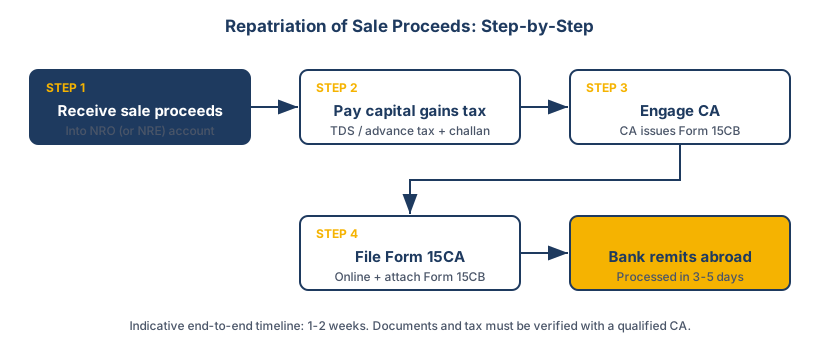
Step 1: Receive Sale Proceeds
- Buyer pays to your NRO account (or NRE if repatriable)
Step 2: Pay Capital Gains Tax
- File advance tax or let TDS be deducted
- Obtain tax payment challan
Step 3: Engage CA
- CA reviews transaction
- Issues Form 15CB (certifying tax compliance)
Step 4: File Form 15CA
- Online filing on income tax portal
- Attach Form 15CB
Step 5: Submit to Bank
- Provide Form 15CA/15CB to bank
- Instruct remittance to foreign account
- Bank processes within 3-5 days
Timeline: 1-2 weeks
7. Property Management for NRIs
7.1 Renting Out Property
Finding Tenants:
- Property management companies (charge 1 month rent as fee)
- Online platforms: 99acres, MagicBricks, NoBroker
- Local brokers (1 month rent as brokerage)
- Word of mouth (via family, friends)
Rental Agreement:
- 11-month agreement (avoid registration; <12 months doesn't require)
- OR 2-3 year agreement (must register on stamp paper)
- Clauses: Rent, deposit, maintenance, lock-in, notice period
- Tenant's responsibilities: Electricity, water (or included in rent)
Security Deposit:
- Typically 2-6 months' rent
- Refundable at end of tenancy (less any damages)
- No interest paid on deposit
Rent Collection:
- Auto-debit to your NRO account (set up ECS)
- Online transfer (UPI, NEFT)
- Check/Demand Draft (less common now)
Maintenance:
- Minor repairs: Tenant's responsibility (bulbs, plumbing)
- Major repairs: Owner's responsibility (structural, appliances)
- Society maintenance: Owner pays or tenant (as per agreement)
7.2 Property Management Companies
Services:
- Tenant sourcing and verification
- Rent collection
- Maintenance coordination
- Property inspections
- Legal compliance (rental agreement, TDS)
Top Companies:
- NoBroker (commission-free, management fee 1-2%)
- Nestaway (guaranteed rent, management)
- NestAway, Homigo, PropertyPistol
- Local boutique firms in each city
Fees:
- Tenant sourcing: 1 month rent
- Monthly management: 5-10% of monthly rent
- Full-service: 8-12% of annual rent
Pros:
- Hassle-free, professional
- Regular property inspection
- Rent guarantee (some companies)
Cons:
- Cost (10% of rent = ₹5,000-10,000/month)
- Quality varies
- Limited control
7.3 Legal Compliance
TDS on Rent:
- If rent > ₹50,000/month, tenant must deduct TDS
- Tenant needs TAN (Tax Deduction Account Number)
- Many tenants don't comply; NRI must pay advance tax
File Income Tax Return:
- Mandatory if rental income
- Declare gross rent, claim deductions
- Report TDS (if deducted by tenant)
Property Tax:
- Pay annually to local municipal corporation
- Owner's responsibility (even if tenant pays as per agreement)
- Can claim in ITR (reduces rental income)
Society Maintenance:
- Pay monthly to housing society
- Non-payment can lead to legal notice
8. Common Mistakes & How to Avoid
8.1 Mistake #1: Buying Agricultural Land
Problem: NRIs cannot buy agricultural land (FEMA violation)
Solution:
- Verify land classification (agricultural vs non-agricultural)
- If you want land, ensure it's converted to non-agricultural (NA plot)
- Check revenue records (7/12 extract in Maharashtra, Pahani in Karnataka)
8.2 Mistake #2: Poor Location Selection
Problem: Property in remote area, low rental demand, poor appreciation
Solution:
- Research location thoroughly (connectivity, employment hubs, schools)
- Visit if possible or appoint trusted local representative
- Check upcoming infrastructure (metro, highways, IT parks)
- Avoid over-supply areas (too many unsold units)
8.3 Mistake #3: Buying from Unregistered Builder (RERA)
Problem: Project delays, quality issues, no recourse
Solution:
- Verify RERA registration: https://rera.gov.in
- Check builder's track record (past projects, delivery timeline)
- Read reviews, talk to existing customers
- Avoid builders with multiple delayed projects
8.4 Mistake #4: Inadequate Due Diligence
Problem: Legal disputes, encumbrance, fake documents
Solution:
- Hire local property lawyer (₹25,000-50,000 for due diligence)
- Get title search for 30 years
- Verify encumbrance certificate
- Check for pending litigations (property, builder, land)
8.5 Mistake #5: Not Factoring All Costs
Problem: Budget overrun (stamp duty, GST, interiors, brokerage)
Solution:
- Budget 15-20% above property price for additional costs
- Stamp duty: 5-7%
- Registration: 1-2%
- GST: 5% (under-construction)
- Brokerage: 1-2%
- Interiors: ₹1,000-3,000 per sq ft
- Loan processing: 0.5-1%
8.6 Mistake #6: Overleveraging (Too High EMI)
Problem: EMI burden, default risk, stress
Solution:
- Keep EMI <40% of monthly income
- Factor in forex risk (INR depreciation increases INR income needed)
- Have 6-month EMI buffer
- Consider partial prepayment to reduce EMI
8.7 Mistake #7: Ignoring Tax Planning
Problem: High TDS (20% on sale), no exemptions claimed
Solution:
- Apply for Section 197 certificate (reduce TDS upfront)
- Plan Section 54 exemption (reinvest in another property)
- File ITR to claim refund
9. Alternative Real Estate Investments
9.1 REITs (Real Estate Investment Trusts)
What are REITs:
- Securitized real estate (like mutual funds for property)
- Invest in commercial properties (offices, malls, warehouses)
- Listed on stock exchange (easy to buy/sell)
- Minimum investment: ₹10,000-15,000 (1 unit)
Available REITs in India:
- Embassy Office Parks REIT (₹350/unit, ₹40,000 Cr AUM)
- Mindspace Business Parks REIT (₹300/unit, ₹25,000 Cr AUM)
- Brookfield India REIT (₹280/unit, ₹18,000 Cr AUM)
Returns:
- Dividend yield: 6-7% annually
- Capital appreciation: 5-10% annually
- Total return: 11-17%
Advantages for NRIs:
- No property management hassle
- High liquidity (sell on stock exchange)
- Diversification (across multiple properties)
- Professional management
- Lower entry ticket (vs ₹50 lakh for physical property)
Tax for NRIs:
- Dividend: 20% TDS (or lower with DTAA)
- Capital gains: 12.5% LTCG (>36 months), 20% STCG
9.2 Fractional Ownership Platforms
Platforms:
- Strata, Hbits, PropertyShare
How it Works:
- Buy fractional ownership in commercial property (5-10% stake)
- Minimum investment: ₹25 lakh - ₹50 lakh
- Returns: 8-12% annually (rental yield + appreciation)
Advantages:
- Lower ticket size than full property
- Diversification (multiple properties)
- Professional management
Disadvantages:
- Liquidity: Locked for 3-5 years typically
- Regulatory uncertainty
- Platform risk
9.3 Real Estate Mutual Funds
Not common in India (REITs more popular)
9.4 Land Banking
What: Buy agricultural land on urban periphery, wait for conversion to non-agricultural
Risk:
- NRIs cannot buy agricultural land
- Speculative, long holding period
- Regulatory risks
- Not recommended for NRIs
10. Action Plan: Step-by-Step Guide
10.1 Phase 1: Research & Planning (3-6 months)
- Define investment objective (rental income vs capital appreciation)
- Decide budget (including loan if needed)
- Research cities and localities
- Track property prices (MagicBricks, 99acres, Housing.com)
- Understand tax implications
- Check home loan eligibility
- Engage property consultant (optional)
10.2 Phase 2: Property Selection (2-4 months)
- Shortlist 5-10 properties online
- Visit India (if possible) or appoint local representative
- Physical inspection of properties
- Check builder reputation (for under-construction)
- Compare prices, amenities, location
- Negotiate price (typically 5-10% discount possible)
- Pay token amount (₹50,000-2 lakh)
10.3 Phase 3: Due Diligence (4-6 weeks)
- Hire property lawyer
- Title search (30 years)
- Encumbrance certificate
- Legal clearances (RERA, building approval, OC)
- Physical verification
- Bank loan application (if needed)
- Get property valuation report
10.4 Phase 4: Purchase & Registration (4-6 weeks)
- Sign sale agreement
- Pay down payment (20-25% if loan, or full if cash)
- Loan sanction and disbursement
- Pay stamp duty and registration charges
- Register property at Sub-Registrar office
- Collect sale deed
- Update property records in your name
- Obtain possession (if ready property)
10.5 Phase 5: Post-Purchase (Ongoing)
- Pay property tax annually
- Pay society maintenance (if apartment)
- Get property insurance (fire, earthquake)
- If renting: Find tenant, sign agreement, collect deposit
- File ITR (declare rental income or property ownership)
- Maintain property (periodic repairs)
- Track market value and appreciation
Conclusion
Real estate investment in India offers NRIs a tangible asset, rental income, and long-term appreciation. Success requires thorough research, proper due diligence, understanding of legal and tax framework, and realistic expectations.
Key Takeaways:
- Know what you can buy: Residential/commercial yes, agricultural no
- Choose location wisely: Growing cities, good infrastructure, rental demand
- Do thorough due diligence: Title, legal, builder reputation
- Factor all costs: Property + 15-20% for stamp duty, GST, registration
- Plan taxes: TDS, rental income, capital gains, exemptions
- Understand repatriation: Up to 2 properties, full proceeds
- Property management: Essential for NRIs (appoint family or professional)
- Alternative options: REITs offer liquidity and hassle-free investment
Real estate is a long-term investment (5+ years). Choose wisely, plan thoroughly, and reap the rewards.
Disclaimer
This guide is for informational purposes only. Real estate regulations, tax laws, and FEMA rules are subject to change. Property prices and rental yields vary significantly by location and market conditions.
This is not professional real estate or legal advice. Consult a qualified property lawyer, chartered accountant, and financial advisor before making property investments.
The author and NRI Wealth Partners are not liable for any investment decisions made based on this guide.
Prepared by: NRI Wealth Partners Real Estate Team Updated: December 2025 Contact: realestate@nriwealthpartners.com Website: www.nriwealthpartners.com
For personalized property search, due diligence support, legal assistance, and property management services, contact our real estate advisory team.