The Complete NRI Repatriation Guide 2025
A Practical Framework for Moving Money Out of India Legally and Efficiently
Published by NRI Wealth Partners | December 2025
Table of Contents
- What is Repatriation?
- Account Types: NRE vs NRO vs FCNR
- USD 1 Million Limit Explained
- Form 15CA/15CB Walkthrough
- CA Certificate Requirements
- Property Sale Repatriation
- Rental Income Repatriation
- Investment Returns Repatriation
- RBI Guidelines Overview
- Common Mistakes & Solutions
- Country-Specific Rules
- Process Flowchart
- Timeline Guide
- Frequently Asked Questions
1. What is Repatriation? {#what-is-repatriation}
Repatriation is the process of transferring money earned or accumulated in India back to your country of residence or overseas. For NRIs (Non-Resident Indians), it's the legal mechanism to move funds from Indian bank accounts, investments, or property sales to foreign accounts.
The Reserve Bank of India (RBI) allows NRIs to repatriate all legitimate foreign income and capital gains. However, Indian-sourced income (like rental income or capital gains from property sales) is subject to annual limits. The key distinction is understanding which funds can be freely repatriated and which require documentation, tax compliance, and RBI approval.
Repatriation is not optional reporting—it's a transparent, regulated process that protects both you and the RBI. Proper compliance ensures you avoid penalties, interest charges, and potential legal complications when moving large sums of money.
2. Account Types: NRE vs NRO vs FCNR Repatriation Rules {#account-types}
| Feature | NRE Account | NRO Account | FCNR Account |
|---|---|---|---|
| Full Name | Non-Resident External | Non-Resident Ordinary | Foreign Currency Non-Resident |
| Currency | INR only | INR only | Foreign currency (USD, GBP, EUR, etc.) |
| Source of Funds | Foreign income/remittances | Any income (mixed) | Foreign currency only |
| Repatriation Limit | Unlimited | USD 1 million/FY | Unlimited |
| Interest Taxable in India | No (if interest credited in India) | Yes | Yes (in INR equivalent) |
| Capital Gains Tax | No (if from abroad) | Yes | Yes |
| Resident Conversion | Changes to Savings A/C | Remains NRO | Changes to Savings A/C |
| Documentation for Transfer | Simple — Just authorization | Form 15CA/15CB | Simple — Just authorization |
| Best For | Parking foreign income safely | Mixed income management | Earning interest in foreign currency |
| Repatriation Process | Straightforward wire transfer | Requires CA certificate + tax compliance | Straightforward wire transfer |
| Example Scenario | Salary earned in USA | Rental income + dividends from India | Savings in USD earned abroad |
Key Insight for Repatriation:
- NRE: Most flexible for repatriation—no limits, no forms needed
- NRO: Most restricted—USD 1M annual limit + Form 15CA/15CB required
- FCNR: Good middle ground—no limits but currency conversion may apply
The single biggest factor in how easily money leaves India is which account it sits in. The chart below shows where each account type falls on the repatriation-freedom scale.
Repatriation Freedom by Account Type
Illustrative scale: NRE/FCNR are freely repatriable; NRO is capped at USD 1M/FY with Form 15CA/15CB; resident savings rupee income is not repatriable.
3. USD 1 Million Limit for NRO Accounts Explained {#usd-1-million-limit}
What is This Limit?
The USD 1 million annual limit applies only to NRO (Non-Resident Ordinary) accounts and represents the maximum amount of rupee funds that can be freely repatriated to any country without RBI approval. This limit resets on April 1st each financial year.
Critical Points:
- Applies to NRO accounts only — NRE and FCNR have no limit
- Includes principal + interest — Both are counted in the USD 1M limit
- Conversion rate at TCS time — Use the TDS/TCS rate on the date of remittance, not the actual exchange rate
- Unused limit doesn't roll over — If you don't use the full USD 1M in a financial year, the remaining amount lapses
- Beyond USD 1M requires RBI permission — Amounts exceeding the limit need explicit RBI approval (can take 15-30 days)
Practical Example:
Scenario: Rajesh, an NRI, has an NRO account with INR 85 lakhs in savings and INR 15 lakhs in accrued interest.
Year 1 (FY 2024-25):
- Total in NRO: INR 100 lakhs (principal + interest)
- Wants to repatriate: INR 100 lakhs
- Exchange rate on transfer date: USD 1 = INR 83.50
- Amount in USD: INR 100L ÷ 83.50 = USD 1,197,600
What can be repatriated freely?
- USD 1 million = INR 83.5 lakhs (at that rate)
- Remaining USD 197,600 = Requires RBI approval
Visually, Rajesh's request splits into a free portion and an approval-needed portion. The chart below shows how the USD 1M cap carves up his intended remittance.
Rajesh's NRO Remittance: Free vs Approval-Needed (Illustrative)
Illustrative example at INR 83.50/USD. The USD 1M/FY cap on NRO repatriation resets every 1 April.
Step-by-step:
- Request NRO to approve USD 1M transfer (usually instant or 1-2 days)
- Apply to RBI/bank for approval of remaining USD 197,600
- Include Form 15CA with CA certificate for the entire amount
- Wait 15-30 days for RBI approval of excess amount
- Complete transfer in 1-2 tranches if needed
When USD 1M Limit Doesn't Apply:
- Repatriating NRE account funds (earned abroad)
- Repatriating FCNR account funds (already in foreign currency)
- Repatriating funds for medical emergencies (RBI exceptions)
- Repatriating funds for higher education abroad (RBI exceptions)
4. Form 15CA/15CB Walkthrough: 5-Step Process {#form-15ca-15cb}
Form 15CA is a declaration for TDS (Tax Deducted at Source) payment on remittance. Form 15CB is the CA certificate validating this declaration. Both are mandatory for amounts over certain thresholds and when tax compliance is required.
When Do You Need Forms 15CA/15CB?
- Repatriating NRO account funds
- Repatriating capital gains from property sales
- Repatriating rental income
- Amounts exceeding INR 50,000 in a single transaction from NRO
- When bank asks for tax compliance proof
Step 1: Gather Required Documents
Before meeting your Chartered Accountant, collect:
- NRO account statements (last 3-6 months showing income sources)
- TDS certificates (Form 16A from bank, if any TDS already deducted)
- Income tax returns (ITR) for last 2 years
- Proof of income source (salary slips, rental agreement, investment statements)
- Bank authorization letter (from your bank for repatriation)
- Passport copy and PAN card
- Overseas address proof (utility bill, residence permit, or lease agreement)
Time Required: 2-3 days to gather
Step 2: Consult Your Chartered Accountant (CA)
Meeting details:
- Book appointment (1-2 days in advance)
- Meeting duration: 30-45 minutes
- Fee: INR 5,000-15,000 depending on complexity
- CA verifies your documents and income sources
- CA calculates applicable TDS liability
What the CA does:
- Reviews source of funds (foreign income vs. Indian income)
- Calculates TDS applicable (e.g., 20% on NRO interest income)
- Confirms you're compliant with tax laws
- Prepares Form 15CA with accurate details
Time Required: 1-3 days
Step 3: CA Prepares and Signs Form 15CA
The CA creates two copies:
- Copy for your records (keep this)
- Copy for bank submission (bank forward to RBI/tax authorities)
Form 15CA includes:
- Your PAN and passport details
- Remittance amount and currency
- Purpose of remittance
- Applicable TDS rate
- CA's professional opinion
Form 15CB is the CA certificate attached to 15CA.
Time Required: 1-2 days
Step 4: Submit to Your Bank
Visit your bank's NRO desk with:
- Signed Form 15CA (original + 1 copy)
- Form 15CB (CA certificate)
- Your identification proof
- Bank's remittance request form (already filled)
At the bank:
- Manager reviews forms (5-10 minutes)
- Bank cross-checks PAN with Income Tax records
- Bank calculates TDS
- You sign TDS authorization
- Forms submitted to RBI/tax authorities
Time Required: 1-2 days for processing
Step 5: Final Remittance & TDS Payment
Once bank processes:
-
TDS is calculated on the remittance amount
- Example: Repatriating INR 50 lakhs = 20% TDS = INR 10 lakhs deducted
- Amount received abroad: INR 40 lakhs (after TDS)
-
TDS is remitted to Income Tax authorities within 7 days
-
TDS certificate (Form 16A) is issued to you within 15 days
- This proves TDS paid on repatriation
- Use for income tax filing
-
Money reaches your overseas account in 3-5 business days
Time Required: 3-5 days
Complete Timeline for Forms 15CA/15CB:
- Document collection: 2-3 days
- CA consultation: 1-3 days
- Form preparation: 1-2 days
- Bank submission: 1-2 days
- RBI processing: 2-7 days
- Total: 7-19 days
5. CA Certificate Requirements: When, Why, and How {#ca-certificate}
A CA (Chartered Accountant) certificate is your auditor's professional certification that the funds being repatriated are legitimate and comply with Indian tax laws.
When Is a CA Certificate Mandatory?
- NRO account repatriation exceeding INR 50,000
- Property sale proceeds (any amount)
- Rental income repatriation (any amount)
- Capital gains remittance (stocks, mutual funds)
- Business income repatriation (any amount)
- Amounts over USD 100,000 in a single transaction
- When RBI specifically requests it (for NRO excess of USD 1M)
When It's Optional:
- NRE account transfers (foreign currency earned abroad)
- FCNR account transfers (already foreign currency)
- Amounts under INR 50,000 from NRO (though bank may still ask)
What Documents Are Required for CA Certificate?
Financial Documents:
- Last 3-6 months NRO bank statements
- Property deed + registered sale agreement (for property sales)
- Rental agreement + last 2 years rental income proof
- Investment statements (mutual funds, stocks)
- Income tax returns (ITR) for last 2 years
Compliance Documents:
- Valid passport copy
- PAN card copy
- Proof of NRI status (visa, employment letter, overseas address proof)
- Proof of income source (salary certificate, rental agreement, etc.)
Tax Documents:
- TDS certificates from bank (Form 16A)
- Withholding tax proofs (if any)
- Earlier TDS payments on the account
Supporting Declarations:
- Signed declaration of fund source
- Authorization letter to bank for repatriation
- Undertaking that funds are not from prohibited sources
CA Certificate Contents:
The certificate should include:
- PAN and passport details of the remitter
- Remittance amount and currency
- Source of funds (Indian income, foreign income, capital gains, etc.)
- Applicable tax treatment (whether taxable, TDS applicable)
- Compliance statement ("These funds are legitimate and comply with FEMA regulations")
- TDS calculation (if applicable)
- CA's professional opinion on legality
- CA's signature and seal
- CA's registration number
How Long Does the CA Certificate Take?
- With complete documents: 1-2 days
- If documents are missing: 3-5 days (back-and-forth needed)
- Expedited certificate (premium fee): 1 day
Typical Cost: INR 5,000-20,000 depending on complexity
Common Mistakes in CA Certificates:
- Wrong income classification — CA marks Indian income as foreign (attracts tax + penalties)
- Missing TDS calculation — Should show exact TDS amount, not just "applicable"
- Vague fund source — Should be specific (e.g., "rental income from 2 Delhi properties" not "various sources")
- Expired CA registration — Always verify CA's credentials with ICAI
- Incorrect remittance amount — Must match bank's remittance request form exactly
6. Property Sale Repatriation: The 2-Property Lifetime Rule {#property-sale}
The 2-Property Lifetime Limit
NRIs can repatriate capital gains from a maximum of 2 residential properties sold in their lifetime. This is one of the strictest RBI regulations for NRIs. Beyond 2 properties, capital gains must be kept as rupees in NRO accounts or reinvested in India.
Important Clarifications:
- 2 properties = 2 separate sale proceeds, not 2 properties simultaneously
- Applies to capital gains only — The sale price itself comes from the local buyer (not an NRI concern)
- "Lifetime" means once counted, cannot be changed — Plan carefully which 2 properties to repatriate
- Commercial properties count — The rule applies to all residential real estate, not just primary residences
- Joint ownership complicates matters — Each co-owner has their own 2-property limit
Step-by-Step Process:
Step 1: Prepare Property Documents
- Property purchase deed
- Property sale deed (registered)
- Payment proof from buyer
- Municipal property tax receipts (to establish cost basis)
- Previous improvement receipts (additions, renovations)
Step 2: Calculate Capital Gain
- Formula: Sale Price - Cost of Acquisition - Cost of Improvement = Capital Gain
- Example:
- Bought property: INR 50 lakhs (2015)
- Improvements: INR 5 lakhs
- Sold property: INR 1 crore (2024)
- Capital gain: 100 - 50 - 5 = INR 45 lakhs
Step 3: Register the Property Sale
- Sale deed must be registered at district sub-registrar's office
- Seller must obtain registered sale deed (not agreement, but final deed)
- Cost: Typically 5-8% of property value (registration + stamp duty)
- Time: 2-4 weeks after sale completion
Step 4: File Income Tax Return (ITR)
- File ITR-2 or ITR-3 (depending on income type)
- Report capital gain (short-term or long-term)
- Calculate tax liability
- Long-term capital gains (held >2 years): 20% + cess
- Short-term capital gains (held <2 years): Per slab rate (up to 42.25%)
- Time: File ITR within 31st July of next financial year
Step 5: Obtain TDS Certificate (Form 16A)
- Property buyers usually deduct 1-5% TDS on sale price
- Claim TDS as credit in ITR
- This certificate helps with repatriation approval
Step 6: Consult CA for Repatriation
- Meet CA with:
- Registered sale deed (original)
- ITR filed and acknowledgment
- TDS certificate
- Bank account statement showing deposits
- Cost of acquisition proof (earlier deeds, receipts)
- CA prepares Form 15CA with:
- Capital gain calculation
- Tax already paid
- Repatriation amount (after tax)
Step 7: Apply to RBI
- Submit through your bank:
- Form 15CA + Form 15CB (CA certificate)
- Registered sale deed (copy)
- ITR acknowledgment
- Cost of acquisition documents
- Bank's "intimation letter" confirming this is the 1st or 2nd property repatriation
- Bank forwards to RBI (usually approved within 15-30 days)
Step 8: Remit Funds
- Once approved, bank initiates wire transfer to overseas account
- Fund reach in 3-5 business days
- TDS is deducted and remitted separately
Realistic Timeline:
- Property sale completion: 30-60 days
- Registration: 14-30 days
- ITR filing: 30-45 days
- CA consultation: 2-3 days
- RBI approval: 15-30 days
- Total: 3-5 months from sale completion to funds in overseas account
Real Example:
Scenario: Aman, US-based NRI, sells a Delhi apartment.
- Purchase (2012): INR 40 lakhs
- Sale (2024): INR 1.2 crores
- Capital gain: INR 80 lakhs
- Holding period: 12 years (long-term)
- Long-term capital gains tax: 20% + 4% cess = 24% = INR 19.2 lakhs
- Net capital gain: INR 80L - 19.2L = INR 60.8 lakhs
- Tax paid: INR 19.2 lakhs
- Repatriation amount: INR 60.8 lakhs (no additional TDS as tax already paid via ITR)
- Buyer TDS deducted (1%): Already paid, credited in ITR
- RBI approval: Counts as 1st property repatriation (2 remaining)
- Time to repatriate: 3-4 months from sale completion
7. Rental Income Repatriation: Annual Limits & Tax Implications {#rental-income}
Annual Repatriation Limits for Rental Income:
| Rental Income Type | Annual Repatriation Limit | Form Required | TDS Rate |
|---|---|---|---|
| Residential property | USD 200,000 (~INR 1.66 crores) | Form 15CA | 20% on net income |
| Commercial property | No specific limit | Form 15CA | 20% on net income |
| Holiday home | USD 200,000 | Form 15CA | 20% |
| Multiple properties combined | USD 200,000 total | Form 15CA | 20% |
| Arrears (unpaid) | No limit once approved | Form 15CA | On arrear amount |
Important Notes on Limits:
- USD 200,000 = ~INR 1.66 crores (at current exchange rates; check actual rate on transfer date)
- Resets on April 1st each financial year
- Includes net income after expenses (not gross rent)
- TDS deducted at source (you receive less, but claim as credit in ITR)
Step-by-Step Repatriation Process:
Step 1: Organize Rental Income Documents
- Last 2 years rental agreements (original registered copies)
- Rent receipts or bank statements showing deposits
- Proof of collection (bank statements, checks)
- Property maintenance expenses (repair bills, property tax)
- Insurance policies
- Tenant details and identity
- Previous 2 years ITRs showing rental income
Time needed: 3-5 days to compile
Step 2: Calculate Net Rental Income
Example:
Gross Annual Rent: INR 24 lakhs (INR 2L/month)
Less: Property tax: INR 1.5 lakhs
Less: Maintenance: INR 2 lakhs
Less: Insurance: INR 0.5 lakhs
Less: Municipal charges: INR 1 lakh
Net Rental Income: INR 19 lakhs
Step 3: Plan Repatriation (Important!)
Example scenario:
- Net rental income: INR 19 lakhs/year
- Want to repatriate all income abroad
- Exchange rate: 1 USD = INR 83
- In USD: INR 19L ÷ 83 = USD 228,900
- Limit: USD 200,000/year
- Problem: Exceeds USD 200K limit by USD 28,900
- Solution:
- Repatriate USD 200,000 this year (INR ~16.6L)
- Keep INR 2.4L in NRO and repatriate next year
- OR seek RBI exemption for medical/education
Step 4: Consult CA for Repatriation Certificate
Prepare meeting with CA:
- Rental agreements (original)
- Property tax receipts (last 2 years)
- Expense bills (electricity, maintenance, insurance)
- Bank statements (rental deposits + expense payments)
- ITR filed for last 2 years
- Municipal property card
- Proof of ownership (sale deed)
CA will:
- Verify income legitimacy
- Confirm expense deductions
- Calculate net repatriable income
- Prepare Form 15CA showing:
- Gross rent
- Allowable expenses
- Net income
- TDS calculation (20% on net income)
- Repatriation amount (net of TDS)
Fee: INR 5,000-10,000
Time: 2-3 days
Step 5: File Income Tax Return
Must file ITR showing:
- Property rental income schedule
- Expenses claimed
- Net income
- Tax liability
- Plan to repatriate
File by July 31st of next financial year.
Step 6: Submit Forms to Bank
Visit bank with:
- Form 15CA (original + 1 copy)
- Form 15CB (CA certificate)
- ITR filed (acknowledgment copy)
- Rental agreements (copies)
- Property tax receipts (copies)
- Proof of expenses
- Your remittance request form
- Identification proof
At bank:
- Manager verifies income source
- Bank cross-checks PAN-ITR records
- Bank calculates TDS (20% on net income shown in CA certificate)
- You authorize TDS deduction
- Forms sent to RBI
Processing time: 2-3 days
Step 7: Approval & Remittance
- RBI approves (usually 7-15 days for residential property rental)
- Bank deducts TDS and remits to tax department
- Bank initiates wire transfer to your overseas account
- Funds arrive in 3-5 business days
TDS Certificate (Form 16A):
- Issued within 15 days
- Shows TDS deducted on repatriation
- Use as credit in next year's ITR
Real Example:
Scenario: Priya, UK-based NRI, wants to repatriate rental income from Mumbai flat.
Year 1 Scenario:
- Monthly rent: INR 1.5 lakhs
- Annual gross: INR 18 lakhs
- Expenses: INR 3 lakhs (tax, maintenance, insurance)
- Net income: INR 15 lakhs
- Exchange rate: 1 USD = INR 83
- Net in USD: INR 15L ÷ 83 = USD 180,722 (within limit)
- TDS (20% on net): INR 3 lakhs
- Amount received after TDS: INR 12 lakhs
- Status: Approved for full repatriation
Year 2 Scenario (with higher rent):
- Annual rent increased to: INR 24 lakhs
- Expenses remain: INR 3 lakhs
- Net income: INR 21 lakhs
- Exchange rate: 1 USD = INR 82
- Net in USD: INR 21L ÷ 82 = USD 256,097 (exceeds USD 200K limit)
- Can repatriate up to: USD 200,000 = INR 16.4 lakhs
- TDS (20% on repatriable): INR 3.28 lakhs
- Amount received: INR 13.12 lakhs
- Remaining INR 4.6 lakhs: Stays in NRO, can repatriate next year
Common Issues & Solutions:
| Problem | Solution |
|---|---|
| Landlord didn't deduct TDS | CA prepares certificate showing gross rent; TDS deducted during repatriation |
| Expenses not documented | Retain all bills/receipts for last 2 years; estimate permitted expenses if some missing |
| Tenant stopped paying | Report arrears in ITR; repatriation allowed only for received amount |
| Property not registered | Get rental agreement registered at sub-registrar before repatriation |
| Multiple properties combined | Combine income for USD 200K limit; each property listed separately in CA cert |
8. Investment Returns Repatriation: Mutual Funds, Stocks & More {#investment-returns}
Types of Investment Returns:
1. Mutual Fund Dividends & Redemption Proceeds 2. Stock Dividends 3. Capital Gains from Stock Sales 4. Interest from Fixed Deposits 5. Bond Redemptions
Repatriation Rules by Investment Type:
| Investment Type | Repatriation Limit | Tax Rate | Form Required | Processing |
|---|---|---|---|---|
| MF Dividends (Indian fund) | No limit | Dividend distribution tax + 20% tax | Form 15CA | 5-7 days |
| MF Redemption (units held >1 year) | No limit | 20% + cess | Form 15CA | 5-7 days |
| MF Redemption (units held <1 year) | No limit | Slab rate | Form 15CA | 5-7 days |
| Stock Dividends (Indian company) | No limit | 20% dividend tax | Form 15CA | 5-7 days |
| Stock Capital Gains (long-term) | No limit | 20% + cess | Form 15CA | 7-10 days |
| Stock Capital Gains (short-term) | No limit | Slab rate | Form 15CA | 7-10 days |
| FD Interest (NRO) | Covered under USD 1M limit | 20% | Form 15CA | 3-5 days |
| Bond/Debenture Interest | No limit if foreign-earned | 20% if Indian-earned | Form 15CA | 5-7 days |
Detailed Process:
For Mutual Fund Redemption:
-
Check holding period
- Long-term: Held >3 years (for equity) or >1 year (for debt)
- Short-term: Held <holding period
-
Calculate capital gains
- Purchase price (cost basis)
- Sale price (redemption price on transfer date)
- Gain/Loss = Sale price - Cost basis
- Example:
- Purchased: INR 5 lakhs (2021)
- Redeemed: INR 8.5 lakhs (2024)
- Capital gain: INR 3.5 lakhs (long-term)
-
Determine tax liability
- Long-term equity MF gain: 20% + 4% cess = 24%
- Long-term debt MF gain: 20% + 4% cess = 24%
- Short-term gain: Per your tax slab (22%-42.25%)
- Example: INR 3.5L × 24% = INR 84,000 tax
-
File ITR
- Include capital gains schedule
- Show MF units sold and redemption proceeds
- File by July 31 of next FY
-
Consult CA for Repatriation
- Provide MF statements (purchase + redemption)
- ITR filed (acknowledgment)
- Mutual fund redemption slip
- Bank account statement showing deposits
- CA prepares Form 15CA showing:
- Investment purchase date & cost
- Redemption date & amount
- Capital gain calculation
- Applicable tax rate
- Repatriation amount (net of tax)
-
Submit to Bank
- Form 15CA + 15CB
- MF statement (copy)
- ITR acknowledgment
- Redemption slip
- Bank processes (2-3 days)
-
Remittance
- RBI approves (3-5 days)
- Bank transfers funds
- Arrives in 3-5 business days
For Stock Capital Gains:
Process is similar but includes:
- Stock purchase confirmation (brokerage statement)
- Stock sale confirmation (with exact date and price)
- Demat account statement (showing holdings)
- Broker certificate (if needed)
Key difference: Stock capital gains are often short-term (held <1 year), taxed at higher slab rates (up to 42.25%), making long-term holdings preferable.
Real Example:
Scenario: Vikas, Canada-based NRI, repatriates MF gains.
Investment Details:
- Invested in ICICI Prudential Growth Fund: INR 10 lakhs (2020)
- Redeemed units: INR 16 lakhs (2024)
- Holding period: 4 years (long-term)
- Capital gain: INR 6 lakhs
- Tax (20% + 4% cess): INR 1.44 lakhs
- Net repatriation: INR 16L - 1.44L = INR 14.56 lakhs
Timeline:
- MF redemption request: 1 day
- MF settlement: 2-3 days
- Funds in bank account: 3 days
- CA consultation: 2 days
- Forms to bank: 1 day
- RBI approval: 5-7 days
- Remittance to Canada: 3-5 days
- Total: 14-23 days
Special Cases:
Dividend Income:
- No holding period requirement
- Dividend distribution tax already deducted by fund/company
- TDS not deducted again on repatriation (as tax already paid)
- Simple repatriation via Form 15CA
Interest on Bonds/Debentures:
- If purchased with foreign income: No limit, simple repatriation
- If held in NRO (Indian-earned): Subject to USD 1M annual limit
- Debenture issuer may have already deducted TDS (check)
9. RBI Guidelines Overview: Key Points for NRI Repatriation {#rbi-guidelines}
Master Regulations:
The RBI operates under the Liberalized Remittance Scheme (LRS) for resident Indians and Master Direction on Foreign Exchange Management (Remittance) Rules for NRIs.
Key RBI Rules for NRI Repatriation:
1. Account-Level Rules
- NRE accounts: Unlimited repatriation of foreign-sourced income
- NRO accounts: USD 1 million per financial year
- FCNR accounts: Unlimited repatriation (no rupee conversion limit)
- Savings accounts: No repatriation of rupee income
2. Income Source Classification
-
Freely repatriable (no limit):
- Foreign salary/income earned abroad
- Foreign investments income
- NRE account interest
- FCNR account interest
-
Limited repatriation (USD 1M/year from NRO):
- Indian salary/income
- Rental income from Indian property
- Interest on NRO deposits
- Dividend income from Indian companies
- Capital gains from property sales (max 2 properties lifetime)
- Capital gains from stocks/MF (annual cap via ITR compliance)
3. Documentation Requirements
- Amount > INR 50,000: Form 15CA + CA certificate
- Property sales: Always require CA certificate
- Rental income: Always require CA certificate
- Capital gains > INR 1 lakh: Always require CA certificate
- NRO repatriation: Always require Form 15CA/15CB
4. Tax Compliance Must-Haves
- Income Tax Return (ITR) filed showing all income
- TDS payment proof (if applicable)
- No unfiled demands or pending tax cases
- No outstanding income tax/penalty liabilities
- Clean PAN record with Income Tax department
5. Forms & Certificates Needed
- Form 15CA: TDS declaration (prepared by CA)
- Form 15CB: CA certificate validating Form 15CA
- Form 16A: TDS certificate from bank (proof TDS remitted)
- ITR acknowledgment: Proof of filing income tax return
6. Processing & Approval Times
- NRE transfers: 2-3 days (no RBI approval needed)
- FCNR transfers: 2-3 days (no RBI approval needed)
- NRO under USD 1M: 5-7 days (bank approval sufficient)
- NRO exceeding USD 1M: 15-30 days (RBI approval required)
- Property sale repatriation: 15-30 days (RBI approval)
- First-time repatriation: May take 20-45 days (additional verification)
7. Prohibited Repatriations
- No repatriation of funds from Resident Savings Accounts
- No repatriation of rupee gifts received in India
- No repatriation of funds from prohibited sources (hawala, unofficial transfers)
- No repatriation of unexplained income (no ITR filed)
- No repatriation if income tax liability pending
8. Beneficial Owner & KYC
- RBI requires verification that you're the beneficial owner of funds
- Your bank will cross-check PAN with Income Tax database
- Full KYC must be updated (address, occupation, source of funds)
- Bank may ask for source of fund affidavit if source unclear
9. Limit Resets
- USD 1 million NRO limit: Resets April 1 each FY
- Property lifetime limit (2): Once used, cannot recover
- Annual rental income limit: Resets April 1
- Currency conversion: Use actual TCS rate on transfer date
10. Special RBI Exemptions Available in cases of:
- Medical emergencies — Full repatriation without limit
- Higher education abroad — Full repatriation without limit
- Emigration/relocation — Enhanced limits (up to USD 1 million even for Indian income)
- Hardship cases — RBI discretionary approval
Important Official Sources:
- RBI's FAQ on NRI Repatriation: https://www.rbi.org.in (search "remittance")
- FEMA Rules: Foreign Exchange Management (Remittance) Rules, 2016
- Liberalized Remittance Scheme: For limits and categories
- Income Tax Act Section 115: Special provisions for NRI taxation
10. Common Mistakes & Solutions {#common-mistakes}
Mistake 1: Not Classifying Income Source Correctly
The Error: You tell your CA "I want to repatriate INR 2 crores from my NRO," without specifying if this is foreign-earned income or Indian-earned income. CA assumes it's foreign income (no limit) and prepares forms accordingly. Bank later discovers it's Indian rental income and rejects the repatriation.
Why It's a Problem:
- Foreign income: No limit, simple approval
- Indian income: USD 1M limit, more scrutiny
- Misclassification triggers bank rejection and delays
Solution:
-
Before meeting CA, list all income sources:
- "I earned INR 50 lakhs in USA (foreign salary)"
- "I earned INR 20 lakhs from rental property in India"
- "I earned INR 10 lakhs from stock capital gains"
-
Provide proof of each source:
- Salary: Offer letter + pay stubs
- Rental: Lease agreement + rent deposits
- Capital gains: Broker statement + stock holdings
-
CA then correctly classifies:
- Repatriable without limit: INR 50 lakhs (foreign income)
- Repatriable with USD 1M limit: INR 30 lakhs (Indian income)
- Plan repatriation in 2 tranches if needed
Mistake 2: Forgetting to File ITR Before Repatriation
The Error: You submit repatriation request to bank. Bank checks PAN with Income Tax and discovers no ITR filed. Repatriation rejected. You must now file ITR (4-6 months) before reapplying.
Why It's a Problem:
- Banks are mandated to check ITR status
- Unfiled ITR is red flag for unreported income
- Can trigger income tax notices + penalties
- Delays repatriation by months
Solution:
-
File ITR first (if not already done)
- Go to ClearTax, EY, or a CA for easy ITR filing
- Include all sources of income (foreign + Indian)
- Include capital gains and dividend income
- File by July 31 of next FY (or by Dec 31 with late fee)
-
Get ITR acknowledgment before applying for repatriation
- ITR-V uploaded to Income Tax portal
- Take screenshot of acknowledgment
- Submit this with repatriation forms
-
For next year, file ITR early (by July 31) to avoid delays
Mistake 3: Exceeding USD 1M Limit Without Planning
The Error: You want to repatriate INR 1.2 crores from NRO. You assume the bank will transfer it all. Bank approves only INR 83 lakhs (USD 1M at that day's rate). Remaining INR 37 lakhs stuck in NRO account.
Why It's a Problem:
- USD 1M limit resets on April 1, but you may need funds urgently
- Stuck money incurs interest (taxable in India)
- RBI approval for excess takes 15-30 days
- Leaves you short of expected funds
Solution:
-
Calculate in USD before requesting
- If amount > INR 83-84 lakhs, you may exceed USD 1M
- Calculate: Repatriation amount in INR ÷ current exchange rate = USD amount
- Current rate (Dec 2025): 1 USD = INR 83-84
-
Plan in two tranches if needed
- Tranche 1: Repatriate up to USD 1M immediately (1 week)
- Tranche 2: Apply for RBI approval for excess (15-30 days)
- Total time: 4-6 weeks instead of 1 week
-
Or apply for RBI exemption
- For medical/education emergencies
- Can repatriate full amount without USD 1M limit
- Requires supporting documents (medical bills, school fee letter)
Mistake 4: Incomplete or Wrong Documents
The Error: You submit Form 15CA but forget to attach:
- Copy of registered property deed (for property sale)
- ITR acknowledgment (for rental income)
- MF redemption slip (for MF gains)
Bank rejects it and sends back for corrections. Takes additional 1-2 weeks.
Why It's a Problem:
- Banks cannot process incomplete applications
- Each rejection = 1-2 week delay
- May fall outside financial year window
- Causes frustration and rushed submissions
Solution - Complete Checklist:
Before submitting to bank, verify you have:
Always required:
- Form 15CA (original + 1 copy)
- Form 15CB (CA certificate, original + 1 copy)
- Identification proof (passport or Aadhaar)
- Bank authorization form (signed)
For NRO repatriation:
- Last 3-6 months NRO statement
- ITR acknowledgment (last 2 years)
For property sale:
- Registered sale deed (copy)
- ITR showing capital gains
- Cost of acquisition proof
- Registered receipt from buyer (payment proof)
For rental income:
- Rental agreements (copies of all properties)
- Property tax receipts (last 2 years)
- Lease registration certificate
- ITR showing rental income
For investment gains:
- Purchase confirmation (brokerage statement)
- Sale confirmation (exact date & price)
- MF redemption slip OR stock sale slip
- ITR showing capital gains
For NRO interest:
- Bank statement showing interest credited
- ITR showing interest income
- TDS certificate (if already deducted)
Mistake 5: Wrong CA or CA Registration Verification
The Error: You use a "CA" recommended by a friend. Later, bank discovers the CA is not registered with ICAI (Institute of Chartered Accountants of India). Form 15CB is invalid. Bank rejects entire application.
Why It's a Problem:
- Only ICAI-registered CAs can issue Form 15CB
- Non-registered "accountants" cannot issue valid certificates
- Bank will not accept certificate
- You've wasted time and CA fees
- Must redo with registered CA (another 1-2 weeks)
Solution:
-
Verify CA's credentials before hiring
- Go to https://www.icai.org/member-directory
- Search CA's name + registration number
- Confirm "Active" status
- Note the registration number on certificate
-
Ask CA for:
- ICAI registration certificate copy
- Membership confirmation letter
- Insurance/indemnity proof (banks require this)
-
Recommended CA selection:
- Ask bank's NRO desk for list of certified CAs
- Ask friends/colleagues for referrals (verify registration)
- Large accounting firms (Deloitte, EY, KPMG) always registered
- Costs more (INR 10,000-20,000) but reliable
Mistake 6: Timing Issues Around Financial Year End
The Error: It's March 29, and you want to repatriate INR 1.2 crores from NRO (which includes USD 1M+ in rupees). You submit forms on March 30. RBI is flooded with March applications and takes 4 weeks to approve. By then, financial year is over (April 1) and the limit has reset. Now RBI is confused about which FY approval applies.
Why It's a Problem:
- March 25-31 is chaotic (year-end applications)
- Approvals slow down dramatically
- Financial year reset (April 1) complicates approvals
- You lose the April limit or face processing delays
- Filing in new FY complicates ITR
Solution:
-
Start repatriation early in FY (April-May)
- Apply in April/May when approvals are fast
- Get approval before June 30
- Have full 10 months buffer before year-end
-
For large amounts, apply in January
- Gives 3 months before year-end
- RBI office not flooded
- Multiple approvals possible if split tranches
-
Avoid applications in last 2 weeks of March
- Plan repatriation timing accordingly
- Arrange funds by February if year-end critical
Mistake 7: Not Keeping Proof of Repatriation
The Error: Bank remits INR 50 lakhs to your US account. You don't save the Swift confirmation, TDS certificate, or bank's remittance slip. 6 months later, you're audited and IRS asks "Proof of funds received?" You can't provide anything.
Why It's a Problem:
- Overseas tax authorities (IRS, HMRC, CRA) may audit
- They need proof of repatriation source
- Without documentation, they assume unreported income
- Can trigger US/UK/Canada tax notices
- Penalties and interest charges
- Double taxation without relief
Solution:
-
Request full remittance package from bank:
- Swift confirmation (proof funds sent)
- Amount remitted in foreign currency
- Date remitted
- Receiving bank details
- TDS certificate (Form 16A)
- Remittance slip with all details
- Fee breakdown (if any)
-
Keep copies of:
- All bank communications
- Forms 15CA and 15CB (signed)
- CA certificate and credentials
- ITR filed in India
- TDS payment receipt
- Final bank statement (money received)
- Email confirmations
-
File documentation with:
- Your income tax return (India)
- Your income tax return (overseas country - USA, UK, Canada, etc.)
- Personal record for audit proof
11. Country-Specific Repatriation Rules {#country-specific}
NRI tax and financial rules vary by residence country. Here's a brief overview:
USA-Based NRIs
Key Points:
- FATCA Compliance: US banks share your Indian bank account details with IRS
- FBAR Requirement: If you have >USD 10,000 in foreign accounts, file FBAR with US FinCEN (annual)
- Repatriation Tax: Funds repatriated to US are subject to US income tax on the gains
- Form 8938: File if foreign account > USD 200,000 (with tax return)
- Credit for Foreign Taxes: If India taxes the gain (say, 20%), you can claim credit on US return
- No double taxation: With US-India tax treaty, same income not taxed twice
- Net effect: Usually taxed in India at 20% (capital gains) or 22%+ (income) + US tax, but treaty credit reduces burden
Repatriation Process:
- Follow full RBI process (Form 15CA, CA certificate, ITR, etc.)
- File ITR in India (by July 31 next FY)
- File US 1040 form + foreign tax credit form (Form 1118)
- FBAR filing (FinCEN Form 114)
- File by April 15 (US extension to June 15)
Timeline: Same as India (7-30 days) + US tax filing (1-2 months)
UK-Based NRIs
Key Points:
- Non-Resident Status: If you've been away >3 years, you're non-resident in UK (no UK tax on Indian income)
- Statutory Residency Test (SRT): Check if you're classed as UK resident or non-resident
- No FBAR equivalent: UK doesn't require FBAR; however, HMRC may ask about foreign accounts via general inquiry
- Tax Treaty: UK-India tax treaty prevents double taxation
- Repatriation: No UK tax on funds if you're truly non-resident
- Dividend Relief: UK has no tax on foreign dividend income if non-resident
Repatriation Process:
- Follow RBI process (Form 15CA, CA certificate, ITR)
- File ITR in India
- Check UK residency status (SP 1/16 guidance)
- If non-resident, no additional UK filing needed
- If resident, file UK tax return (Self Assessment)
Timeline: Same as India (7-30 days) + UK tax filing (Jan 31)
Canada-Based NRIs
Key Points:
- Residency Status: If you've moved to Canada and severed ties in India, you're non-resident for Canadian tax
- Form T776: Not required if you're non-resident
- No FBAR equivalent: Canada Revenue Agency (CRA) doesn't require FBAR
- Tax Treaty: Canada-India tax treaty prevents double taxation
- Repatriation: No Canadian tax on repatriation if non-resident
- Foreign Property Reporting: If non-resident, not required
Repatriation Process:
- Follow RBI process (Form 15CA, CA certificate, ITR)
- File ITR in India
- Confirm non-resident status with CRA
- No additional Canadian filing required (as non-resident)
- Keep repatriation records for audit purposes
Timeline: Same as India (7-30 days)
UAE-Based NRIs
Key Points:
- No Personal Income Tax: UAE has no personal income tax (game changer!)
- Repatriation Benefit: Funds repatriated to UAE accounts are NOT taxed in UAE
- Complete Tax Holiday: Unlike US/UK/Canada, no additional tax on repatriation
- Documentation for UAE: UAE doesn't require reporting of foreign accounts (no FBAR equivalent)
- Flexibility: Can repatriate freely without worrying about UAE taxation
- Net Benefit: Only Indian tax applies (no double taxation)
Repatriation Process:
- Follow RBI process (Form 15CA, CA certificate, ITR)
- File ITR in India (even if UAE resident, because income is Indian-sourced)
- Transfer to UAE account (no UAE tax filing required)
- Keep repatriation proof for Indian audit
Timeline: Same as India (7-30 days)
Comparison Summary:
| Country | Personal Income Tax | Repatriation Tax | FBAR Equivalent | Tax Treaty Relief | Net Tax Impact | |---|---|---|---|---| | USA | Yes (10-37% slab) | Yes (IRS taxing gain) | FBAR (FinCEN 114) | Yes (Credit allowed) | 20-40% total | | UK | Yes (20-45% slab) | No (if non-resident) | No equivalent | Yes (Treaty relief) | 20% (India only) | | Canada | Yes (15-53% slab) | No (if non-resident) | No equivalent | Yes (Treaty relief) | 20% (India only) | | UAE | No (0%) | No (0%) | No equivalent | N/A | 20% (India only) |
Best country for tax-efficient repatriation: UAE (followed by Canada/UK if non-resident)
The chart below compares the rough total tax drag on repatriated gains by residence country—India tax always applies; whether your residence country adds more depends on residency and treaty relief.
Approx. Total Tax Impact on Repatriated Gains by Residence Country
Illustrative — VERIFY FY26-27. Mid-point figures only; actual impact depends on residency status, income type and treaty relief. India tax (~20% on long-term gains) applies in all cases.
12. Process Flowchart {#flowchart}
At a glance, every NRO repatriation moves through four document steps and then one decision—whether you are within the USD 1M annual cap. The diagram below maps that flow.
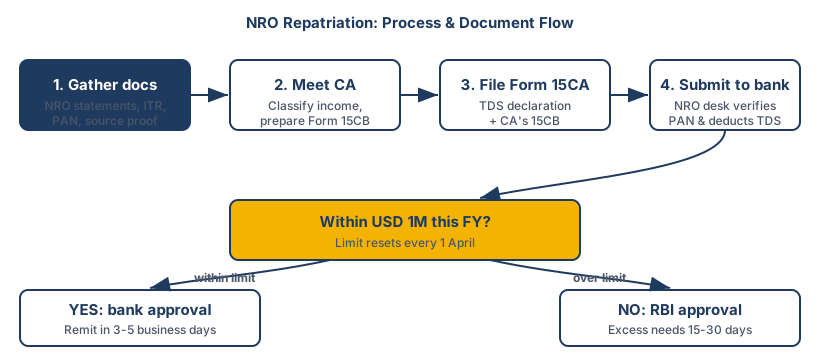
NRO Account Repatriation Flowchart:
START: Want to repatriate from NRO
    |
    v
Is amount > USD 1 Million/FY?
    |
    +-- NO --> Proceed (within limit)
    |          |
    |          v
    |     Gather documents
    |          |
    |          v
    |     Meet CA (Form 15CA)
    |          |
    |          v
    |     Submit to bank
    |          |
    |          v
    |     Bank processes (2-3 days)
    |          |
    |          v
    |     RBI approval (5-7 days)
    |          |
    |          v
    |     Remit funds (3-5 days)
    |          |
    |          v
    |     END: Money in overseas account
    |
    +-- YES --> Exceed limit?
                 |
                 +-- Request RBI exemption (medical/education)
                 |   |
                 |   v
                 |   RBI approval (15-30 days)
                 |   |
                 |   v
                 |   Remit full amount
                 |   |
                 |   v
                 |   END
                 |
                 +-- OR Repatriate in 2 tranches
                     |
                     v
                 Tranche 1: Up to USD 1M
                     |
                     v
                 Approve (5-7 days)
                     |
                     v
                 Tranche 2: Remaining amount
                     |
                     v
                 RBI approval (15-30 days)
                     |
                     v
                 END: Both tranches remitted
Property Sale Repatriation Flowchart:
START: Sold property in India
    |
    v
Complete property sale & register deed
    |
    v
Calculate capital gain
    |
    v
File ITR showing capital gain
    |
    v
Calculate which # property repatriation (1st, 2nd, or 3rd+)
    |
    +-- 1st or 2nd property --> Eligible for repatriation
    |   |
    |   v
    |   Meet CA (Form 15CA + property docs)
    |   |
    |   v
    |   Submit to bank
    |   |
    |   v
    |   Bank to RBI (15-30 days)
    |   |
    |   v
    |   RBI approves
    |   |
    |   v
    |   Remit funds (3-5 days)
    |   |
    |   v
    |   END: Money in overseas account
    |
    +-- 3rd+ property --> NOT eligible for repatriation
        |
        v
    Capital gains must stay in NRO/reinvest in India
        |
        v
        END: No repatriation available
13. Timeline Guide: How Long Each Step Takes {#timeline}
Quick Reference Timeline:
| Activity | Duration | Notes |
|---|---|---|
| Document collection | 2-3 days | Gather statements, ITR, proofs |
| CA consultation | 1-3 days | Book appointment, meet, discuss |
| Form 15CA preparation | 1-2 days | CA drafts and signs |
| Bank submission | 1-2 days | Visit bank, submit forms |
| Bank processing | 2-3 days | Manager reviews, cross-checks |
| RBI processing (routine) | 5-7 days | Standard approval time |
| RBI processing (complex) | 15-30 days | Excess USD 1M or property sales |
| RBI processing (1st time) | 20-45 days | First repatriation = extra scrutiny |
| Funds transfer | 3-5 days | Wire to overseas account |
| TDS certificate issue | 15 days | Form 16A from bank |
| TOTAL (routine case) | 14-25 days | Within USD 1M, complete docs |
| TOTAL (complex case) | 30-60 days | Exceeds USD 1M, new repatriation |
Realistic Timeline by Scenario:
Scenario 1: Simple NRE Account Repatriation (Fastest)
- Documents: 1 day (just account statement)
- No CA needed (foreign income)
- Bank submission: 1 day
- Bank processing: 2-3 days
- RBI approval: Not needed (NRE exempt)
- Remittance: 3-5 days
- TOTAL: 7-10 days
Scenario 2: NRO Repatriation (Within USD 1M)
- Document collection: 2-3 days
- CA consultation: 2-3 days
- Bank submission: 1-2 days
- Bank processing: 2-3 days
- RBI approval: 5-7 days
- Remittance: 3-5 days
- TDS cert: 15 days (after remit)
- TOTAL: 18-25 days
Scenario 3: Exceeding USD 1M (Slow)
- Document collection: 2-3 days
- CA consultation: 3-4 days
- Bank submission (Tranche 1): 1-2 days
- Approval Tranche 1: 7-10 days
- Bank submission (Tranche 2): 1-2 days
- RBI approval Tranche 2: 15-30 days
- Remittance: 3-5 days each
- TOTAL: 32-60 days (or 2 weeks apart)
Scenario 4: Property Sale Repatriation (Slowest)
- Complete sale & register deed: 15-30 days
- Calculate capital gain: 1-2 days
- File ITR: 5-10 days (or wait until July 31)
- CA consultation: 2-3 days
- Bank submission: 1-2 days
- RBI approval: 15-30 days
- Remittance: 3-5 days
- TOTAL: 40-80 days (from sale completion)
Parallel Processing Tip:
Many steps can happen simultaneously:
- CA consultation while documents are being collected
- Prepare multiple forms while waiting for bank appointment
- File ITR while arranging bank meeting
- This can save 5-10 days
14. Frequently Asked Questions {#faqs}
Q1: Can I repatriate as many times as I want from NRO?
A: Yes, you can repatriate multiple times, but the total repatriable per financial year (April 1 - March 31) cannot exceed USD 1 million for Indian-sourced income. You can split it:
- January: USD 600,000
- March: USD 400,000
- Total: USD 1,000,000 (within limit)
Once you hit USD 1M in a FY, any further repatriation from NRO requires RBI approval.
Q2: Does the USD 1 million limit reset if I become a resident again?
A: No. The USD 1 million limit is tied to the NRO account and your NRI status, not your residency. If you return to India as a resident:
- Your NRO account automatically converts to a regular Savings Account
- No repatriation possible from this account
- The unused USD 1M limit lapses
However, any funds remaining in the NRO (before conversion) are subject to the last year's limit. Once you become a resident, the account rules change completely.
Q3: Is the Form 15CA certificate same for all types of repatriation?
A: No, the form varies by income type:
- NRO interest income: Simple form showing interest rate and TDS
- Rental income: Detailed form with expenses, net income, property details
- Capital gains: Form showing cost of acquisition, sale price, gain calculation
- Salary/bonus: Form with employer letter and tax compliance
The core is the same (TDS declaration + CA signature), but content changes based on income source. Your CA will customize it.
Q4: Can my spouse repatriate if funds are in joint account?
A: Yes, with modifications:
- If account is jointly held, BOTH signatures required on bank authorization
- Each spouse has their own USD 1M limit
- Spouse's ITR must be filed showing their share of income
- Form 15CA must show ownership breakdown (50-50 or custom split)
- RBI may ask for marriage certificate + both PAN cards
Best practice: Ask bank if funds can be split into individual accounts first (both spouses get full USD 1M limit).
Q5: What if I have ITR filed but haven't paid the full tax liability?
A: You can still repatriate, but:
- Bank will cross-check your ITR with Income Tax Department records
- If tax payment is pending, bank may flag the application
- You have two options:
- Pay pending tax first (safest, 3-5 days) → Then repatriate
- Apply with pending liability → RBI may approve but with scrutiny (10-20 day delay)
Recommendation: Clear any pending tax/penalties before applying for repatriation. It costs nothing and saves time.
Q6: Can I repatriate funds invested in property (home loan, construction)?
A: Not directly. You cannot repatriate invested capital in real estate. However, you CAN repatriate:
- Rental income from that property (up to USD 200K/year)
- Capital gains when you sell the property (max 2 properties lifetime)
- Loan proceeds if you took a loan against the property (NOT repatriable as it's a fresh liability)
If you invested INR 50 lakhs in a property 10 years ago, you cannot simply "pull out" INR 50 lakhs. You must sell the property and then repatriate the sale proceeds.
Q7: Does repatriation affect my visa status or residency?
A: No. Repatriation is purely a financial transaction and does NOT affect:
- Your visa status (H-1B, tourist, student visa, etc.)
- Your PR status (permanent residence)
- Your citizenship eligibility in any country
- Your tax residency status
You can repatriate money while holding a visitor visa or while processing a PR application. Financial transactions are separate from immigration status.
Q8: What if RBI rejects my repatriation application?
A: RBI rarely outright rejects, but common reasons for delays/requests:
- Missing documents → Supply within 7-10 days
- Income source unclear → Provide additional proof (employment letter, rental agreement)
- Tax non-compliance → Resolve pending tax issues first
- Fund source suspicious → Provide affidavit explaining source
- PAN mismatch → Update PAN records with Income Tax Department
Action plan if delayed:
- Contact your bank's international desk
- Ask what document is missing
- Provide it within 5-7 days
- Reapply with additional docs
- Usually clears within 2-3 weeks of clarification
Q9: Can I repatriate funds for my child's education abroad?
A: Yes, and it's easier:
- RBI allows unlimited repatriation for genuine education abroad (no USD 1M limit)
- No Form 15CA needed if the amount is clearly for education
Required documents:
- School/university admission letter (original)
- Fee letter from institution
- Bank authorization for education transfer
Process:
- Visit bank with education documents
- Bank initiates transfer under "education" category
- RBI fast-tracks (usually 3-5 days, vs. 7-15 days for regular repatriation)
- Funds reach overseas account within 1 week
Tip: Use this route if the amount is clearly for education. It's faster and avoids the USD 1M limit.
Q10: If I repatriate, do I need to report it to my overseas country (USA/UK/Canada)?
A: Yes, with different requirements by country:
USA:
- Report on Form 3520-A (if repatriation is >USD 100K)
- Include in US income tax return (Form 1040)
- File FBAR if foreign account > USD 10K
UK:
- Report if you're UK resident (Self Assessment tax return)
- No reporting if you're non-resident (confirmed via SRT)
Canada:
- Report if Canadian resident (T1 General form)
- No reporting if you're non-resident
UAE:
- No reporting required (no personal income tax)
General rule: If you're resident in that country, report repatriation. If non-resident, typically no reporting needed (but check with local tax advisor).
Summary: 5-Step Quick Action Plan
-
Determine eligibility
- Check account type (NRE/NRO/FCNR)
- Calculate amount to repatriate
- Verify it's within annual limits
-
Prepare documentation
- Gather bank statements
- Collect ITR acknowledgments
- Get cost of acquisition proofs (for property/investments)
-
Consult CA
- Book appointment (2-3 days in advance)
- Prepare Form 15CA
- Get CA certificate
-
Submit to bank
- Fill bank's remittance form
- Submit with CA certificate
- Authorize TDS deduction
-
Wait and monitor
- RBI approval (5-30 days depending on amount)
- Bank initiates transfer
- Funds arrive in 3-5 days
- Save all proofs for tax filing
Total timeline: 14-30 days (routine cases) | 45-60 days (complex cases)
Contact & Resources
For guidance on your specific repatriation:
- Consult a CA registered with ICAI (https://www.icai.org)
- Contact your bank's NRO/International desk
- Visit RBI's official FAQ: https://www.rbi.org.in
NRI Wealth Partners provides personalized repatriation consulting to help you navigate this process efficiently and minimize tax impact.
Disclaimer: This guide is for informational purposes only. Repatriation rules change periodically. Consult a Chartered Accountant or tax advisor for your specific situation. NRI Wealth Partners is not liable for actions taken based on this guide.
Last Updated: December 2025 Version: 2.0
Copyright © 2025 NRI Wealth Partners. All rights reserved.