Ultimate NRI Investment Guide 2026
Your Complete Guide to Investing in India from Abroad
Published: December 2025 Version: 2026 Edition By: NRI Wealth Partners
Educational information, not investment advice. NRI Wealth Partners is an AMFI-registered Mutual Fund Distributor (ARN-360468) and offers CA/tax services — it is not a SEBI-registered Investment Adviser or Research Analyst. Nothing here is a recommendation to buy or sell any specific scheme. Return figures, fund categories and sample portfolios are illustrative only and not guarantees. Consult a SEBI-registered investment adviser before making decisions. See the full disclaimer at the end.
Table of Contents
- Who is an NRI?
- Why Invest in India?
- NRI Bank Accounts
- Investment Options
- Taxation for NRIs
- Repatriation Rules
- Getting Started
- Common Mistakes to Avoid
1. Who is an NRI?
Definition
According to the Foreign Exchange Management Act (FEMA), you are a Non-Resident Indian (NRI) if you are an Indian citizen who:
- Stayed outside India for 182 days or more during the previous financial year, OR
- Left India for employment, business, or any purpose indicating an indefinite stay abroad
Related Categories
Overseas Citizen of India (OCI)
- Foreign nationals of Indian origin
- Can invest similar to NRIs (with some restrictions)
Person of Indian Origin (PIO)
- Merged with OCI in 2015
- Now referred to as OCI cardholders
Tax Residency
Resident: In India for 182+ days in a financial year Non-Resident: In India for less than 182 days RNOR (Resident but Not Ordinarily Resident): Special category with tax benefits
2. Why Invest in India?
Growth Potential
GDP Growth: India's economy is projected to grow at 6-7% annually (vs 2-3% in developed markets)
Demographics:
- 1.4 billion population
- Median age: 28 years (youngest major economy)
- Growing middle class (400 million by 2030)
Diversification
Currency Diversification: Reduce USD/EUR concentration Geographic Diversification: Exposure to emerging market growth Rupee Appreciation: Potential long-term INR gains
Emotional & Practical Benefits
- Plan for retirement in India
- Support family members financially
- Estate planning and inheritance
- Take advantage of local knowledge
Historical Returns
Nifty 50 (2000-2025): ~12% CAGR Gold in INR: ~10% CAGR Real Estate (Metro cities): 8-10% CAGR Debt Mutual Funds: 7-8% CAGR
The chart below puts these long-term, illustrative return ranges side by side so you can see why equity has historically led the pack.
Illustrative Long-Term Returns by Asset Class
Illustrative ranges, not advice. Past performance does not guarantee future returns.
3. NRI Bank Accounts
Types of Accounts
NRE Account (Non-Resident External)
Purpose: Park foreign earnings in India
Key Features:
- ✅ Fully repatriable (principal + interest)
- ✅ Tax-free interest income
- ✅ Held in INR (subject to forex risk)
- ✅ Joint account allowed (with another NRI only)
Best For: Sending money to India, tax-free savings
NRO Account (Non-Resident Ordinary)
Purpose: Manage India-sourced income (rent, dividends, pension)
Key Features:
- ⚠️ Limited repatriation (USD 1 million/year after tax)
- ❌ Interest is taxable (TDS 30%)
- ✅ Held in INR
- ✅ Joint account with resident Indian allowed
Best For: Rental income, dividends, pension management
FCNR Account (Foreign Currency Non-Resident)
Purpose: Park foreign currency without forex risk
Key Features:
- ✅ Fully repatriable
- ✅ Tax-free interest
- ✅ Held in foreign currency (USD, GBP, EUR, etc.)
- ⏱️ Fixed deposit only (1-5 years)
Best For: Currency hedging, no forex risk
Comparison Table
| Feature | NRE | NRO | FCNR |
|---|---|---|---|
| Currency | INR | INR | Foreign (USD, EUR, etc.) |
| Repatriation | Full | USD 1M/year | Full |
| Interest Taxable? | No | Yes (30% TDS) | No |
| Joint with Resident? | No | Yes | No |
| Forex Risk | Yes | Yes | No |
Which Account Should You Open?
Use this simple flow to match the source of your money to the right account type:
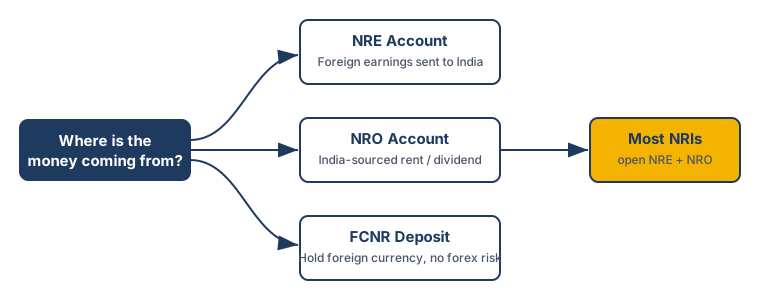
If you're sending money to India regularly: NRE If you earn rent/dividends in India: NRO If you want zero forex risk: FCNR Most NRIs need: NRE + NRO (both)
4. Investment Options for NRIs
A. Mutual Funds (Popular with NRIs)
Why Mutual Funds?
- Professional Management: Expert fund managers
- Diversification: Invest in 50-100 stocks
- Low Minimum: Start with ₹500/month (SIP)
- Liquidity: Redeem anytime (mostly 1-3 days)
- Regulation: SEBI-regulated (safe)
Types of Mutual Funds
Equity Funds (High risk, high return)
- Large-cap funds (Nifty 50, Sensex companies)
- Mid-cap funds (emerging companies)
- Small-cap funds (highest risk/reward)
- Illustrative long-term return range: ~12-15% CAGR (not a guarantee; actual returns vary and can be negative)
Debt Funds (Low risk, moderate return)
- Liquid funds (like savings account, 5-6%)
- Short-duration funds (6-7%)
- Corporate bond funds (7-8%)
Hybrid Funds (Balanced)
- Mix of equity (60-70%) + debt (30-40%)
- Illustrative long-term return range: ~9-11% CAGR (not a guarantee)
Direct vs Regular Plans
Direct Plans: No distributor commission → typically 0.5-1% higher net returns Regular Plans: Includes distributor commission in the expense ratio
Because of the lower costs, many long-term investors prefer Direct Plans. (NRI Wealth Partners is an AMFI-registered mutual fund distributor compensated via trail commissions built into Regular Plans; consider what fits your own needs and the level of support you want.)
How NRIs Can Invest
Requirements:
- NRE/NRO account
- KYC (PAN card, address proof, passport)
- Can invest via: NRI Wealth Partners, Kuvera, Groww, Scripbox
Taxation:
- LTCG (Long-term): 12.5% (if held >1 year for equity)
- STCG (Short-term): 20% (if sold <1 year)
- Debt funds: Taxed as per income tax slab
Fund Categories NRIs Commonly Consider
This section describes categories of funds (illustrative examples only — not recommendations to buy any specific scheme). Within each category there are many schemes from different fund houses; compare costs, track record and mandate, and pick what fits your own goals and risk profile.
- Flexi-cap equity fund (e.g. a low-cost flexi-cap fund, sometimes with some global exposure) — diversified across large/mid/small caps at the fund manager's discretion.
- Large-cap equity fund (e.g. a Nifty/Sensex-oriented large-cap fund) — typically lower volatility than mid/small caps.
- Mid-cap equity fund — higher growth potential with higher risk.
- Hybrid / balanced advantage fund — mixes equity and debt and may rebalance with market conditions.
- Short-duration debt fund — lower risk, relatively liquid, for the shorter-horizon portion of a portfolio.
These are illustrative category examples, not a ranked buy-list. Past performance does not guarantee future returns, and any specific scheme should be evaluated against your own situation (ideally with a SEBI-registered investment adviser).
B. Stocks (Direct Equity)
Can NRIs Buy Stocks?
Yes, via Portfolio Investment Scheme (PIS)
Requirements:
- NRE/NRO demat account
- PIS permission from RBI (bank will help)
Restrictions:
- ❌ Cannot buy small-cap stocks below ₹2 crore market cap
- ❌ Cannot hold >10% of any company (without FIPB approval)
- ✅ Can buy Nifty 50, large-cap stocks freely
Repatriation: Up to USD 1 million/year (NRO) or unlimited (NRE funds)
Taxation
- LTCG: 12.5% (if held >1 year)
- STCG: 20%
- Dividend: 20% TDS (can claim DTAA benefit)
C. Fixed Deposits (FD)
NRE FD
- Interest: 6-7% per annum
- Tenure: 1-10 years
- Tax-free: No TDS
- Fully repatriable
NRO FD
- Interest: 6-7% per annum
- TDS: 30% (reduce via DTAA)
- Limited repatriation
FCNR FD
- Interest: 3-5% (in USD/EUR)
- No forex risk
- Tax-free
Best For: Risk-averse investors, parking funds for 1-2 years
D. Real Estate
Can NRIs Buy Property in India?
✅ Yes (residential and commercial) ❌ Cannot buy agricultural land or farmhouses
Repatriation:
- Sale proceeds: Up to 2 residential properties (per lifetime)
- Rental income: Up to USD 1 million/year (after tax)
Taxation:
- LTCG (held >2 years): 20% (with indexation benefit)
- STCG: As per tax slab
- TDS: 20% (deducted by buyer)
Pros: Hedge against inflation, rental income Cons: Illiquid, tenant issues, maintenance
E. Gold
Options
- Physical Gold: Jewelry, coins (hard to store)
- Gold ETFs: Traded on stock exchange (liquid)
- Sovereign Gold Bonds: Govt-backed, 2.5% interest + capital appreciation
Best Option: Sovereign Gold Bonds (SGB)
- ✅ No storage cost
- ✅ 2.5% annual interest
- ✅ Tax-free after 8 years
- ⚠️ Lock-in: 5-8 years
Taxation:
- LTCG (held >3 years): 20% with indexation
- SGB (held 8 years): Tax-free
F. PPF (Public Provident Fund)
Can NRIs invest in PPF?
- ❌ New accounts: Not allowed
- ✅ Existing accounts: Can continue (until maturity)
Alternatives:
- ELSS mutual funds (tax-saving)
- NPS (National Pension System)
G. National Pension System (NPS)
Can NRIs invest?
✅ Yes (since 2019)
Benefits:
- Tax deduction: Up to ₹2 lakh/year (Section 80C + 80CCD)
- Low cost: 0.1% expense ratio
- Returns: 10-12% CAGR (long-term)
Drawback: Lock-in until age 60
H. Tax-Saving Investments (ELSS)
ELSS Mutual Funds (Equity-Linked Savings Scheme)
- Tax deduction: Up to ₹1.5 lakh/year (Section 80C)
- Lock-in: 3 years (shortest among tax-saving instruments)
- Returns: illustrative long-term range of ~12-15% CAGR for equity funds (not a guarantee; returns vary and can be negative)
ELSS options: Most fund houses offer a tax-saving (ELSS) equity scheme. Compare expense ratio, long-term track record and the fund's mandate, and choose one that fits your goals rather than picking by past returns alone.
5. Taxation for NRIs
Income Tax Residency
Resident: Tax on global income Non-Resident: Tax only on India-sourced income
India-Sourced Income (Taxable)
- Rental income from India property
- Interest on NRO FD
- Dividend from Indian stocks
- Capital gains from Indian assets
- Salary from Indian employer
Foreign-Sourced Income (Not Taxable in India)
- Foreign salary (if you're an NRI)
- Interest on NRE/FCNR FD
- Foreign stock dividends
Tax Rates (FY 2026-27 / Tax Year 2026-27)
Income Tax Act 2025 (effective 1 April 2026): A single "Tax Year" (1 Apr–31 Mar) replaces the old "Previous Year"/"Assessment Year" (AY) concept. Key sections are renumbered — 80C → Section 123, 80D → Section 126, and the 87A rebate → Section 157.
Old Regime (with deductions): slabs unchanged
- Up to ₹2.5L: 0%
- ₹2.5L - ₹5L: 5%
- ₹5L - ₹10L: 20%
- Above ₹10L: 30%
New Regime (default; no deductions):
- Up to ₹4L: 0%
- ₹4L - ₹8L: 5%
- ₹8L - ₹12L: 10%
- ₹12L - ₹16L: 15%
- ₹16L - ₹20L: 20%
- ₹20L - ₹24L: 25%
- Above ₹24L: 30%
A rebate under Section 157 (₹60,000) means effectively no tax up to ₹12L of taxable income, plus a ₹75,000 standard deduction on salary/pension.
TDS (Tax Deducted at Source)
| Income Source | TDS Rate (NRI) |
|---|---|
| Interest (NRO FD) | 30% |
| Interest (NRE/FCNR FD) | 0% (tax-free) |
| Dividend | 20% |
| Property sale | 20% |
| Rental income | 31.2% |
| Mutual fund redemption | 0% (you file return) |
DTAA (Double Taxation Avoidance Agreement)
What is DTAA?
Treaty between India and your country of residence to avoid paying tax twice on the same income.
Countries with DTAA: USA, UK, Canada, UAE, Singapore, Australia, Germany, France (80+ countries)
How it works:
- Pay tax in India (TDS)
- Claim foreign tax credit in your home country
- OR claim lower TDS via Form 10F
Example:
- You're an NRI in USA
- Earn ₹10L rental income in India
- TDS in India: 31.2% = ₹3.12L
- In USA, you claim ₹3.12L as foreign tax credit
- Avoid double tax
Form 15CA/15CB (For Remittances)
When needed?: Sending money abroad from NRO account
Form 15CA: Self-declaration of remittance Form 15CB: CA certificate (if remittance >₹5L)
6. Repatriation Rules
What is Repatriation?
Transfer of funds from India to your foreign bank account.
NRE Account Repatriation
✅ Fully repatriable (principal + interest) ✅ No limit ✅ No Form 15CA/15CB required
NRO Account Repatriation
⚠️ Limited repatriation: USD 1 million per financial year 📄 Requires: Form 15CA/15CB, CA certificate, tax payment proof
Eligible for Repatriation:
- Salary, pension, rent (after tax)
- Sale of property (up to 2 properties per lifetime)
- Investment returns
FCNR Account Repatriation
✅ Fully repatriable (in original foreign currency) ✅ No Form 15CA/15CB required
Repatriation Process
- Submit Form 15CA online (Income Tax Portal)
- Get CA to certify Form 15CB (if >₹5L)
- Submit to your bank with:
- Tax payment proof
- Investment proof
- Source of funds
- Bank processes within 7-10 days
7. Getting Started: Your 30-Day Action Plan
Week 1: Setup Accounts
Day 1-3: Open NRE + NRO account
- Choose bank: ICICI, HDFC, Axis (NRI-friendly)
- Submit documents online (passport, visa, address proof)
Day 4-5: Complete KYC
- In-person verification (IPV) via video call
- Get PAN card (if you don't have one)
Day 6-7: Fund your account
- Transfer USD to NRE via wire transfer
- Expect 2-3 days for funds to credit
Week 2: Research Investments
Day 8-10: Define your goals
- Emergency fund (6 months expenses)
- Retirement (20+ years)
- Child education (10 years)
- Home down payment (5 years)
Day 11-12: Asset allocation
- Age <35: 70% equity, 30% debt
- Age 35-50: 60% equity, 40% debt
- Age >50: 40% equity, 60% debt
As a rule of thumb, your equity share drops and your debt share rises as you get closer to your goals:
Illustrative Equity vs Debt by Age Band
Illustrative rule of thumb, not advice. Tune to your own goals and risk tolerance.
Day 13-14: Select mutual funds
- Use NRI Wealth Partners' AI recommendations
- Choose 3-5 funds (diversify across categories)
Week 3: Start Investing
Day 15-17: Set up SIP (Systematic Investment Plan)
- Amount: 20-30% of monthly income
- Frequency: Monthly (15th of every month)
- Auto-debit from NRE account
Day 18-20: Lumpsum for debt
- Park 6-month emergency fund in liquid fund
- Remaining in short-duration fund
Day 21: Tax-saving
- Invest ₹1.5L in ELSS (spread over 12 months SIP)
Week 4: Monitor & Protect
Day 22-24: Setup portfolio tracking
- Use NRI Wealth Partners dashboard
- Link all accounts (read-only)
- AI chatbot for queries
Day 25-27: Estate planning
- Nominate beneficiaries (NRE, NRO, demat accounts)
- Draft Will (cover India assets)
Day 28-30: Review & optimize
- Setup alerts (INR/USD rate, fund NAV)
- Schedule quarterly reviews
- Rebalance once a year
8. Common Mistakes to Avoid
Mistake #1: Investing in Regular Plans Instead of Direct
Loss: 1-1.5% per year (₹15-20L over 20 years on ₹1 Cr portfolio) Fix: Always choose Direct Mutual Funds
Mistake #2: Keeping All Money in FD
Problem: 6-7% returns may not beat inflation (7-8%) over the long run Consider: For long-term goals, many investors hold a meaningful equity allocation (a common rule of thumb is a higher equity share when the horizon is long and risk tolerance is high) — calibrate to your own goals and comfort with risk
Mistake #3: Not Filing Tax Returns in India
Problem:
- Cannot claim DTAA benefits
- Cannot get Form 16A (TDS certificate)
- May face penalties
Fix: File ITR even if no tax due (to claim TDS refund)
Mistake #4: Not Updating Residential Status
Problem: Become resident in India (after returning) but keep NRE account Fix: Convert NRE to Resident Savings Account within reasonable time
Mistake #5: Investing in Regular Savings Account (Resident Account)
Problem: Illegal after becoming NRI, account may be frozen Fix: Convert to NRE/NRO immediately
Mistake #6: Ignoring FATCA/CRS Compliance
Problem: Penalties in home country (USA: up to $10,000 fine) Fix: Report Indian accounts in FBAR, FATCA (if in USA)
Mistake #7: Not Taking Advantage of DTAA
Problem: Pay 30% TDS in India + tax in home country (double tax) Fix: Submit Form 10F to bank for lower TDS, claim foreign tax credit
Mistake #8: Emotional Real Estate Investments
Problem: Low liquidity, tenant issues, 8-10% returns (worse than equity) Fix: Invest in REITs or mutual funds (unless you need property for personal use)
Mistake #9: Not Rebalancing Portfolio
Problem: After bull market, portfolio becomes 90% equity (too risky) Fix: Rebalance once a year (sell equity, buy debt to maintain 60:40 ratio)
Mistake #10: Chasing Past Returns
Problem: Invest in last year's top-performing fund (often underperforms next year) Fix: Focus on consistency, 5-year track record, fund manager experience
Sample Portfolios
Illustrative only. The portfolios and "Illustrative Return" figures below are educational examples to show how asset mixes differ by risk profile — they are not recommendations or return guarantees. Actual returns vary and can be negative. Build your own allocation around your goals and risk tolerance, ideally with a SEBI-registered investment adviser.
Conservative (Age >50, Low Risk Tolerance)
| Investment | Allocation | Illustrative Return |
|---|---|---|
| Liquid Fund | 20% | 6% |
| Short Duration Fund | 30% | 7% |
| Large-cap Equity Fund | 30% | 12% |
| Balanced Advantage Fund | 20% | 10% |
| Overall | 100% | 8.8% |
Balanced (Age 35-50, Moderate Risk)
| Investment | Allocation | Illustrative Return |
|---|---|---|
| Liquid Fund | 10% | 6% |
| Short Duration Fund | 20% | 7% |
| Large-cap Equity Fund | 30% | 12% |
| Flexi-cap Equity Fund | 25% | 14% |
| Mid-cap Equity Fund | 15% | 16% |
| Overall | 100% | 11.3% |
Visualised, the Balanced portfolio's allocation looks like this:
Balanced Portfolio Allocation (Illustrative)
Illustrative sample, not advice. Allocations should reflect your own goals and risk profile.
Aggressive (Age <35, High Risk Tolerance)
| Investment | Allocation | Illustrative Return |
|---|---|---|
| Liquid Fund | 5% | 6% |
| Large-cap Equity Fund | 25% | 12% |
| Flexi-cap Equity Fund | 30% | 14% |
| Mid-cap Equity Fund | 25% | 16% |
| Small-cap Equity Fund | 15% | 18% |
| Overall | 100% | 14.1% |
FAQs
Q: Can NRIs invest in Indian mutual funds? A: Yes, via NRE/NRO accounts with KYC.
Q: Are mutual fund returns taxable? A: Yes. LTCG 12.5% (equity), 20% (debt). STCG 20% (equity), slab rate (debt).
Q: Can I invest in SIP from abroad? A: Yes, auto-debit from NRE/NRO account.
Q: What if I become a resident again? A: Convert NRE/NRO to resident account, continue investments.
Q: Do I need to report Indian investments in my home country? A: Yes (USA: FBAR, FATCA; UK: Self-Assessment; Canada: T1135).
Q: Can I invest in IPOs? A: Yes, via NRE demat + PIS account.
Q: How do I repatriate mutual fund redemption? A: NRE account → No limit. NRO account → USD 1M/year (Form 15CA/15CB).
Q: What's the minimum SIP amount? A: ₹500/month (some funds allow ₹100/month).
Q: Can I invest in ULIPs? A: Yes, but not recommended (high charges, poor returns vs mutual funds).
Q: How long should I invest? A: Equity: 5+ years, Debt: 1-3 years, Gold: 5+ years.
Next Steps
Start Your NRI Investment Journey Today
Step 1: Open NRE + NRO account → Compare Banks
Step 2: Complete KYC → Upload Documents
Step 3: Get AI Portfolio Recommendation → Free Analysis
Step 4: Start SIP in Direct Mutual Funds → Browse Funds
Step 5: Track & Optimize → Dashboard
About NRI Wealth Partners
We are India's first AI-powered wealth management platform for NRIs. Our mission is to make investing in India:
- Simple: 30-second KYC, auto-portfolio sync
- Transparent: Direct MF only, no hidden fees
- Smart: AI-powered insights, tax optimization
- Compliant: AMFI-registered Mutual Fund Distributor (ARN-360468), FATCA/CRS support
Join 1,500+ NRIs managing ₹540+ crore with us.
Disclaimer: This guide is for educational and informational purposes only and does not constitute investment advice, research, or a recommendation to buy or sell any specific security or scheme. NRI Wealth Partners is an AMFI-registered Mutual Fund Distributor (ARN-360468) and provides CA/tax services; it is not registered with SEBI as an Investment Adviser or Research Analyst. Any fund categories or sample portfolios shown are illustrative examples only. Mutual fund investments are subject to market risks; please read all scheme-related documents carefully. Past performance is not indicative of future returns, and all return figures are illustrative, not guarantees. Please consult a SEBI-registered investment adviser before making investment decisions.
Last Updated: December 2025 Version: 2026 Edition