Currency Hedging Guide for NRIs: Protecting Your Wealth Against Rupee Fluctuations
Author: NRI Wealth Partners Published: December 2025 Recommended Reading Time: 25-30 minutes Audience: Non-Resident Indians managing cross-border finances
Table of Contents
- Introduction
- Understanding INR/USD Volatility
- Impact of Currency Fluctuations on NRI Investments
- Real-World Scenarios: How Rupee Movements Affect You
- Natural Hedging Strategies
- Timing Your Money Transfers
- Tracking INR/USD Rates
- Derivative Hedging Tools
- To Hedge or Not to Hedge?
- Tools and Resources
- FAQs
Introduction
As a Non-Resident Indian (NRI), you face a unique financial challenge that domestic investors don't: currency risk. Whether you're sending money home, investing in Indian stocks, or managing property investments, your returns are directly affected by INR/USD fluctuations.
The Reality:
- Your investment return = Investment return + Currency movement
- A 15% profit in Indian stocks could become a 5% loss if the rupee weakens 10%
- Conversely, a -5% stock market loss could become a +5% gain if the rupee appreciates 10%
This guide provides practical strategies to manage, mitigate, or leverage currency movements to protect and enhance your wealth. Whether you choose to hedge, naturally align your exposures, or use timing strategies depends on your unique circumstances—which we'll explore in detail.
Understanding INR/USD Volatility
Historical Analysis (2000-2025)
The Indian rupee has experienced significant volatility over the past 25 years, driven by global economic cycles, domestic monetary policy, crude oil prices, and capital flows.
Key Historical Milestones:
| Period | INR/USD Range | Key Events | Volatility (Annual) |
|---|---|---|---|
| 2000-2004 | 43-46 | Stable, pre-liberalization period | 3-5% |
| 2004-2007 | 43-41 | Strong growth, FDI inflows | 4-6% |
| 2008 (Global Financial Crisis) | 40-50 | Rupee weakness post-crisis | 12-15% |
| 2009-2012 | 44-56 | Inflation concerns, CAD | 8-10% |
| 2013-2014 | 54-68 | "Taper tantrum" shock | 14-18% |
| 2015-2016 | 64-68 | Demonetization, normalization | 6-8% |
| 2017-2019 | 63-71 | Steady depreciation | 5-7% |
| 2020 | 74-76 | COVID-19, safe-haven flows | 3-5% |
| 2021-2023 | 74-84 | Fed rate hikes, INR weakness | 7-9% |
| 2024-2025 | 82-86 | Geopolitical uncertainty, normalization | 5-7% |
Current Rate (December 2025): Approximately INR 84-85 per USD
Chart 1: INR/USD Historical Movement (2000-2025)
The chart below plots the long-term depreciation trend, with the year-end INR-per-USD rate rising from the low-40s to the mid-80s over 25 years. Note the volatility spikes around 2008, 2013-14 and 2022-23.
Illustrative INR/USD Year-End Rate (2000-2025)
Illustrative, not a forecast. Approximate year-end levels, rounded.
Volatility Patterns
Average Annual Volatility by Decade:
- 2000-2010: 6-8%
- 2010-2020: 8-10%
- 2020-2025: 5-8%
Monthly Volatility Ranges:
- Calm markets: 0.5-1.5% monthly movement
- Normal markets: 1.5-3% monthly movement
- Volatile markets: 3-6% monthly movement
- Crisis periods: 6%+ monthly movement
Key Insight: Even in "stable" periods, the rupee typically fluctuates 2-3% annually, which can significantly impact unhedged returns for NRIs.
Impact of Currency Fluctuations on NRI Investments
The Real Math Behind Currency Impact
Let's assume you invest $100,000 (approximately INR 85,00,000 at current rates).
Scenario 1: Pure Rupee-Denominated Investment
Initial Investment: $100,000 = INR 85,00,000 (at 85 INR/USD)
Indian Stock Market Return: +12% = INR 95,20,000
Currency Effect:
  - If INR appreciates to 82/USD: Your $100,000 now = INR 82,00,000 (gain negated!)
  - If INR depreciates to 88/USD: Your $100,000 now = INR 88,00,000 (additional gain!)
Categories of Impact:
1. Outbound Remittances (Money sent to India)
- INR weakness = You send more USD for same INR amount
- INR strength = You send less USD for same INR amount
2. Inbound Remittances (Money received in USD)
- INR weakness = Each USD buys more INR goods/services
- INR strength = Each USD buys fewer INR goods/services
3. Investment Returns
- Rupee-denominated assets: Currency movement adds/subtracts from returns
- USD-denominated assets: Rupee movement provides natural hedge
- Mixed portfolio: Blended effect depends on allocation
4. Property Values and Expenses
- While property values in INR may appreciate, relative USD value fluctuates
- Monthly expenses (if maintaining a home in India) are currency-sensitive
Real-World Scenarios: How Rupee Movements Affect You
Scenario 1: INR Appreciates 10% (Rupee Strengthens)
Initial Situation:
- You invested $100,000 in Indian equities at INR 85/USD
- Equivalent to INR 85,00,000
- Indian equity market rises 8% in the next year
What Happens:
| Component | Amount | Impact |
|---|---|---|
| Investment Principal (USD) | $100,000 | - |
| Initial INR Value | INR 85,00,000 | - |
| Market Return | +8% = INR 91,80,000 | +INR 6,80,000 |
| Currency Movement | INR appreciates to 77/USD | -$22,078 loss |
| Your Final Value in USD | $91,80,000 ÷ 77 = $119,221 | - |
| Total Return in USD | +$19,221 | 19.2% return |
Key Insight: The 10% rupee appreciation actually helped you! Even though the market went up 8%, your total return in USD was 19.2% because you're converting back to USD at a stronger rupee rate.
Real Example:
- If you invested $100,000 in Nifty 50 in October 2024 (at ~84 INR/USD)
- The index rose ~6% through December 2024
- Rupee strengthened to ~82 INR/USD
- Your return would be approximately 12-13% in USD terms
Action Items When Rupee Strengthens:
- Good time to convert INR back to USD (if needed)
- Domestic India-focused investments look better in USD terms
- Consider increasing USD-hedged portion of portfolio
Scenario 2: INR Depreciates 10% (Rupee Weakens)
Initial Situation:
- Same as above: $100,000 invested at INR 85/USD = INR 85,00,000
- Indian equity market rises 8%
What Happens:
| Component | Amount | Impact |
|---|---|---|
| Investment Principal (USD) | $100,000 | - |
| Initial INR Value | INR 85,00,000 | - |
| Market Return | +8% = INR 91,80,000 | +INR 6,80,000 |
| Currency Movement | INR depreciates to 93.5/USD | -$35,855 loss |
| Your Final Value in USD | INR 91,80,000 ÷ 93.5 = $98,130 | - |
| Total Return in USD | -$1,870 | -1.87% return |
Critical Insight: Despite 8% stock market gains, you lost money in USD terms because of rupee depreciation! This is the core risk NRI investors face.
Real Example:
- Investment in July 2013 at INR 58/USD
- Indian market rose ~4% by June 2014
- Rupee crashed to 64/USD (10% depreciation)
- Your net return: -6% in USD terms despite positive stock returns
Action Items When Rupee Weakens:
- Avoid converting large amounts to INR (hold USD in FCNR)
- Add to positions if you have strong conviction (rupee typically overshoots)
- Consider gold as a hedge (typically rises in INR weakness)
- Evaluate forward contracts for large upcoming transfers
Scenario 3: Combined Impact - The Worst Case
Situation: Bad market + Weakening rupee
$100,000 invested → INR 85,00,000
Market falls -5% → INR 80,75,000
Rupee weakens to 93.5/USD

Your balance: INR 80,75,000 ÷ 93.5 = $86,362
Total loss: -13.6% (5% market loss + currency loss)
This happened to many NRIs in 2011-2012 and again in 2022-2023.
Scenario 4: Positive Divergence - The Best Case
Situation: Good market + Strengthening rupee
$100,000 invested → INR 85,00,000
Market rises +15% → INR 97,75,000
Rupee strengthens to 77/USD

Your balance: INR 97,75,000 ÷ 77 = $127,019
Total gain: +27% (15% market gain + currency gain)
This occurred for NRIs investing in 2020-2021 when rupee strengthened.
Natural Hedging Strategies
Natural hedging means creating a natural offset to currency risk without using derivatives. This is ideal for long-term NRI investors.
Strategy 1: FCNR (Foreign Currency Non-Resident) Deposits
What It Is: A savings/fixed deposit account maintained in foreign currency (USD, EUR, GBP, JPY) with Indian banks.
Key Features:
| Aspect | Details |
|---|---|
| Currency Options | USD, EUR, GBP, JPY |
| Tenure | 1-5 years (varying by bank) |
| Current Interest Rate (Dec 2025) | 4.5-5.25% p.a. (USD) |
| Tax Treatment | Interest taxed as per ITR provisions |
| Repatriation | Fully repatriable to overseas account |
| Minimum Amount | $10,000 typically |
| Rupee Risk | Zero (remains in foreign currency) |
Best Banks for FCNR:
- ICICI Bank: 5.15% on 2-year USD deposits
- HDFC Bank: 4.85-5.25% depending on tenure
- Axis Bank: 4.75-5.00%
- IDBI Bank: 5.25% (competitive rates)
Worked Example: FCNR as Rupee Hedge
Initial: $100,000 in FCNR at 85 INR/USD

Scenario A: You need money after 1 year
- FCNR Interest earned: 5% = $5,000
- Total amount: $105,000
- Rupee movement: 85 → 93.5 (depreciates 10%)
- What you get: Same $105,000 (no currency loss!)
- Alternative without FCNR: Would have lost $10,000 to currency

Scenario B: You decide to convert to INR after 1 year
- Amount: $105,000
- Exchange rate: Now 93.5 INR/USD
- Get: INR 98,17,500
- You earned 5% return PLUS protected against depreciation
When to Use FCNR:
- You have USD income and will eventually transfer it to India
- You expect the rupee to weaken.
- You want fixed contractual interest without currency risk.
- You're planning major INR expenses in 2-5 years.
FCNR Portfolio Example for $500,000 NRI:
- $100,000 in FCNR (2-year, 5.2%) - Emergency fund in USD
- $150,000 in FCNR (1-year, 5.0%) - Expenses next year
- $250,000 in equity/hybrid (rupee-exposed) - Long-term growth
Strategy 2: International Mutual Funds with USD Exposure
The Concept: Invest in Indian mutual funds that have significant international/USD exposure. As rupee weakens, the USD-denominated assets appreciate in INR terms, offsetting losses.
Example: A Flexi-Cap Fund with International Exposure
The illustration below uses an example flexi-cap fund with significant international (primarily US) exposure. This is for educational purposes only and is not a recommendation of any specific scheme.
Illustrative Portfolio Structure:
- 25% International Stocks (primarily US)
- 60% Indian Stocks
- 10% Fixed Income
- 5% Cash
How It Hedges Currency Risk:
Initial Investment: $100,000 = INR 85,00,000

Fund Composition:
- INR portion: INR 51,00,000 (60% Indian stocks)
- USD portion: INR 21,25,000 (25% international, held in USD)
- Debt/Cash: INR 12,75,000

Scenario: Market stable, rupee depreciates 10% (85 → 93.5)

INR Portion: INR 51,00,000 (unchanged in INR, loses value in USD)
- Market returns ~10%: INR 56,10,000
- Value in USD: 56,10,000 ÷ 93.5 = $60,000

USD Portion: INR 21,25,000 stays as $250,000
- Market returns ~8%: $270,000
- Value in INR: $270,000 × 93.5 = INR 25,25,000

Total Fund Value:
- INR 56,10,000 + INR 25,25,000 = INR 81,35,000
- In USD: 81,35,000 ÷ 93.5 = $87,000
- Return: -13% (limited by international diversification)
- Without international portion: -18% loss

The USD exposure limited losses by 5%!
Fund Categories That Offer International/USD Exposure:
- Global/international equity funds (partial international allocation)
- US-focused equity funds (high USD exposure, closer to a pure USD hedge)
- Emerging-market funds (emerging markets plus currency diversification)
Allocation Strategy:
For $300,000 NRI investor:
- $100,000: FCNR deposits (100% USD hedge)
- $100,000: Flexi-cap fund with international exposure (25% USD hedge)
- $100,000: Pure Indian equity (0% USD hedge, high growth)
- Total effective USD hedge: ~42%
Strategy 3: Gold as a Currency Hedge
The Golden Rule: Gold appreciates during rupee weakness because:
- Gold is priced in USD globally
- When rupee weakens, imported gold becomes more expensive
- Domestic gold prices in INR rise
- Gold is a "safe haven" that appreciates during currency stress
Historical Evidence:
| Period | Rupee Movement | Gold Movement (INR) | Correlation |
|---|---|---|---|
| 2011-2013 | -12% depreciation | +28% appreciation | Strong inverse |
| 2013-2014 | -18% depreciation | +13% appreciation | Strong inverse |
| 2020-2021 | +3% appreciation | +23% appreciation | Positive (both up) |
| 2021-2023 | -12% depreciation | +18% appreciation | Strong inverse |
The chart below contrasts the rupee move against the gold move (in INR) across the periods in the table above. When the rupee depreciated, gold in INR generally rose, illustrating the inverse relationship that makes gold a partial hedge.
Illustrative: Rupee Move vs Gold Move (INR), by Period
Illustrative, not a forecast. Approximate historical moves; past behaviour is not a guarantee.
Gold Price Correlation with INR:
- During rupee weakness: -0.65 correlation (strong inverse)
- During rupee strength: -0.30 correlation (weak inverse)
- Overall: Best hedge during crisis periods
Gold Allocation Strategy:
For $500,000 portfolio:

Conservative (High rupee sensitivity):
- 10% Gold = $50,000
- 40% FCNR = $200,000
- 50% Indian equities = $250,000

Moderate:
- 7% Gold = $35,000
- 25% FCNR = $125,000
- 68% Indian equities = $340,000

Growth-Focused:
- 5% Gold = $25,000
- 15% FCNR = $75,000
- 80% Indian equities = $400,000
How to Invest in Gold:
-
Physical Gold:
- Jewelry (not recommended - high markup)
- Bullion coins/bars (2-3% premium)
- Best for large sums
-
Sovereign Gold Bonds (SGB):
- 2.5% guaranteed annual return + capital appreciation
- Issued by RBI, zero default risk
- No storage costs like physical gold
-
Gold ETFs (Indian rupees):
- Liquid, tradeable on stock exchange
- Example: ICICI Prudential Gold ETF
- Can buy/sell anytime
-
Gold Mutual Funds:
- Fund invests in gold ETFs
- Additional layer of management
- Higher expense ratio (0.5-0.8%)
Recommended: Mix of Sovereign Gold Bonds (for stability) + Gold ETF (for liquidity)
Timing Your Money Transfers
Principle: Transfer to India When INR is Strong (USD is Weak)
The key to optimal timing is understanding where we are in the currency cycle.
How to Identify INR Strength vs Weakness
INR is "Weak" (USD is Strong) when:
Indicators:
✓ INR/USD ratio > historical average + 1 standard deviation
✓ RBI's Real Effective Exchange Rate (REER) < 105
✓ Capital outflows from India
✓ Rising US interest rates
✓ Crude oil prices elevated
✓ Positive USD carry trades
INR is "Strong" (USD is Weak) when:
Indicators:
✓ INR/USD ratio < historical average
✓ RBI's REER > 110
✓ Capital inflows to India
✓ Falling US interest rates
✓ Global risk-on sentiment
✓ Strong India growth story
Historical Example: The 2013-2014 Transfer Decision
June 2013: INR at 58-59/USD (historically strong)
- Investor X transfers $50,000 → Gets INR 28,50,000

July 2013-June 2014: INR crashes to 64/USD
- Investor Y transfers $50,000 → Gets only INR 32,00,000
- Investor X would now need $50,000 to get same amount
- But Investor X locked in when rupee was strong!

One year later:
- Investor X gains: +13% on same USD amount
- This timing advantage could outweigh 2-3 years of investment returns!
Rupee Cost Averaging: The SIP Approach for Large Transfers
If you're uncertain about timing, use Rupee Cost Averaging (RCA), similar to Systematic Investment Plans:
Strategy: Transfer $X every month instead of lump sum
Scenario: You have $100,000 to transfer, uncertain about timing

Option A: Lump Sum at 85 INR/USD
- Transfer: $100,000
- Get: INR 85,00,000

Option B: Rupee Cost Averaging - $10,000/month for 10 months

Month 1: $10,000 @ 85 = INR 8,50,000
Month 2: $10,000 @ 87 = INR 8,70,000
Month 3: $10,000 @ 84 = INR 8,40,000
Month 4: $10,000 @ 88 = INR 8,80,000
Month 5: $10,000 @ 86 = INR 8,60,000
Month 6: $10,000 @ 82 = INR 8,20,000
Month 7: $10,000 @ 85 = INR 8,50,000
Month 8: $10,000 @ 89 = INR 8,90,000
Month 9: $10,000 @ 83 = INR 8,30,000
Month 10: $10,000 @ 86 = INR 8,60,000

Total INR: INR 85,50,000
Average rate: 85.5 INR/USD

Benefit: Better average rate than any single timing, PLUS
- You capture the 82 INR/USD low point
- You're not unlucky if rupee crashes immediately
When to Use RCA:
- Large transfers ($50,000+)
- Uncertain about market direction
- Need funds over next 6-12 months
- Risk-averse approach
RCA Calculator - Your Situation:
If you have $50,000 to transfer:
Conservative (12 months): $4,166/month
Moderate (6 months): $8,333/month
Aggressive (3 months): $16,667/month
Calendar-Based Timing Guide
Best Times Historically to Transfer to India:
Q4 (Oct-Dec):
- Often sees rupee weakness (Q2 US earnings season, capital rebalancing)
- But: Returns might already be realized - less advantage
March-April:
- End of fiscal year capital flows
- Mixed outcomes historically
May-June:
- Summer peak in rupee weakness
- Good historical track record
Worst Times Historically:
September-October:
- Pre-Diwali corporate demand for dollars
- Holiday season inflows reduce INR weakness
January-February:
- January seasonal dollar strength globally
- Higher dollar demand for advance tax payments
Tracking INR/USD Rates
Where to Monitor Real-Time Rates
1. Reserve Bank of India (Official Source)
- Website: rbi.org.in → "Reference Rates"
- Frequency: Updated daily at 12:00 PM IST
- Most Reliable: Official RBI reference rate used for remittances
- Data: Current + 5-year historical
2. OANDA Currency Tools
- Website: oanda.com/currency/converter
- Best For: Multiple currency pairs, historical data
- Data Frequency: Real-time market rates
3. XE Currency Converter
- Website: xe.com
- Best For: Mid-market rates, no markup
- Historical Data: Yes, downloadable
- Mobile App: Available
4. CEIC Data (Economic Data)
- Website: ceicdata.com
- Best For: Economic context, RBI policy rates
- Data: INR index, capital flows, interest rates
5. TradingView
- Website: tradingview.com
- Symbol: USDINR
- Best For: Technical analysis, charts, alerts
- Mobile App: Advanced charting
6. Reserve Bank's Weekly Monetary Policy:
- Website: rbi.org.in
- Frequency: Every 6 weeks
- Impact: Major moves often follow RBI policy
Setting Up Alerts
Gmail Alerts Method:
- Search Google for "USDINR rate" daily
- Or set price alerts on TradingView when:
- INR appreciates 2% (good time to transfer)
- INR depreciates 3% (hold off transfers)
Recommended Thresholds:
Action Alert: USDINR reaches 87 (from 85)
- "Rupee weakening, may want to delay transfer"

Opportunity Alert: USDINR drops to 83 (from 85)
- "Rupee strengthening, good time to transfer"
Creating Your Own Tracking Sheet
Google Sheets Template:
Date | INR/USD Rate | 52-Week High | 52-Week Low | Status | Action
Dec 7, 2025 | 84.50 | 88.50 | 82.00 | Neutral | Hold
Derivative Hedging Tools
For large sums or timing-critical transfers, derivatives provide precise protection.
Forward Contracts
What It Is: An agreement to exchange currency on a future date at a pre-agreed rate.
Example: Protecting a $100,000 Transfer
Situation: You'll get $100,000 in USD next month,
but you need INR in 6 months.

Current Rate: 85 INR/USD
Forward Rate: 85.8 INR/USD (6-month forward)
(Forward rate slightly higher due to interest rate differential)

Forward Contract: Lock in 85.8 INR/USD for $100,000 in 6 months

Scenario 1: INR strengthens to 82/USD in 6 months
- Without forward: Get INR 82,00,000 (lost out)
- With forward: Get INR 85,80,000 (protected)
- Benefit: +INR 3,80,000 protection

Scenario 2: INR weakens to 90/USD in 6 months
- Without forward: Get INR 90,00,000 (happy!)
- With forward: Get INR 85,80,000 (locked in lower rate)
- Cost: -INR 4,20,000 opportunity cost

Net Benefit: You eliminate uncertainty
The chart below compares the INR you would receive on the same $100,000 transfer, with versus without the 85.8 forward, under the two scenarios above. The forward floors your outcome if the rupee strengthens but caps it if the rupee weakens.
Illustrative $100,000 Transfer: With vs Without a 85.8 Forward
Illustrative, not a forecast. Forward rate and spot levels are hypothetical.
How to Arrange Forward Contracts:
| Bank | Forward Rates | Minimum | Process | Time |
|---|---|---|---|---|
| HDFC Bank | 85.8-86.2 | $50,000+ | Online/branch | 1-2 days |
| ICICI Bank | 85.7-86.1 | $50,000+ | Online/branch | 1-2 days |
| Axis Bank | 85.6-86.0 | $50,000+ | Online/branch | 1-2 days |
| Standard Chartered | 85.5-85.9 | $100,000+ | Relationship manager | 2-3 days |
Costs:
- No commission typically
- Slight spread included in quoted rate (0.2-0.5%)
- Settlement fee: INR 500-2,000
When to Use Forward Contracts:
- You have a definite USD amount coming (salary, bonus)
- You have a definite future INR need (property purchase)
- Timeline is 3-12 months
- Amount is $50,000+
SWAP Agreements (Currency Swaps)
What It Is: Exchange principal and interest in one currency for principal and interest in another currency. More complex than forwards.
Example: Interest Rate Swap for Liability
Situation: You have a $500,000 house loan in the US.
You want to reduce USD exposure but need to service the loan.

Strategy: Currency Swap Agreement

Leg 1: You pay INR interest on INR borrowed amount
Leg 2: Counterparty pays your USD loan interest

Mechanics:
- Swap $500,000 for INR 42,50,000 (at 85 INR/USD)
- You receive INR interest (7% = INR 2,97,500/year)
- You pay USD interest (4% = $20,000/year)

Net Effect: You've converted USD liability to INR funding
Key Characteristics:
- Minimum: Usually $1,000,000+
- Duration: 2-10 years typically
- Requires credit approval
- Mark-to-market daily
- Used by HNIs and corporates
When to Use Currency Swaps:
- Large foreign currency liabilities
- Multi-year certainty of INR need
- Want to lock in long-term funding rate
- Amount exceeds $500,000
Reality Check: Most individual NRIs don't need swaps; forwards are simpler.
To Hedge or Not to Hedge?
This is the critical decision. Let's analyze both sides honestly.
Arguments FOR Hedging
1. Protect Core Needs
Example: You maintain a family in India
Monthly need: INR 2,00,000 (≈ $2,400 USD)

Unhedged scenario:
- INR weakens to 90/USD: Now costs $2,200 per month
- You're paying more USD for same INR needs
- Over 12 months: Extra $0 × 0 = $2,400 extra

Hedged scenario (FCNR deposits):
- Same INR 2,00,000 every month
- No currency risk
- Sleep better at night
2. Eliminate Worst-Case Risk
Scenario: Rupee crashes (like 2013, 2020)
INR drops 15-20% in 6 months

Unhedged: Your net worth drops 10-15% just from currency
Hedged: Your core portfolio is protected
3. Allow Better Decision-Making
Without hedge:
- Stock down 5%, rupee down 8% = Total down 13%
- Panicked decision: Sell everything
- Result: Crystallized losses

With hedge:
- Stock down 5%, but currency protected
- Better perspective: Market is down 5%, not catastrophic
- Better decision: Hold or add to position
4. Reduced Volatility in USD Terms
Unhedged Indian equity: ~18-20% annual volatility
Hedged (40% FCNR): ~12-14% annual volatility
Professional managers: What institutional investors do

Benefit: Sleep at night, less emotional decisions
Arguments AGAINST Hedging
1. Cost Reduces Returns
FCNR earning 5.2%
vs.
INR depreciation earning 0% or negative

If INR appreciates instead: You "paid" 5% for no hedge benefit

10-year horizon:
- Unhedged: Benefit from rupee appreciation if it happens
- Hedged: Guaranteed 5%, miss upside
2. You're Betting Against Rupee
Reality: India is a 5%+ GDP growth economy
Long-term trend: Rupee should strengthen (not weaken)
Historical: From 43 in 2000 to 85 in 2025 is temporary

By hedging, you're:
- Betting INR will weaken further (contrarian view)
- Accepting permanent cost for temporary protection
3. Hedging Costs Add Up
Example: $500,000 portfolio over 10 years

Hedging approach:
- $200,000 in FCNR @ 5%: Earns INR 50,00,000 interest
- Opportunity cost: If INR appreciated, loss is 5% return

Unhedged approach (assuming 8% INR appreciation):
- Benefit: Additional 8% return = INR 40,00,000 gain
- Cost: If INR depreciated, loss is 8% return

Over long periods, hedging costs more than it protects.
4. Rupee Cycles Are Real
Cycles observed:
2000-2010: INR appreciated overall
2010-2020: INR depreciated overall
2020-2025: Appreciation phase

Hedging keeps you out of appreciation phases!
The Verdict: A Balanced Approach
For Most NRIs:
1. CORE Liabilities (30-40%): Fully Hedged
   What: Monthly family expenses, committed obligations
   How: FCNR deposits matching 18-24 months of expenses
   Benefit: Peace of mind, no currency stress on essentials

2. MEDIUM-TERM Needs (20-30%): Partially Hedged
   What: Expected large expenses in 2-5 years
   How: Flexi Cap funds (25% international), Gold (5-7%)
   Benefit: Flexible, some protection, growth upside

3. LONG-TERM Growth (30-40%): Mostly Unhedged
   What: Wealth building for 10+ years
   How: High-conviction Indian equities, direct stocks
   Benefit: Long-term rupee strength, higher returns
Decision Tree: Should YOU Hedge?
The diagram below walks through the same questions visually: each "Yes" routes you to a specific hedging action, while a chain of "No" answers points toward leaving long-term growth unhedged.
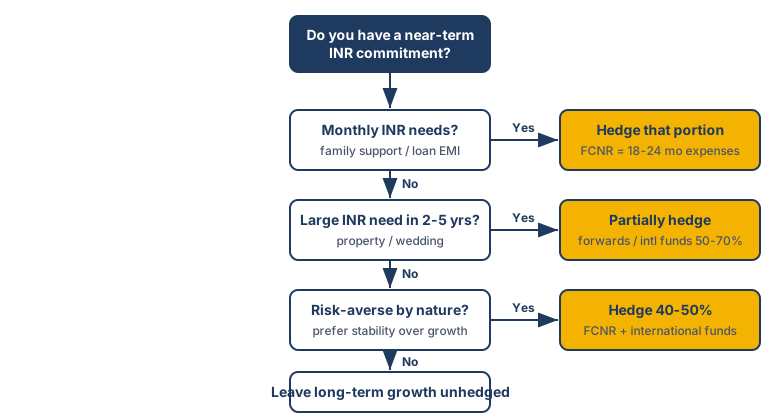
START HERE:
-
Do you have monthly INR commitments (family support, loans)?
- YES → Hedge that portion immediately
- NO → Go to question 2
-
Do you expect to need INR in next 3-5 years (property, wedding)?
- YES → Hedge 50-70% of that amount with forwards/FCNR
- NO → Go to question 3
-
Are you risk-averse by nature (prefer stability over growth)?
- YES → Hedge 40-50% with FCNR + international funds
- NO → Hedge only 20-30% (core needs)
-
Is your USD income steady and exceeds INR expenses?
- YES → Less hedging needed (natural offset)
- NO → More hedging needed (currency becomes critical)
Tools and Resources
Recommended Tools and Websites
Currency Tracking & Analysis
| Tool | URL | Best For | Free? |
|---|---|---|---|
| RBI Reference Rates | rbi.org.in/interface/DBSIndexOld | Official rates | Yes |
| TradingView USDINR | tradingview.com | Charts & alerts | Yes (basic) |
| XE Currency Tool | xe.com | Multi-currency | Yes |
| CEIC Data | ceicdata.com | Economic data | No (premium) |
| Forex.com | forex.com/en-us/rates | Live rates | Yes |
Banking & Remittance Options
| Service | URL | Best For | Typical Rates |
|---|---|---|---|
| SWIFT Transfer | Your bank | Large formal transfers | -0.5% to -2% |
| Wise (TransferWise) | wise.com | Cheaper transfers | -0.5% to -1% |
| OFX | ofx.com | Direct transfers | -0.5% to -1.5% |
| MoneyGram | moneygram.com | Cash pickup | -1.5% to -3% |
| Your Bank Portal | HDFC/ICICI/Axis | Convenience | -1% to -2% |
Investment Platforms for Hedging
| Platform | Focus | Indian Funds | International | Best For |
|---|---|---|---|---|
| Kuvera | SIP & funds | Yes | Yes | Easy rebalancing |
| Groww | ETFs & funds | Yes | Limited | Cost-effective |
| MFOnline | Direct mutual funds | Yes | Some | Lower fees |
| Motilal Oswal | Direct investing | Yes | Yes | Research + funds |
| ICICI Direct | Stocks & funds | Yes | Some | Integrated platform |
Gold Investment Options
| Option | Minimum | Best For | Liquidity |
|---|---|---|---|
| Sovereign Gold Bonds | INR 500 | Long-term hedge | 5+ years best |
| Gold ETFs | 1 unit (~INR 8,000) | Flexibility | Daily |
| Gold Funds | INR 500-1,000 | Easy management | Daily |
| Physical Gold | INR 10,000+ | Long-term hold | 3-7 days |
Financial Calculators
- Rupee Cost Averaging: Use Excel with your timeline
- Forward Contract Comparison: Bank websites
- Currency Impact on Returns: Internal NRI Wealth Partners calculator
Books & Reading Materials
-
"The Intelligent Investor" by Benjamin Graham
- Principles apply to currency hedging decisions
- When to hedge, when to ignore
-
RBI Monetary Policy Statements
- Free on rbi.org.in
- Understand INR dynamics from the horse's mouth
-
Motilal Oswal Financial Services - NRI Guides
- Detailed technical analysis of rupee movements
- Available on motilaloswaldirect.com
-
"Fooled by Randomness" by Nassim Taleb
- Helps understand currency volatility and decision-making under uncertainty
- Perspective on hedging vs. risk
FAQs
Q1: Is the rupee going to weaken or strengthen in 2025-2026?
A: No one can predict with certainty, but here's the base case:
Factors Suggesting Weakness (85-90/USD):
- Crude oil prices elevated (>$70/barrel)
- US rates higher than India (carry trade)
- Global uncertainty
- India's CAD (Current Account Deficit) pressure
Factors Suggesting Strength (80-82/USD):
- India's strong 7%+ GDP growth
- FDI inflows continue
- RBI forex reserves near all-time high
- Domestic investment appeal
Our View: Likely trading 82-88 range in 2025-26, with neutral to slightly weak bias. Action: Use rupee cost averaging rather than timing.
Q2: Should I use a forward contract to lock in rates?
A: Use forward contracts when:
- ✓ You have a confirmed USD inflow (salary, asset sale)
- ✓ You have a confirmed INR need (property purchase date)
- ✓ Amount is $50,000+
- ✓ Timeline is 3-12 months
Don't use when:
- ✗ You're uncertain about the exact timing
- ✗ Amount is small (<$20,000)
- ✗ You want flexibility
Default answer: For most NRIs, rupee cost averaging is better than forward contracts (easier, no commitment, lower cost).
Q3: What's the difference between FCNR and NRO accounts?
FCNR:
- Foreign currency (USD, EUR, GBP, JPY)
- Fixed deposit terms (1-5 years)
- Cannot withdraw before maturity
- 5%+ interest rate
- Best for: Long-term protection
NRO:
- Indian rupees only
- Savings/current/fixed deposits
- Flexible withdrawals
- 3-4% interest rate
- Best for: Monthly income, daily needs
For Hedging: FCNR is better (foreign currency protection).
Q4: Can I invest in US stocks directly as a hedge?
A: Yes, but with limitations:
Advantages:
- True USD hedge (asset in USD, returns in USD)
- Potential for higher returns (US tech stocks, S&P 500)
- Direct exposure, no middleman
Disadvantages:
- Requires US brokerage account (IBKR, Charles Schwab, etc.)
- US tax reporting complexity (FATCA)
- Limited knowledge of US companies for many Indians
- Margin requirements, currency conversion fees
Practical Alternative: Use international mutual funds (flexi-cap funds with international exposure) for easier management.
Q5: Is gold a good hedge against rupee weakness?
A: Yes, historically strong (correlation: -0.65 during weakness), BUT:
Pros:
- Appreciates when rupee weakens
- Inflation hedge
- Zero default risk (unlike bank deposits)
- 2.5% return on Sovereign Gold Bonds minimum
Cons:
- Zero interest income (unless SGB, which gives 2.5%)
- Storage costs if physical
- Volatile (swings 2-3% monthly sometimes)
- Doesn't provide income (important if you need monthly funds)
Recommendation: Use gold for 5-7% of portfolio (not as main hedge). FCNR is more practical for monthly needs.
Q6: My investment went down 5% in rupees but I see my USD value hasn't fallen as much. Why?
A: Rupee appreciation is offsetting your loss:
Example:
- Stock fell 5% in INR terms
- But INR appreciated 2% vs USD
- Your net loss in USD: Only 3% (5% - 2%)

This is the natural hedge working for you!
When markets decline, rupee often strengthens
(flight to safety, FII inflows stop).
This is why unhedged Indian investments can sometimes preserve value during crises.
Q7: How often should I rebalance my hedging portfolio?
A: Follow this schedule:
-
Quarterly (Every 3 months): Review allocation
- Are my percentages still aligned?
- Has INR moved significantly?
-
Semi-annual (Every 6 months): Rebalance if hedge ratio drifted >5%
-
Annual: Full portfolio review
- Any major life changes?
- Should hedge ratio change?
-
After major moves (>5% INR move): Evaluate if timing is right for large transfers
Default: Quarterly review is enough for most NRIs.
Q8: What happens to my FCNR if the rupee crashes 20% (like 2013)?
A: Nothing to your FCNR itself:
Your FCNR: Stays as $100,000 (still $100,000)
Its INR value: Increases!

2013 Crisis Example:
- FCNR locked at $100,000
- Rupee crashed 58 → 68 (-17%)
- In INR: Your FCNR worth more INR (because INR weakened)
- Benefit: You're protected AND profit from timing

This is why FCNR is an excellent hedge!
Q9: Should I hedge if I'm a long-term investor (20+ years)?
A: Only hedge essentials, leave growth unhedged:
20-Year Horizon:
- Rupee long-term trend is WEAK (43→85 = depreciation)
- BUT: This trend is driven by inflation differential
- Real returns: Currency usually neutral long-term
- Better approach: Invest in strong rupee businesses
  (they export, earn USD)

Example:
- Invest in export-oriented IT companies (which earn revenue in USD)
- They earn USD globally
- Natural hedges built-in
- Plus, they grow earnings

Strategy for 20-year horizon:
- Hedge: Monthly obligations (20% of portfolio)
- Don't hedge: 80% growth portfolio
Q10: What's the cheapest way to transfer large amounts to India?
A: Comparison for $100,000 transfer:
| Method | Rate | Fees | Net Amount | Timeline |
|---|---|---|---|---|
| Bank SWIFT | 85.00 | $50-200 | INR 85,48,000 | 3-5 days |
| Wise (TransferWise) | 84.70 | $12 | INR 84,68,000 | 1-2 days |
| OFX | 84.60 | $20 | INR 84,59,000 | 2-3 days |
| Forward Contract | 85.80 | $1,000 | INR 85,79,000 | 6 months |
| Direct Remittance | 84.80 | INR 2,000 | INR 84,78,000 | 1-2 days |
Best for cost: Wise (TransferWise) saves ~$500-800 vs. bank Best for certainty: Forward contract if you can wait Best for speed: Wise or OFX (1-2 days)
Q11: I have USD salary and INR expenses. Do I need to hedge?
A: You have a natural hedge! Your currency flows match:
Situation:
- Earning: $10,000/month (USD)
- Spending: INR 8,00,000/month (current rate ≈ $9,500)

Natural Hedge Working:
- INR weakens to 90: Spending becomes $8,888 (less in USD terms)
- INR strengthens to 80: Spending becomes $10,000 (more in USD terms)
- Roughly balanced!

Your Strategy:
- Don't hedge (natural offset)
- Keep 3 months expenses in FCNR (only for safety)
- Rest can go into growth investments
- You're naturally protected
Q12: What if I'm wrong about the rupee direction and hedge unnecessarily?
A: Cost of unnecessary hedging:
Scenario: You lock $100,000 in FCNR @ 5% for 2 years
But INR appreciated (weakened opposite your bet)

Opportunity Loss:
- FCNR earns: 5% × 2 years = 10% total return
- If you'd invested in Indian equity: +25% possible
- Opportunity cost: 15%

BUT: If INR weakened while you were hedged:
- FCNR protected you: 10% gain from currency
- You saved a 15% loss
- You were right!

Reality: Hedging is insurance.
Insurance isn't profitable, but it provides peace of mind.
The Real Question: Can you afford to be wrong (emotionally and financially)? If yes, don't hedge. If no, hedge your core needs.
Q13: How do I report currency gains/losses on my tax returns?
A: Complex area; consult a CA, but overview:
FCNR Interest: Taxed as income at your slab rate
Capital Gains (selling FCNR early or converting):
- < 2 years: Short-term capital gain (100% taxed)
- ≥ 2 years: Long-term capital gain (20% with indexation)
Forex Gains (if trading currency): Treated as income or capital gain depending on intention
Important: Keep documented records of:
- Purchase date and rate
- Sale date and rate
- All interest earned
Recommendation: File an ITR (Income Tax Return) showing all foreign assets (FCNR, international funds) to avoid scrutiny.
Q14: Should I use cryptocurrency or crypto as a currency hedge?
A: No, and here's why:
| Aspect | Crypto | Proper Hedges |
|---|---|---|
| Correlation with INR | Low/random | Inverse (negative) |
| Volatility | 30-50% annual | 5-10% annual |
| Regulatory Risk | High (India) | Zero |
| Liquidity | Limited in India | Excellent |
| Tax Treatment | Unclear | Clear |
| As Currency Hedge | Fails (too volatile) | Works (stable) |
Verdict: Crypto is a speculative asset, not a hedge. Use proper tools (FCNR, forwards, international funds).
Q15: My NRI friend made 40% by betting on INR appreciation. Should I try?
A: Currency speculation ≠ investing:
Your friend:
- Got lucky (or smart market timing)
- Took significant risk
- Could have lost 40% easily

Reality of Currency Speculation:
- Win rate: 40-50% (random)
- Risk/reward: Asymmetric (lose $10,000, make $15,000)
- Stress: High (watching rates daily)
- Taxes: Complex

Better Approach:
- Invest in fundamentals (stocks, funds)
- Let currency be a secondary factor
- Hedge only what you need to hedge
- Don't bet on currency direction (hard to time)
Lesson: A 5% return with certainty (FCNR) beats a 30% return with 80% failure risk.
Conclusion
Currency hedging for NRIs isn't a one-size-fits-all solution. The right approach depends on:
- Your income source (USD vs. INR)
- Your expenses (USD vs. INR)
- Your investment horizon (2 years vs. 20 years)
- Your risk tolerance (conservative vs. aggressive)
- Your conviction (on rupee direction)
The Sweet Spot for Most NRIs:
- Hedge monthly obligations fully (FCNR)
- Partially hedge medium-term needs (mix of funds + gold)
- Leave long-term growth unhedged (high-conviction Indian equities)
- Use timing strategies (Rupee Cost Averaging) for large transfers
- Review and rebalance quarterly
Remember: Hedging is insurance, not profit. The goal is to protect what you have while allowing growth for the future.
About NRI Wealth Partners
NRI Wealth Partners is a dedicated platform helping Non-Resident Indians make informed financial decisions across borders. We specialize in:
- Currency risk management for NRI portfolios
- Cross-border investment strategies
- Tax-efficient wealth building for NRIs
- Real estate and property guidance in India
- Retirement planning for NRIs
Contact: For personalized consultation on your hedging strategy, reach out through our website.
Disclaimer: This guide is educational content only and does not constitute investment advice, a recommendation, or an offer to buy or sell any security, scheme, or product. NRI Wealth Partners operates as an AMFI-registered Mutual Fund Distributor (ARN-360468) and provides Chartered Accountant (CA) services; it is not a SEBI-registered investment adviser or research analyst. Any funds, instruments, companies, or allocations mentioned are illustrative examples used to explain concepts, not recommendations. Mutual fund and market-linked investments are subject to market risks, including possible loss of principal; currency movements and past performance do not guarantee future results. Please read all scheme-related documents carefully and consult a qualified, appropriately registered professional familiar with your complete financial situation before making any investment decision.
Last Updated: December 2025 Version: 1.0 Document ID: NRW-2025-CURRENCY-HEDGE-001
This guide has been meticulously researched with data from RBI, historical currency records, and practical NRI investor experiences. All examples are illustrative and rates are approximations based on 2024-2025 scenarios.