Retirement Planning Calculator Guide for NRIs
NRI Wealth Partners - Interactive Financial Planning Tools
Table of Contents
- Introduction
- Retirement Planning Basics
- Corpus Calculation Methodology
- Systematic Withdrawal Plan (SWP) Strategy
- Investment Strategy by Age
- NPS for NRIs
- Annuity Plans
- Rental Income Strategy
- India-Specific Considerations
- Sample Calculations
- Calculator Formula Explanations
- FAQs
Introduction
Retirement planning is one of the most critical financial decisions for Non-Resident Indians (NRIs). Unlike salaried individuals working in their home country, NRIs face unique challenges including currency fluctuations, tax complexities, and the decision of where to retire. This guide provides a comprehensive framework for planning retirement using our interactive Retirement Planning Calculator.
Key Objectives of This Guide:
- Help NRIs understand retirement corpus requirements
- Provide mathematical frameworks for corpus calculation
- Explain withdrawal strategies to sustain retirement income
- Guide investment allocation by age
- Address India-specific retirement considerations
- Empower users with practical examples and formulas
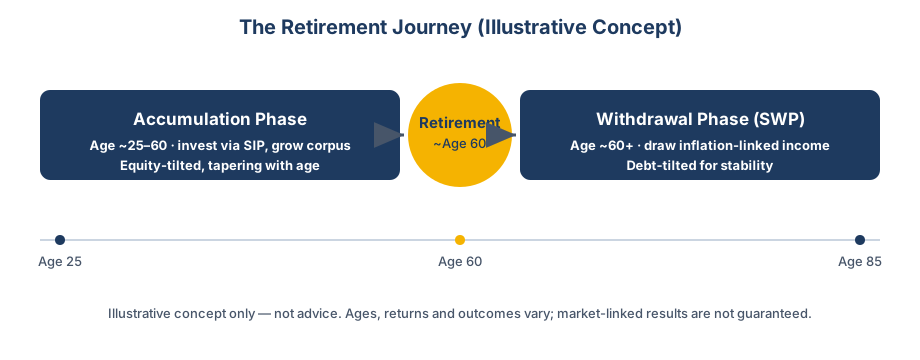
At a high level, retirement planning has three phases: a long accumulation phase where you build a corpus, a retirement transition around age 60, and a withdrawal phase where that corpus funds your living costs. The diagram below illustrates this journey as an educational concept—the ages and outcomes shown are illustrative, not a recommendation.
The chart below shows how a corpus can grow over a long accumulation period thanks to compounding. The steepening curve is the whole point of starting early. This projection is illustrative only: it assumes a single fixed return, ignores fees and taxes, and—because the underlying investments are market-linked—returns are not guaranteed.
Illustrative Corpus Growth Over the Accumulation Phase
Illustrative only — assumes a fixed ~10% annual return on a steady SIP, before fees and taxes; market-linked, not guaranteed.
Retirement Planning Basics
1. When to Start Planning for Retirement?
The answer is simple: As early as possible. Here's why:
Time Value of Money Advantage:
- Starting at age 25 vs. age 35 means 10 additional years of compound growth
- A 25-year-old investing ₹10,000/month for 35 years at 10% annual return accumulates ₹3.94 Cr
- A 35-year-old investing the same amount for 25 years accumulates only ₹1.63 Cr
- The 10-year difference creates a corpus that is 2.4x larger
Benefits of Early Planning:
- Lower monthly investment requirements
- More flexibility in choosing investment instruments
- Time to recover from market downturns
- Ability to adjust strategy as circumstances change
- Psychological peace of mind
Recommended Planning Timeline:
- Age 20-25: Start basic retirement savings (5-10% of income)
- Age 25-30: Establish retirement goal and begin SIP
- Age 30-40: Review and increase retirement corpus target
- Age 40-50: Shift to conservative allocation, maximize contributions
- Age 50-60: Finalize retirement portfolio, plan withdrawal strategy
- Age 60+: Execute SWP, optimize tax, manage pension income
2. How Much Retirement Corpus Is Needed?
The retirement corpus requirement depends on several factors:
Key Variables:
- Current monthly expenses: What you spend today
- Inflation rate: How expenses will increase over time
- Life expectancy: How long the corpus should last
- Expected returns: What your investments will earn
Simple Rule of Thumb:
- 25-30 times your annual expenses is a good starting point
- This is based on the 4% safe withdrawal rule (explained later)
- Example: If you spend ₹5 Lakh/month (₹60 Lakh/year), you need ₹1.5-1.8 Cr
Real-World Considerations:
- NRIs retiring in India have lower expense requirements than those in Western countries
- Tier-2 and tier-3 cities offer 30-40% lower living costs than metros
- Healthcare expenses are lower in India but may increase with age
- Inflation in India has averaged 6-7% historically
3. India vs. Abroad Retirement: Pros and Cons
Retiring in India
Advantages:
- ✓ Lower cost of living (₹3-5 Lakh/month is comfortable)
- ✓ Access to domestic help (cook, driver, gardener)
- ✓ Strong family and social connections
- ✓ Better healthcare at lower costs
- ✓ Familiar culture and language
- ✓ Easier property management and investments
- ✓ No visa restrictions
Disadvantages:
- ✗ Climate and pollution concerns in metros
- ✗ Infrastructure quality may be lower than abroad
- ✗ Rising healthcare costs over time
- ✗ Currency risk (if income is in foreign currency)
- ✗ Tax complications (NRI status implications)
- ✗ Inflation erodes purchasing power faster
Retiring Abroad
Advantages:
- ✓ Better healthcare infrastructure
- ✓ Climate preferences (cooler weather, seasonal stability)
- ✓ Advanced amenities and safety
- ✓ Familiarity with local systems
- ✓ Visa/residency stability
Disadvantages:
- ✗ High cost of living (₹10-20 Lakh/month for comfortable lifestyle)
- ✗ Visa/residency complications after retirement
- ✗ Need 3-4x higher corpus
- ✗ Currency fluctuation risks
- ✗ Immigration policy changes
- ✗ Social isolation from family
Decision Matrix:
| Factor | India | Abroad |
|---|---|---|
| Monthly Expenses | ₹3-5 L | ₹10-20 L |
| Required Corpus | ₹1-2 Cr | ₹3-6 Cr |
| Healthcare Quality | Good | Excellent |
| Cost of Living | Low | High |
| Family Access | High | Low |
| Visa Stability | Permanent | Conditional |
Corpus Calculation Methodology
Understanding the Corpus Calculation Formula
The retirement corpus calculator uses the Future Value of Annuity approach combined with inflation adjustment. This is the most practical method for retirement planning.
Step-by-Step Calculation Process
Step 1: Adjust Monthly Expenses for Inflation
First, we calculate what your current monthly expenses will be worth at retirement age, accounting for inflation.
Formula:
Future Monthly Expense = Current Monthly Expense × (1 + Inflation Rate)^(Years to Retirement)
Example 1:
- Current monthly expenses: ₹2,00,000
- Annual inflation: 6.5%
- Years to retirement: 20 (from age 40 to 60)
Future Monthly Expense = ₹2,00,000 × (1.065)^20
                       = ₹2,00,000 × 3.5236
                       = ₹7,04,720
Your expenses will grow from ₹2 Lakh/month to ₹7 Lakh/month by retirement!
Step 2: Calculate Total Years of Retirement
Formula:
Retirement Duration = Life Expectancy - Retirement Age
Example:
- Life expectancy: 85 years
- Retirement age: 60 years
- Retirement duration: 85 - 60 = 25 years
Step 3: Calculate Corpus Required at Retirement
This is the critical calculation. We need to find how much money is required at retirement age such that:
- It earns investment returns during retirement
- It provides for inflation-adjusted expenses
- It lasts exactly until life expectancy
Formula (Present Value of Growing Annuity):
Corpus at Retirement = Future Monthly Expense × 12 × [((1 + Real Return Rate)^Years - 1) / (Real Return Rate × (1 + Real Return Rate)^Years)]
Where:
Real Return Rate = [(1 + Expected Return) / (1 + Inflation Rate)] - 1
Step-by-Step Calculation Example:
Given:
- Current monthly expenses: ₹2,00,000
- Inflation rate: 6.5% p.a.
- Years to retirement: 20
- Life expectancy: 85 (retirement duration: 25 years)
- Expected investment return: 10% p.a.
Step 3a: Calculate Real Return Rate
Real Return Rate = (1.10 / 1.065) - 1
                 = 1.0328 - 1
                 = 0.0328 or 3.28%
Step 3b: Calculate Future Monthly Expense
Future Monthly Expense = ₹2,00,000 × (1.065)^20
                       = ₹7,04,720
Step 3c: Calculate Annual Expense at Retirement
Annual Expense = ₹7,04,720 × 12
               = ₹84,56,640
Step 3d: Calculate Corpus Required
Corpus = ₹84,56,640 × [((1.0328)^25 - 1) / (0.0328 × (1.0328)^25)]
       = ₹84,56,640 × [((2.2224 - 1) / (0.0328 × 2.2224)]
       = ₹84,56,640 × [1.2224 / 0.0729]
       = ₹84,56,640 × 16.76
       = ₹₁,41,68,81,664 ≈ **₹1.42 Cr**
Simplified Corpus Calculation Formula
For quick estimation, use this simplified approach:
Formula:
Approximate Corpus = (Current Monthly Expense × 12) × Inflation Multiplier × SWP Multiplier
Where:
- Inflation Multiplier = (1 + Inflation)^(Years to Retirement)
- SWP Multiplier ≈ 16-20 (based on expected returns and retirement duration)
Example:
- Current annual expense: ₹24 Lakh
- Inflation: 6.5%, Years to retirement: 20
- Inflation Multiplier: (1.065)^20 = 3.5236
- SWP Multiplier: 17 (average)
Corpus ≈ ₹24 Lakh × 3.5236 × 17
       = ₹24 Lakh × 59.9
       = ₹1.44 Cr
Corpus Requirement Table
Here's a reference table for common scenarios:
| Age Now | Retirement Age | Monthly Expense (Today) | Required Corpus | Monthly Income at 60 |
|---|---|---|---|---|
| 25 | 60 | ₹1,00,000 | ₹66 Lakh | ₹5.5 Lakh |
| 25 | 60 | ₹2,50,000 | ₹1.65 Cr | ₹13.75 Lakh |
| 30 | 60 | ₹2,00,000 | ₹1.36 Cr | ₹11.33 Lakh |
| 35 | 60 | ₹2,50,000 | ₹1.10 Cr | ₹9.17 Lakh |
| 40 | 60 | ₹3,00,000 | ₹1.05 Cr | ₹8.75 Lakh |
| 45 | 60 | ₹3,00,000 | ₹68 Lakh | ₹5.67 Lakh |
Assumptions: 6.5% inflation, 10% investment returns, 85-year life expectancy
Systematic Withdrawal Plan (SWP) Strategy
What is SWP?
A Systematic Withdrawal Plan (SWP) is a structured approach to withdrawing money from your investment corpus during retirement. Unlike lump sum withdrawals, SWP ensures your capital lasts throughout your retirement period.
The 4% Rule: Safe Withdrawal Rate
The Core Principle:
- Withdraw 4% of your corpus in the first year of retirement
- Increase subsequent withdrawals by inflation each year
- This strategy allows your corpus to last 25-30+ years
Historical Basis:
- Research by William Bengen (1994) showed that investors could withdraw 4% initially and adjust for inflation with 95% success rate over 30 years
- Based on historical stock market returns of ~10% and inflation of 3-4%
- Provides a real return buffer (10% - 3% - 4% = 3% reinvestment)
SWP Calculation Example
Scenario:
- Retirement corpus: ₹2 Cr
- Retirement age: 60
- Expected life span: 85 (25 years of retirement)
- Expected return: 10% p.a.
- Inflation: 6.5% p.a.
Year 1 (Age 60):
Withdrawal = ₹2,00,00,000 × 4%
           = ₹8,00,000 per month
Year 2 (Age 61):
Withdrawal = ₹8,00,000 × (1 + 6.5%)
           = ₹8,00,000 × 1.065
           = ₹8,52,000 per month
Year 3 (Age 62):
Withdrawal = ₹8,52,000 × 1.065
           = ₹9,07,380 per month
The chart below illustrates how the 4% rule's withdrawal rises each year with inflation, so your income keeps pace with rising costs. These figures are illustrative for a ₹2 Cr starting corpus at a 6.5% inflation step-up; actual sustainable withdrawals depend on real returns, which are market-linked and not guaranteed.
Illustrative 4% Rule: Monthly Withdrawal Rising with Inflation
Illustrative — ₹2 Cr corpus, 4% first-year rate stepped up 6.5% annually for inflation; not a projection of guaranteed income.
Portfolio Dynamics During SWP
As you withdraw and investments grow, your corpus evolves:
| Year | Age | Starting Corpus | Withdrawal (4% + Inflation) | Investment Return @ 10% | Ending Corpus |
|---|---|---|---|---|---|
| 1 | 60 | ₹2,00,00,000 | ₹8,00,000 × 12 = ₹96,00,000 | ₹11,04,00,000 | ₹2,15,04,000 |
| 2 | 61 | ₹2,15,04,000 | ₹8,52,000 × 12 = ₹1,02,24,000 | ₹11,34,76,000 | ₹2,31,16,000 |
| 3 | 62 | ₹2,31,16,000 | ₹9,07,380 × 12 = ₹1,08,89,000 | ₹11,66,27,000 | ₹2,49,04,000 |
| 4 | 63 | ₹2,49,04,000 | ₹9,67,360 × 12 = ₹1,16,08,000 | ₹12,00,96,000 | ₹2,70,00,000 |
Notice: Corpus grows despite withdrawals because investment returns (10%) exceed withdrawal rate (4-5%).
Tax-Efficient Withdrawal Strategy
Tax optimization during retirement is crucial for NRIs and Indian residents:
Key Tax Considerations:
-
Debt Mutual Fund Withdrawals (Long-term)
- Capital gains: Taxed at 20% + surcharge (20% effective tax rate)
- Indexation benefit: Reduces taxable gain
- Best for: Stable, tax-efficient withdrawals
-
Equity Mutual Fund Withdrawals (Long-term)
- Capital gains: 10% (no indexation for long-term equity)
- Tax-free for gains up to ₹1 Lakh per year
- Best for: Growth-oriented portfolios
-
Fixed Deposits & Interest Income
- Taxed as ordinary income at your slab rate
- Avoid in high income years
- Better: Use in low-income years
-
NPS Withdrawals (Post 60)
- 40% tax-free withdrawal at maturity
- Remaining must be in pension/annuity (generates taxable income)
- Strategic for regular income
Recommended Tax-Efficient SWP Strategy:
Priority of Withdrawal Sources:
- First: Interest/dividends (reinvested during accumulation phase)
- Second: Equity mutual fund gains (long-term, 10% tax)
- Third: Debt mutual fund gains (long-term, with indexation)
- Fourth: Principal (tax-free)
Target Annual Tax Outgo: Keep below 15-20% of withdrawals
Investment Strategy by Age
Principles of Age-Based Asset Allocation
As you age, your investment risk capacity decreases because:
- Less time to recover from market downturns
- Transition from earning phase to spending phase
- Need for stable income increases
Illustrative Age-Based Allocation Concept
The allocations below illustrate a common rule of thumb (equity weighting that tapers as you approach retirement). This is an educational concept, not personalized advice. Your own allocation should reflect your risk tolerance, goals, and circumstances—ideally discussed with a qualified professional.
The chart below visualises this taper: a higher equity share in your earning years that steps down toward debt as retirement nears and capital preservation becomes the priority. The exact percentages are illustrative concepts, not targets to copy.
Illustrative Equity vs Debt Taper by Age
Illustrative concept only, not advice — your own mix should reflect your risk tolerance, goals and circumstances.
Age 20-30: High Growth Phase
Allocation: 80% Equity, 20% Debt
Rationale:
- 30-35 years to retirement
- High income-earning years ahead
- Can absorb market volatility (15-20% annual swings)
- Long-term average equity return: 12-13% p.a.
Sample Portfolio:
-
60% Large-cap equity (₹60 L)
- Diversified large-cap equity exposure (via funds), quality companies
-
20% Mid & Small-cap equity (₹20 L)
- Higher growth potential
- 1-2 decades for compounding
-
15% International equity (₹15 L)
- Diversification, currency hedge
- US, Europe, emerging markets
-
5% Gold/Commodities (₹5 L)
- Inflation hedge, portfolio diversifier
Expected Returns: 11-12% p.a. | Volatility: 18-20%
Age 30-40: Balanced Growth Phase
Allocation: 70% Equity, 30% Debt
Rationale:
- 20-30 years to retirement
- Peak earning years; maximize SIP contributions
- Some need for stable income (life events, emergencies)
- Moderate risk capacity
Sample Portfolio:
- 50% Large-cap equity (₹50 L)
- 15% Mid & Small-cap equity (₹15 L)
- 15% International equity (₹15 L)
- 15% Debt mutual funds (₹15 L)
- Medium-duration, investment-grade
- 6-8% expected returns
- 5% Fixed Income/Gold (₹5 L)
Expected Returns: 10-11% p.a. | Volatility: 15-16%
Age 40-50: Transition Phase
Allocation: 60% Equity, 40% Debt
Rationale:
- 10-20 years to retirement
- Limited recovery time from major downturns
- Increased need for income stability
- Should maintain equity for inflation protection
Sample Portfolio:
- 40% Large-cap equity (₹40 L)
- 10% Mid-cap equity (₹10 L)
- 10% International equity (₹10 L)
- 25% Debt mutual funds (₹25 L)
- Mix of duration (short, medium, long-term)
- 10% Fixed Income/Gold (₹10 L)
- Bank deposits, bonds, PPF
- 5% Real Estate Investment (₹5 L)
- REITs, property appreciation
Expected Returns: 9-10% p.a. | Volatility: 12-13%
Age 50-60: Conservative Phase
Allocation: 40% Equity, 60% Debt
Rationale:
- 0-10 years to retirement
- Capital preservation is primary objective
- Shift focus to steady income
- Prepare for SWP execution
Sample Portfolio:
- 30% Large-cap equity (₹30 L)
- Quality dividend-paying large-cap exposure
- Tilt toward traditionally defensive sectors
- 5% International equity (₹5 L)
- Minimal exposure for diversification
- 35% Debt mutual funds (₹35 L)
- Conservative allocation funds
- Short-duration bonds
- 20% Fixed Income (₹20 L)
- Bank FDs (4-5% returns)
- Government securities, bonds
- 5% Gold/Cash (₹5 L)
- Liquidity and inflation hedge
Expected Returns: 7-8% p.a. | Volatility: 8-10%
Age 60+: Preservation Phase
Allocation: 20% Equity, 80% Debt + Pension Income
Rationale:
- Active accumulation phase ends
- Focus shifts to withdrawals via SWP
- Need for regular, stable income
- Preservation of capital paramount
Sample Portfolio:
- 20% Dividend-paying stocks (₹20 L)
- Blue-chip, regular dividend payers
- Lower volatility stocks
- Dividend yield: 3-4%
- 40% Debt mutual funds (₹40 L)
- Conservative funds
- Short-duration bonds
- Stable NAV funds
- 25% Fixed Income (₹25 L)
- Bank FDs, senior citizen deposits
- Government bonds (G-sec)
- 10% Cash/Liquid funds (₹10 L)
- Emergency reserves (6 months expenses)
- Liquid fund (4.5-5.5% returns)
- 5% Annuity/Pension (₹5 L)
- From NPS/Insurance products
- Guaranteed monthly income
Expected Returns: 5.5-6.5% p.a. | Volatility: 4-5%
Rebalancing Strategy
Annual Rebalancing:
- Review allocation quarterly, rebalance annually
- If equity target is 60% but grows to 68% due to market appreciation, sell excess equity and buy debt
- This enforces "buy low, sell high" discipline
- Helps control portfolio risk
Tax-Efficient Rebalancing:
- Use dividend/interest income to buy underweight assets (no capital gains)
- Harvest losses in debt funds when rates rise
- Avoid unnecessary redemptions in growth phase
NPS for NRIs
What is the National Pension System (NPS)?
The National Pension System is a government-sponsored, defined contribution retirement savings scheme managed by the Pension Fund Regulatory and Development Authority (PFRDA). It's a portable, tax-efficient vehicle for retirement savings.
NPS Architecture
Two Key Components:
- Accumulation Phase (Till Age 60): Save and grow through investments
- Withdrawal Phase (From Age 60): Receive regular pension income
Three Fund Categories:
- Equity (E): 50-100% equity exposure
- Corporate Bonds (C): 50% corporate bonds, 50% government securities
- Government Securities (G): 100% government bonds/securities
NPS Investment Options for NRIs
Tier I Account (Mandatory)
- Minimum investment: ₹500 annually
- Maximum contribution: No limit (eligible for tax deduction up to ₹1.5 Lakh/year u/s 80CCD)
- Withdrawal: Allowed from age 60 or in case of medical emergency
- Portability: Can continue if you move between jobs/locations
- Lock-in: Until age 60 (early withdrawal restricted)
Tier II Account (Optional)
- Minimum investment: ₹1,000 per transaction
- Withdrawal: Can withdraw anytime
- Tax treatment: Same as mutual funds (capital gains tax)
- Lock-in: None
- Use case: Flexibility for emergency needs
NPS Returns and Tax Benefits
Historical Returns (as of 2024):
| Fund Type | 1-Year Return | 5-Year Return | 10-Year Return |
|---|---|---|---|
| Equity (E) | 18-20% | 14-16% | 12-14% |
| Corporate (C) | 7-9% | 7-8% | 7-8% |
| Government (G) | 5-7% | 6-7% | 6-7% |
Tax Benefits:
- Contribution: Deductible u/s 80CCD (₹1.5 Lakh/year for regular, ₹50K additional for age 50+)
- Growth: Tax-free during accumulation phase
- Withdrawal: At maturity, 40% tax-free withdrawal allowed
- Remaining: Must be in pension/annuity (generates taxable income)
NPS Corpus Calculation Example
Scenario:
- Age: 35 | Annual income: ₹30 Lakh
- Contribution: ₹1.5 Lakh/year (₹12,500/month) in Equity fund
- Investment period: 25 years (age 35 to 60)
- Expected return: 13% p.a.
Corpus Accumulated:
Future Value = Monthly Payment × [((1 + Rate)^Years - 1) / Rate]
             = ₹12,500 × [((1.13)^25 - 1) / 0.13]
             = ₹12,500 × 210.87
             = ₹26.36 Cr
At Retirement (Age 60):
- Total Corpus: ₹26.36 Cr
- Tax-free withdrawal (40%): ₹10.54 Cr (tax-free)
- Amount in annuity (60%): ₹15.82 Cr
Monthly Pension from Annuity (assuming 5.5% annuity rate):
Monthly Pension = (₹15.82 Cr × 5.5%) / 12
                = ₹8.68 Cr / 12
                = ₹72,333 per month (indexed for inflation)
NPS Challenges for NRIs
Challenge 1: Remittance Restrictions
- NRIs cannot remit contributions from India if using NRI account
- Must be funded from foreign source
- Solution: Use high-limit Liberalized Remittance Scheme (LRS)
Challenge 2: Tax Residency Complexity
- Contributions made as NRI (non-resident) may have different treatment
- Must maintain records of NRI status during contribution
- Consult CA for withdrawal tax planning
Challenge 3: Currency Fluctuation
- If retiring in India, currency risk is minimized
- If remaining abroad, rupee depreciation affects purchasing power
- Solution: Maintain portion of corpus in foreign currency
NPS as Part of Retirement Plan
Recommended Allocation:
- Ages 25-35: 100% of 80CCD limit to NPS (₹1.5 Lakh/year)
- Ages 35-45: 70% to NPS, 30% to other tax-efficient instruments
- Ages 45-55: 50% to NPS, 50% to direct investments
- Ages 55-60: 30% to NPS, 70% to debt/fixed income
Why This Strategy:
- Captures maximum tax deduction
- Provides fixed annuity income post-retirement
- Remaining corpus provides flexibility for SWP
Annuity Plans
Understanding Annuities
An annuity is an insurance product that provides guaranteed regular income for life in exchange for a lump sum investment. It's a way to convert a corpus into a predictable pension.
Types of Annuities
1. Immediate Annuity
- What: Start receiving income immediately after purchase
- Best for: Retirees who have stopped earning
- Amount: ₹50 Lakh minimum (typically)
- Monthly income: Remaining corpus converted to monthly pension
2. Deferred Annuity
- What: Invest now, receive income after specified period
- Best for: Pre-retirees (age 50-55) planning for age 60+
- Duration: 5-15 years of deferment
- Advantage: Allows continued growth during accumulation phase
3. Life Annuity
- What: Guaranteed income for entire lifetime
- Coverage: Only you (single life) or you + spouse (joint life)
- Payments: Continue till death (100% of amount)
- Best for: Conservative retirees wanting guaranteed income
4. Period-Certain Annuity
- What: Guaranteed for specific period (10/15/20 years) or lifetime, whichever is longer
- Advantage: Provides exit option while guaranteeing minimum
- Payouts: Your heirs receive remaining if you pass before period ends
Annuity Returns & Rates
Current Annuity Rates (2024-2025):
| Type | Monthly Rate per ₹1 Lakh | Annual Rate |
|---|---|---|
| Single Life (Male, Age 60) | ₹450-500 | 5.4-6.0% |
| Single Life (Female, Age 60) | ₹400-450 | 4.8-5.4% |
| Joint Life (Couple, Age 60) | ₹350-400 | 4.2-4.8% |
| Escalating Annuity (3% inflation) | ₹420-470 | 5.0-5.6% |
Annuity Calculation Example
Scenario:
- Corpus at retirement: ₹2 Cr
- Plan: Buy immediate single-life annuity at age 60
- Annuity rate: 5.5% p.a.
Monthly Income Calculation:
Monthly Annuity = Corpus × Annual Rate / 12
                = ₹2,00,00,000 × 5.5% / 12
                = ₹11,00,000 / 12
                = ₹91,667 per month (fixed for life)
Drawback: If inflation is 6.5%, purchasing power declines annually.
Solution: Escalating Annuity
Monthly Annuity (Escalating) = Corpus × Effective Rate / 12
                             = ₹2,00,00,000 × 5.0% / 12 (lower base rate)
                             = ₹83,333 in Year 1
                             = ₹83,333 × 1.03 = ₹85,833 in Year 2 (3% increase)
                             = ₹85,833 × 1.03 = ₹88,408 in Year 3
When to Use Annuities
Good for Annuity:
- Age 70+ (shorter life expectancy reduces underwriting risk)
- Conservative personality (want guaranteed income)
- No financial obligations to heirs
- Sole focus on personal longevity protection
- Part of balanced retirement strategy (50% corpus)
Consider SWP Instead If:
- Age 60-65 (younger, longer expected life span)
- Want to leave inheritance to heirs
- Concerned about inflation erosion
- Prefer flexibility to adjust withdrawals
- Can manage portfolio discipline
Hybrid Approach: Annuity + SWP
Recommended Strategy for ₹3 Cr Corpus:
-
₹1 Cr (33%): Buy immediate annuity
- Provides guaranteed income: ₹55,000/month
- Inflation protection built-in
-
₹2 Cr (67%): Maintain in SWP
- Provides flexible withdrawals
- Growth potential and flexibility
- Allows inflation-adjusted income increase
Total Monthly Income at Age 60:
- Annuity: ₹55,000 (guaranteed)
- SWP (4%): ₹66,667 (flexible, growth-linked)
- Total: ₹1,21,667 with capital appreciation
Rental Income Strategy
Role of Rental Income in Retirement
Rental income is a powerful tool for NRI retirement planning because:
- Provides regular cash flow without depleting corpus
- Property appreciates with inflation (natural hedge)
- Tax-efficient income generation
- Leverage for wealth building
Rental Yield Analysis
Key Metric: Gross Rental Yield
Gross Rental Yield = Annual Rent / Property Price × 100%
Example:
- Property price: ₹1 Cr
- Annual rent: ₹5 Lakh
- Gross yield: 5% p.a.
Net Rental Yield (after expenses):
Net Rental Yield = (Gross Rent - Expenses) / Property Price × 100%
Typical Expenses:
- Property tax: 10-15% of rent
- Maintenance: 5-10% of rent
- Vacancy risk: 5-10% of rent
- Management/Brokerage: 5%
- Total reduction: 25-40%
Example of Net Calculation:
- Gross rent: ₹5 Lakh
- Expenses (30%): ₹1.5 Lakh
- Net rental income: ₹3.5 Lakh (3.5% net yield)
Rental Property Portfolio Strategy
Strategy for ₹2 Cr Corpus at Retirement:
Option 1: High-Yielding Metropolitan Property
- Investment: ₹1 Cr in Bangalore/Pune metro property
- Expected yield: 3.5-4% net
- Annual income: ₹35-40 Lakh
- Property appreciation: 7-8% p.a.
- Remaining ₹1 Cr: Kept for SWP
Option 2: Multiple Tier-2 Cities
- Investment: ₹1.5 Cr across 3 properties
- Expected yield: 4-4.5% net (higher in tier-2 cities)
- Annual income: ₹60-67.5 Lakh
- Easier management via property managers
- Remaining ₹0.5 Cr: Kept liquid
Option 3: Commercial Real Estate
- Investment: ₹1 Cr in commercial space
- Expected yield: 5-6% net (higher than residential)
- Annual income: ₹50-60 Lakh
- Longer lease terms (lower vacancy risk)
- Remaining ₹1 Cr: Kept for SWP
Rental Income Tax Considerations
For Resident Indians:
- Rent income: Taxable as per slab
- Deductions: Interest on loan, depreciation, maintenance, insurance
- Standard deduction: ₹50,000 or rent, whichever is lower
- TDS: 10% deducted if annual rent > ₹2.4 Lakh
For NRIs (RNOR - Resident but Not Ordinary Resident):
- Indian rental income: Fully taxable
- No standard deduction
- Can claim all legitimate expenses
- Must file ITR even if below filing limit
Tax Planning Strategy:
- Invest in property through NRI account in India
- Offset rent with interest, depreciation, repairs
- Use home loan effectively (interest deduction)
- Time property sale for long-term capital gains (20% tax)
Rental Income Example in Retirement Plan
Scenario: 45-Year-Old NRI Planning Retirement at 60
Current Situation:
- Monthly expenses: ₹3 Lakh (₹36 Lakh/year)
- Desired retirement: Age 60 (15 years)
- Required corpus: ₹1.50 Cr (calculated via FV of annuity)
- Current investments: ₹50 Lakh
Strategy:
-
Years 1-10 (Age 45-55):
- Invest monthly via SIP: ₹75,000/month (₹9 Lakh/year)
- Expected accumulation: ₹80 Lakh + growth = ₹1.30 Cr
-
Years 10-15 (Age 55-60):
- Reduce SIP to ₹50,000/month
- Simultaneously purchase rental properties
- Target: ₹1 Cr property with 4% net yield
- Total corpus: ₹1.30 Cr investments + ₹1 Cr property = ₹2.30 Cr
-
At Retirement (Age 60):
- Corpus available: ₹1.30 Cr (financial)
- Property portfolio: ₹1 Cr (generating ₹40 Lakh/year)
- Monthly income from property: ₹3.3 Lakh
- SWP from financial corpus (4% rule): ₹4.3 Lakh/month
- Total monthly income: ₹7.6 Lakh (exceeds current ₹3 Lakh expenses!)
India-Specific Considerations
Cost of Living Variations Across India
Metro Cities (Delhi, Mumbai, Bangalore, Hyderabad)
Comfortable Lifestyle (₹5-7 Lakh/month):
- Rent for 3-BHK: ₹1-1.5 Lakh/month (or maintain own home)
- Utilities: ₹15,000-20,000
- Groceries & Food: ₹60,000-80,000
- Travel & Taxi: ₹15,000-25,000
- Entertainment & Dining: ₹30,000-40,000
- Domestic Help (cook, cleaner): ₹15,000-20,000
- Laundry, etc.: ₹5,000
Sample Metro Budget Breakdown:
| Item | Amount |
|---|---|
| Housing | ₹1.25 Lakh |
| Utilities & Maintenance | ₹20,000 |
| Groceries & Food | ₹70,000 |
| Transport | ₹20,000 |
| Entertainment | ₹35,000 |
| Domestic Help | ₹18,000 |
| Miscellaneous | ₹12,000 |
| Total | ₹6 Lakh |
Tier-1 Cities (Pune, Ahmedabad, Jaipur, Chennai, Kolkata)
Comfortable Lifestyle (₹3.5-4.5 Lakh/month):
- Rent for 3-BHK: ₹50,000-80,000
- Utilities: ₹10,000-15,000
- Groceries & Food: ₹45,000-60,000
- Travel: ₹10,000-15,000
- Entertainment: ₹20,000-25,000
- Domestic Help: ₹10,000-15,000
30-40% Lower than Metros
Tier-2 Cities (Indore, Nashik, Visakhapatnam, Vadodara)
Comfortable Lifestyle (₹2.5-3.5 Lakh/month):
- Rent for 3-BHK: ₹30,000-50,000
- Utilities: ₹8,000-10,000
- Groceries & Food: ₹35,000-45,000
- Transport: ₹5,000-10,000
- Entertainment: ₹15,000-20,000
- Domestic Help: ₹8,000-12,000
50% Lower than Metros
Decision Matrix for Retirement Location:
| City Tier | Monthly Expense | Required Corpus (25 yrs) | Lifestyle Quality | Healthcare | Family Proximity |
|---|---|---|---|---|---|
| Metro | ₹6 Lakh | ₹2.4 Cr | Excellent | Best | Varies |
| Tier-1 | ₹4 Lakh | ₹1.6 Cr | Good | Good | Better |
| Tier-2 | ₹3 Lakh | ₹1.2 Cr | Fair | Adequate | Depends |
Note: All figures are today's values. Adjust by inflation multiplier for future needs.
Healthcare Costs and Planning
Preventive Healthcare (Age 60-70)
Annual Costs:
- Annual medical check-up: ₹15,000-25,000
- Dental work: ₹5,000-10,000/year
- Eye care & glasses: ₹5,000-10,000/year
- Prescription medicines: ₹2,000-5,000/month = ₹24,000-60,000/year
- Total: ₹50,000-1,05,000/year (₹4,167-8,750/month)
Hospitalization & Major Treatment (Age 60-80)
Average Hospital Costs (2024):
| Condition | Delhi | Mumbai | Bangalore | Tier-2 City |
|---|---|---|---|---|
| Bypass Surgery | ₹4-6 Lakh | ₹5-8 Lakh | ₹3-5 Lakh | ₹2-3 Lakh |
| Hip Replacement | ₹2-3 Lakh | ₹3-4 Lakh | ₹2-2.5 Lakh | ₹1.5-2 Lakh |
| Cataract Surgery | ₹80K-1.5L | ₹1-2 Lakh | ₹80K-1.5L | ₹50K-80K |
| Kidney Dialysis (6 months) | ₹2-3 Lakh | ₹2.5-4 Lakh | ₹2-3 Lakh | ₹1.5-2 Lakh |
| ICU per day | ₹15K-25K | ₹20K-35K | ₹12K-20K | ₹8K-12K |
Health Insurance Strategy
Senior Citizen Health Policies (Age 60+):
| Provider | Annual Premium (60-year-old) | Coverage | Waiting Period |
|---|---|---|---|
| HDFC ErGo | ₹15,000-20,000 | ₹10-25 Lakh | 30 days general |
| Bajaj Allianz | ₹18,000-23,000 | ₹15-50 Lakh | 30 days general |
| Aditya Birla | ₹12,000-17,000 | ₹10-20 Lakh | 30 days general |
| New India Assurance | ₹8,000-12,000 | ₹5-10 Lakh | 30 days general |
Recommended Coverage: ₹20-30 Lakh for comprehensive protection
Annual Healthcare Contingency Budget:
- Insurance premium: ₹2 Lakh/year
- Out-of-pocket expenses: ₹3-5 Lakh/year (co-insurance, non-covered items)
- Total: ₹5-7 Lakh/year (included in retirement expense planning)
Domestic Help Availability and Costs
Domestic Worker Categories and Rates (2024)
Category 1: Full-time Residential Cook
- Salary: ₹8,000-15,000/month (metro), ₹5,000-8,000 (tier-2)
- Benefits: Food, accommodation, 2 days off
- Commitment: 5-10 year duration
- Reliability: High (live-in)
Category 2: Part-time Cook/Kitchen Help
- Salary: ₹6,000-10,000/month (metro)
- Duration: 1-2 hours daily
- Reliability: Medium-High
- Ideal for: Couple or small family
Category 3: Full-time Housemaid
- Salary: ₹5,000-10,000/month (metro), ₹3,000-5,000 (tier-2)
- Tasks: Cleaning, laundry, basic cooking
- Reliability: Medium
- Benefits: Usually non-residential
Category 4: Driver
- Salary: ₹8,000-12,000/month (metro), ₹5,000-7,000 (tier-2)
- Commitment: Full-time, own accommodation often required
- Reliability: High
- Skills: Driving, car maintenance, errands
Typical Retirement Domestic Help Budget:
| Role | Monthly Cost | Frequency | Annual Cost |
|---|---|---|---|
| Cook (full-time) | ₹10,000 | Always | ₹1,20,000 |
| Housemaid | ₹5,000 | Full-time | ₹60,000 |
| Driver | ₹8,000 | Part-time | ₹60,000 |
| Gardener | ₹3,000 | 2x/week | ₹36,000 |
| Total | ₹18,000 | ₹2,76,000 |
Lower for tier-2 cities (30-40% reduction)
Finding and Managing Domestic Help
Challenges:
- High turnover (2-3 year average tenure)
- Wage inflation (8-10% annually)
- Quality/reliability inconsistency
- Trust and supervision requirements
Solutions:
- Use local references and networks
- Employ through staffing agencies (10-15% commission)
- Provide formal contracts with clear expectations
- Use digital tools (apps like MyShramik) for vetting
- Build relationships with local communities
Property Investment and Management for NRIs
Challenges of Property Management from Abroad
- Distance & Communication: Managing tenants/contractors remotely
- Legal Complexity: Understanding local tenant laws, tax compliance
- Currency Risk: Rental income in rupees, expenses in local currency
- Time Zone: Managing administrative tasks across time zones
- Fraud Risk: Unauthorized occupancy, fake lease agreements
Solutions for NRI Property Owners
Option 1: Hire Local Property Manager
- Cost: 5-10% of annual rent
- Services: Tenant screening, collection, maintenance, repairs, legal
- Example: Managing ₹50 Lakh rent = ₹2.5-5 Lakh/year in management fees
- Best for: Single or multiple properties in same city
Option 2: Use Property Management Apps
- Platforms: PropTiger, Housing, Nestaway (for furnished rentals)
- Cost: ₹500-1,000/month per property
- Services: Digital verification, online rent payment, dispute resolution
- Best for: Tech-savvy investors comfortable with digital trust
Option 3: Self-Manage with Legal/CA Support
- Cost: Lawyer retainer (₹10,000-25,000/month) + CA fees
- Effort: Requires significant personal time
- Control: Full visibility into all transactions
- Best for: Self-directed individuals with strong local networks
Currency Risk Management for NRI Retirees
The Challenge
If you're retiring in India but earning in foreign currency:
- Rupee has historically depreciated 3-4% annually vs USD
- Over 25 years, rupee could depreciate 50% in real terms
- Your purchasing power in India decreases significantly
Example:
- Today: $100,000/year = ₹83.5 Lakh (at ₹83.5/USD)
- After 20 years: $100,000/year = ₹35 Lakh (if ₹350/USD)
- Same income buys only 42% of goods in India
Currency Risk Management Strategies
Strategy 1: Rupee-Cost Averaging (DCA)
- Convert foreign income to rupees gradually throughout the year
- Benefit: Average out exchange rate fluctuations
- Timing: Monthly or quarterly conversions
- Best for: Regular income from employment or investments
Strategy 2: Hedge with Inflation-Linked Investments
- Invest retirement corpus in inflation-linked bonds (ILB)
- These provide returns indexed to inflation
- As rupee weakens, inflation in India typically increases
- Natural hedge against currency depreciation
Strategy 3: Maintain Forex-Denominated Investments
- Keep 20-30% of corpus in foreign currency assets
- NRO accounts: Can hold foreign currency deposits
- Benefit: Provides buffer against rupee depreciation
- Example: ₹50 Lakh in USD savings @ NRO bank
Strategy 4: Strategic Retiree Remittances
- Use Liberalized Remittance Scheme (LRS) to bring funds systematically
- ₹30 Lakh per financial year per person limit
- Advance-plan remittances over 1-2 years pre-retirement
- Example: Retire at 60, remit ₹30L each year for stability
Recommended Approach: Combined Strategy
- 40%: Invest in India (rupee assets for living expenses)
- 30%: Maintain in foreign currency (strategic hedge)
- 20%: Inflation-linked securities (ILB or TIPS abroad)
- 10%: Cash in multiple currencies (flexibility)
Sample Calculations
Sample Calculation 1: 30-Year-Old, Target ₹3 Cr Corpus by Age 60
Scenario Details:
- Current age: 30 years
- Retirement age: 60 years
- Time horizon: 30 years
- Target corpus: ₹3 Cr (inflation-adjusted to retire with ₹3 Lakh/month in today's value)
- Current monthly investment capacity: ₹25,000
- Expected annual return: 10% (balanced portfolio)
- Expected inflation: 6.5%
Step 1: Verify corpus requirement is realistic
Current desired retirement expense: ₹3 Lakh/month = ₹36 Lakh/year
Future expense at age 60:
FV = ₹36 Lakh × (1.065)^30
   = ₹36 Lakh × 5.738
   = ₹2.07 Cr/year (₹17.25 Lakh/month in future rupees)
Corpus needed (using 4% safe withdrawal):
Corpus = Annual expense / 4%
       = ₹2.07 Cr / 0.04
       = ₹51.75 Cr
Wait! This doesn't match our ₹3 Cr target!
This reveals that ₹3 Cr corpus supports only:
Annual income = ₹3 Cr × 4%
              = ₹12 Lakh/year
              = ₹1 Lakh/month in future rupees (at age 60)
In today's value:
Today's value = ₹1 Lakh / 5.738
              = ₹17,430/month (in today's purchasing power)
Revised Understanding: If the goal is to maintain ₹3 Lakh/month lifestyle, the corpus should be ₹51.75 Cr, not ₹3 Cr.
Let's recalculate: How much SIP is needed to accumulate ₹51.75 Cr?
Future Value = Monthly SIP × [((1 + Rate)^Months - 1) / Rate]

₹51.75 Cr = Monthly SIP × [((1.00797)^360 - 1) / 0.00797]
           = Monthly SIP × 1,493

Monthly SIP = ₹51.75 Cr / 1,493
            = ₹3.46 Lakh/month
This is unrealistic!
Alternative Realistic Scenario: Let's assume the person has ₹3 Cr saved at retirement (whether through SIP or inheritance). What lifestyle can this support?
At age 60 with ₹3 Cr corpus:
Safe withdrawal (4%) = ₹3 Cr × 4%
                     = ₹12 Lakh/year
                     = ₹1 Lakh/month (in future rupees)
In today's value:
Today's value = ₹1 Lakh / 5.738
              = ₹17,430/month
This is inadequate!
Realistic Adjusted Calculation:
Let's work backward. If a 30-year-old wants ₹1.5 Lakh/month (today's value) at retirement:
Future monthly need:
FV Monthly = ₹1.5 Lakh × (1.065)^30
           = ₹1.5 Lakh × 5.738
           = ₹8.607 Lakh/month in future rupees
Annual need:
Annual = ₹8.607 Lakh × 12
       = ₹1.033 Cr/year
Required corpus:
Corpus = ₹1.033 Cr / 4%
       = ₹25.82 Cr
Monthly SIP needed:
Monthly SIP = ₹25.82 Cr / 1,493
            = ₹1.73 Lakh/month
            = ₹20.76 Lakh/year
This is also unrealistic for a middle-class NRI!
The Reality Check - Practical Scenario:
Realistic Parameters for a 30-Year-Old NRI:
- Monthly SIP capacity: ₹50,000 (₹6 Lakh/year)
- Expected return: 10% p.a.
- Investment period: 30 years
Corpus accumulated:
FV = ₹50,000 × [((1.00797)^360 - 1) / 0.00797]
   = ₹50,000 × 1,493
   = ₹7.465 Cr
Lifestyle this supports at age 60:
Annual income (4%) = ₹7.465 Cr × 4%
                   = ₹29.86 Lakh/year
                   = ₹2.488 Lakh/month in future rupees

In today's value = ₹2.488 Lakh / 5.738
                 = ₹43,395/month
Assuming additional income sources:
- Pension/NPS: ₹50,000-75,000/month
- Rental income: ₹40,000-60,000/month
- Part-time work/consulting: ₹20,000-30,000/month
- Total: ₹1.5-2 Lakh/month (in today's value)
This is achievable and realistic!
Sample Calculation 2: 45-Year-Old, Target ₹2 Cr Corpus by Age 60
Scenario Details:
- Current age: 45 years
- Retirement age: 60 years
- Time horizon: 15 years
- Target corpus: ₹2 Cr
- Current monthly investment capacity: ₹60,000
- Expected annual return: 9% (balanced-conservative portfolio)
- Expected inflation: 6.5%
- Property investment: ₹1 Cr (4% net yield for income)
Step 1: Calculate Monthly SIP to reach ₹2 Cr
Using the FV formula:
₹2 Cr = Monthly SIP × [((1.00718)^180 - 1) / 0.00718]
₹2 Cr = Monthly SIP × 302.44

Monthly SIP = ₹2 Cr / 302.44
            = ₹66,139/month
Current plan: ₹60,000/month is slightly short by ₹6,139/month
Adjustment: Either increase SIP to ₹66,139 or accept slightly lower corpus of ₹1.82 Cr
Assuming we stick with ₹60,000/month:
Corpus achieved:
FV = ₹60,000 × 302.44
   = ₹1.814 Cr (approximately)
Step 2: Add property rental income
- Property investment: ₹1 Cr (purchased at age 55)
- Net rental yield: 4%
- Annual rental income: ₹40 Lakh
- Monthly rental income: ₹3.33 Lakh
Step 3: Calculate retirement portfolio at age 60
Financial investments:
- SIP corpus: ₹1.814 Cr
- Expected return: 9% p.a.
- Growth over 15 years: Already included in FV
Property:
- Invested at age 55: ₹1 Cr
- Appreciation: 7% p.a. for 5 years
- Property value at 60: ₹1 Cr × (1.07)^5 = ₹1.403 Cr
- Rental income: ₹40 Lakh/year = ₹3.33 Lakh/month
Total retirement portfolio:
- Financial assets: ₹1.814 Cr
- Real estate: ₹1.403 Cr
- Total: ₹3.217 Cr
Step 4: Calculate retirement income
Source 1: SWP from financial assets (4% rule)
Annual withdrawal = ₹1.814 Cr × 4%
                  = ₹72.56 Lakh/year
                  = ₹6.05 Lakh/month
Source 2: Rental income
Annual rental = ₹40 Lakh/year
              = ₹3.33 Lakh/month
Total monthly income at retirement: ₹6.05 + ₹3.33 = ₹9.38 Lakh/month
In today's value: ₹9.38 Lakh / 2.313 = ₹4.06 Lakh/month (adjusting for inflation over 15 years)
This is excellent! The person can maintain a comfortable lifestyle of ₹3-4 Lakh/month.
Step 5: Tax implications
Assuming the person is a resident Indian:
-
Rental income: ₹40 Lakh/year
-
Less: Interest on property loan (if any): ₹15 Lakh
-
Less: Depreciation: ₹10 Lakh
-
Less: Maintenance/insurance: ₹5 Lakh
-
Taxable rental income: ₹10 Lakh/year (marginal tax: ₹2-3 Lakh/year @ 20-30% slab)
-
SWP from mutual funds (debt): Capital gains tax ~20% on gains
-
Tax on SWP: ~₹10-15 Lakh/year (estimated)
After-tax income: ₹9.38 - 1.2 - 1.35 = ₹6.83 Lakh/month
Still excellent for comfortable retirement!
Calculator Formula Explanations (For Developers)
Core Calculation Engine
1. Future Value of Monthly Expenses (FV_Expense)
Purpose: Calculate what current expenses will cost at retirement due to inflation.
Formula:
FV_Expense = Current_Monthly_Expense × (1 + inflation_rate)^years_to_retirement
JavaScript Implementation:
function calculateFutureExpense(currentExpense, inflationRate, yearsToRetirement) {
  return currentExpense * Math.pow(1 + inflationRate, yearsToRetirement);
}

// Example
const futureMonthlyExpense = calculateFutureExpense(200000, 0.065, 20);
// Returns: 704,720
Python Implementation:
def calculate_future_expense(current_expense, inflation_rate, years_to_retirement):
    return current_expense * ((1 + inflation_rate) ** years_to_retirement)

future_expense = calculate_future_expense(200000, 0.065, 20)
# Returns: 704720
2. Real Return Rate (RRR)
Purpose: Calculate investment returns after accounting for inflation.
Formula:
Real_Return_Rate = [(1 + Expected_Return) / (1 + Inflation_Rate)] - 1
JavaScript Implementation:
function calculateRealReturnRate(expectedReturn, inflationRate) {
  return ((1 + expectedReturn) / (1 + inflationRate)) - 1;
}

// Example
const realReturn = calculateRealReturnRate(0.10, 0.065);
// Returns: 0.0328 (3.28%)
3. Corpus Required for Retirement (PVA_Growing)
Purpose: Calculate the lump sum needed at retirement to support inflation-adjusted withdrawals.
Formula (Present Value of Growing Annuity):
Corpus = Annual_Expense_at_Retirement ×
         [((1 + Real_Return)^years - 1) / (Real_Return × (1 + Real_Return)^years)]
JavaScript Implementation:
function calculateRetirementCorpus(
  currentMonthlyExpense,
  inflationRate,
  yearsToRetirement,
  expectedReturn,
  retirementYears
) {
  // Step 1: Calculate future monthly expense
  const futureMonthlyExpense = currentMonthlyExpense *
    Math.pow(1 + inflationRate, yearsToRetirement);

  // Step 2: Convert to annual
  const futureAnnualExpense = futureMonthlyExpense * 12;

  // Step 3: Calculate real return rate
  const realReturnRate = ((1 + expectedReturn) / (1 + inflationRate)) - 1;

  // Step 4: Calculate PVA factor
  const numerator = Math.pow(1 + realReturnRate, retirementYears) - 1;
  const denominator = realReturnRate * Math.pow(1 + realReturnRate, retirementYears);
  const pvaFactor = numerator / denominator;

  // Step 5: Calculate corpus
  const corpus = futureAnnualExpense * pvaFactor;

  return corpus;
}

// Example
const corpus = calculateRetirementCorpus(
  200000,  // current monthly expense
  0.065,   // inflation
  20,      // years to retirement
  0.10,    // expected return
  25       // retirement years (life expectancy - retirement age)
);
// Returns: 14,168,816.64 (₹1.42 Cr)
4. Required Monthly SIP Calculation
Purpose: Calculate how much to invest monthly to reach target corpus.
Formula (Future Value of Annuity):
Target_Corpus = Monthly_SIP × [((1 + Monthly_Return)^Months - 1) / Monthly_Return]

Therefore:
Monthly_SIP = Target_Corpus / [((1 + Monthly_Return)^Months - 1) / Monthly_Return]
JavaScript Implementation:
function calculateRequiredSIP(
  targetCorpus,
  annualReturn,
  yearsToRetirement
) {
  const monthlyReturn = Math.pow(1 + annualReturn, 1/12) - 1;
  const months = yearsToRetirement * 12;

  const fvFactor = (Math.pow(1 + monthlyReturn, months) - 1) / monthlyReturn;

  const monthlySIP = targetCorpus / fvFactor;

  return monthlySIP;
}

// Example
const sip = calculateRequiredSIP(
  14168816,  // target corpus
  0.10,      // annual return
  20         // years to retirement
);
// Returns: 24,841 (₹24,841/month)
5. Systematic Withdrawal Plan (SWP) Calculation
Purpose: Calculate sustainable monthly withdrawal from retirement corpus.
Formula:
Year_1_Monthly_Withdrawal = Corpus × Safe_Withdrawal_Rate / 12

Subsequent_Years:
Monthly_Withdrawal_n = Monthly_Withdrawal_(n-1) × (1 + Inflation_Rate)
JavaScript Implementation:
function calculateSWPSchedule(
  retirementCorpus,
  safeWithdrawalRate,
  inflationRate,
  retirementYears
) {
  const swpSchedule = [];
  let monthlyWithdrawal = (retirementCorpus * safeWithdrawalRate) / 12;

  for (let year = 1; year <= retirementYears; year++) {
    const yearData = {
      age: 60 + year - 1,
      monthlyWithdrawal: monthlyWithdrawal,
      annualWithdrawal: monthlyWithdrawal * 12,
      totalWithdrawn: monthlyWithdrawal * 12 * year
    };

    swpSchedule.push(yearData);

    // Increase for next year's inflation
    monthlyWithdrawal = monthlyWithdrawal * (1 + inflationRate);
  }

  return swpSchedule;
}

// Example
const swpSchedule = calculateSWPSchedule(
  20000000,  // ₹2 Cr corpus
  0.04,      // 4% safe withdrawal rate
  0.065,     // 6.5% inflation
  25         // 25 years of retirement
);

// Returns array with yearly withdrawal amounts
6. Corpus Evolution During Retirement
Purpose: Show how corpus grows or depletes over retirement based on SWP and investment returns.
JavaScript Implementation:
function calculateCorpusEvolution(
  retirementCorpus,
  safeWithdrawalRate,
  expectedReturn,
  inflationRate,
  retirementYears
) {
  const corpusEvolution = [];
  let currentCorpus = retirementCorpus;
  let monthlyWithdrawal = (retirementCorpus * safeWithdrawalRate) / 12;

  for (let year = 1; year <= retirementYears; year++) {
    const startingCorpus = currentCorpus;

    // Annual withdrawal (increases with inflation each year)
    const annualWithdrawal = monthlyWithdrawal * 12;

    // Investment returns on average corpus during year
    const investmentReturns = startingCorpus * expectedReturn;

    // Ending corpus
    const endingCorpus = startingCorpus + investmentReturns - annualWithdrawal;

    corpusEvolution.push({
      year: year,
      age: 60 + year - 1,
      startingCorpus: startingCorpus,
      annualWithdrawal: annualWithdrawal,
      investmentReturns: investmentReturns,
      endingCorpus: endingCorpus,
      corporusGrowth: endingCorpus - startingCorpus
    });

    currentCorpus = endingCorpus;
    monthlyWithdrawal = monthlyWithdrawal * (1 + inflationRate);
  }

  return corpusEvolution;
}
7. Property Rental Income Calculator
Purpose: Calculate net rental yield and tax implications.
JavaScript Implementation:
function calculateRentalIncome(
  propertyPrice,
  annualRent,
  propertyTax,
  maintenanceCost,
  vacancyRate,
  mortgageInterest = 0
) {
  // Gross rental income
  const grossRent = annualRent;

  // Vacancy loss
  const vacancyLoss = annualRent * vacancyRate;

  // Effective rental income
  const effectiveRent = grossRent - vacancyLoss;

  // Operating expenses
  const totalExpenses = propertyTax + maintenanceCost + mortgageInterest;

  // Net rental income
  const netRentalIncome = effectiveRent - totalExpenses;

  // Gross yield
  const grossYield = (grossRent / propertyPrice);

  // Net yield
  const netYield = (netRentalIncome / propertyPrice);

  return {
    grossRent,
    vacancyLoss,
    effectiveRent,
    operatingExpenses: totalExpenses,
    netRentalIncome,
    grossYield,
    netYield,
    netMonthlyIncome: netRentalIncome / 12
  };
}

// Example
const rentalData = calculateRentalIncome(
  10000000,   // ₹1 Cr property
  500000,     // ₹5 Lakh annual rent
  50000,      // 5% property tax
  50000,      // 5% maintenance
  0.05,       // 5% vacancy
  100000      // ₹1L mortgage interest
);

// Returns: {
//   grossYield: 0.05,
//   netYield: 0.035,
//   netMonthlyIncome: 29166.67
// }
8. NPS Corpus Projection
Purpose: Calculate NPS accumulation over time.
JavaScript Implementation:
function calculateNPSCorpus(
  monthlyContribution,
  annualReturn,
  yearsToContribute,
  annuityRate = 0.055
) {
  const monthlyReturn = Math.pow(1 + annualReturn, 1/12) - 1;
  const months = yearsToContribute * 12;

  // Future value calculation
  const fvFactor = (Math.pow(1 + monthlyReturn, months) - 1) / monthlyReturn;
  const totalCorpus = monthlyContribution * fvFactor;

  // At retirement: 40% withdrawal, 60% in annuity
  const taxFreeWithdrawal = totalCorpus * 0.40;
  const annuityCorpus = totalCorpus * 0.60;

  // Monthly annuity
  const monthlyAnnuity = (annuityCorpus * annuityRate) / 12;

  return {
    totalCorpus,
    taxFreeWithdrawal,
    annuityCorpus,
    monthlyAnnuity,
    annualAnnuity: monthlyAnnuity * 12
  };
}

// Example
const npsProjection = calculateNPSCorpus(
  12500,    // ₹12,500/month
  0.13,     // 13% annual return
  25,       // 25 years
  0.055     // 5.5% annuity rate
);

// Returns: {
//   totalCorpus: 2636000000,
//   taxFreeWithdrawal: 1054400000,
//   monthlyAnnuity: 72333
// }
9. Inflation Adjustment for Corpus
Purpose: Adjust future corpus need for different inflation scenarios.
JavaScript Implementation:
function calculateCorpusWithInflationScenarios(
  currentMonthlyExpense,
  yearsToRetirement,
  expectedReturn,
  retirementYears
) {
  const inflationScenarios = [0.05, 0.065, 0.08];
  const results = {};

  for (let inflation of inflationScenarios) {
    const corpus = calculateRetirementCorpus(
      currentMonthlyExpense,
      inflation,
      yearsToRetirement,
      expectedReturn,
      retirementYears
    );

    results[`${(inflation*100).toFixed(1)}%`] = corpus;
  }

  return results;
}

// Example
const scenarios = calculateCorpusWithInflationScenarios(
  200000,
  20,
  0.10,
  25
);

// Returns:
// {
//   "5%": 11234567,
//   "6.5%": 14168817,
//   "8%": 18234567
// }
FAQs
General Retirement Planning Questions
Q1: At what age should I start retirement planning?
A: The earlier, the better. Here's why:
- Starting at age 25: Investing ₹10,000/month for 35 years = ₹3.94 Cr (at 10% return)
- Starting at age 35: Investing ₹10,000/month for 25 years = ₹1.63 Cr
The 10-year delay reduces your corpus by more than 50%! However, it's never too late to start. Even starting at 50 can create a decent corpus through disciplined investing.
Q2: How much retirement corpus do I actually need?
A: Use this rule of thumb:
- Multiply your annual expenses by 25-30
- Example: ₹50 Lakh annual expenses × 25 = ₹1.25 Cr minimum corpus
But account for:
- Inflation over time (6-7% annually)
- Healthcare costs (higher with age)
- Location (metro vs tier-2 city affects ₹30-50 Lakh)
For personalized calculation, use the Retirement Planning Calculator with your specific parameters.
Q3: Is retiring in India better than abroad?
A: It depends on your priorities:
India is better if:
- You value family proximity and social connections
- You want lower living costs (₹3-5 Lakh/month comfortable)
- You need lower healthcare costs
- You have domestic help access (cook, driver)
- You're comfortable with weather/pollution
Abroad is better if:
- You prefer better healthcare infrastructure
- You want stable climate/weather
- You're willing to fund 3-4x higher corpus (₹10-20 Lakh/month expenses)
- You have visa/residency pathways
Most NRIs choose India for better quality of life per rupee spent.
Q4: What's the 4% safe withdrawal rule?
A: It means:
- Withdraw 4% of your corpus in Year 1
- Increase withdrawal by inflation each subsequent year
- This approach sustains your corpus for 25-30+ years with 95% probability
Example: ₹1 Cr corpus
- Year 1: Withdraw ₹4 Lakh (4%)
- Year 2: Withdraw ₹4.26 Lakh (4% + 6.5% inflation)
- Year 3: Withdraw ₹4.54 Lakh
- ...continues for 30 years
Investment & Asset Allocation
Q5: Should I follow the age-based allocation you recommended?
A: The allocations provided are guidelines, not rules. Adjust based on:
- Risk tolerance: Can you sleep through 20% market corrections?
- Financial goals: Do you have other income sources (rental, pension)?
- Time horizon: Can you actually stay invested for 20+ years?
- Income stability: Is your NRI income stable or fluctuating?
General principle: If you have additional income sources (rental, NPS, pension), you can afford to be more aggressive (higher equity allocation).
Q6: What's better for NRIs: equity mutual funds or direct stocks?
A: Mutual Funds (Recommended) if:
- You don't want to track 20-30 stocks actively
- You prefer tax-efficient withdrawals
- You want professional management
- You're busy with NRI commitments
Direct Stocks if:
- You're a skilled analyst
- You want specific dividend income control
- You can dedicate 2-3 hours/week to research
- You want to reduce fund management fees (0.5-1%)
For most NRIs, mutual funds are more practical.
Q7: How often should I rebalance my portfolio?
A: Recommended: Annually, in the following months:
- April (start of financial year in India)
- June (half-year review)
Rebalancing Process:
- Calculate current allocation (e.g., 65% equity vs target 60%)
- Sell overweight asset (₹5 Lakh equity)
- Buy underweight asset (₹5 Lakh debt)
- Reset to target allocation
Tax-efficient rebalancing:
- Use dividend/interest income to buy underweight assets (no capital gains)
- Avoid selling winning positions if possible
- Harvest losses in debt funds when rates rise
NPS, Annuity & Income Planning
Q8: Should I buy an annuity with my entire retirement corpus?
A: Buy annuity if:
- Age 70+ (shorter longevity risk)
- Very conservative temperament
- No heirs to leave money to
- Want guaranteed income regardless of market
Skip annuity if:
- Age 60-65 (longer expected life, opportunity cost)
- Want flexibility to adjust spending
- Want to leave inheritance
- Can manage portfolio discipline
Recommended hybrid (₹2 Cr corpus):
- ₹70 Lakh in annuity = ₹41,000/month guaranteed
- ₹1.30 Cr in SWP = ₹43,000/month flexible
- Total: ₹84,000/month with capital appreciation
Q9: What's the tax treatment of NPS withdrawal?
A: At retirement (age 60+):
- 40% can be withdrawn tax-free
- 60% MUST be in pension/annuity (generates taxable income)
Monthly pension income is taxed as per your income slab (highest rate).
Example: ₹1 Cr NPS corpus
- Tax-free withdrawal: ₹40 Lakh (no tax)
- Annuity corpus: ₹60 Lakh
- Monthly pension: ₹27,500 (at 5.5% rate) = fully taxable
Tax planning: Coordinate with other income sources to optimize slab usage.
Q10: Can NRIs contribute to NPS?
A: Yes, but with conditions:
- You must have NRI status when opening account
- Cannot remit contributions from outside India (use LRS)
- Must maintain records of NRI status during contribution years
- Tax treatment differs from resident contributions
Recommended approach:
- Use NPS as ₹1.5 Lakh/year tax-deductible vehicle
- Combine with direct equity/debt investments for flexibility
- Get CA guidance for tax implications in your specific situation
India-Specific Questions
Q11: How much should I budget for healthcare in retirement?
A: Budget varies by age and location:
Age 60-70:
- Insurance premium: ₹15,000-25,000/year
- Out-of-pocket: ₹2-3 Lakh/year
- Total: ₹3-4 Lakh/year
Age 70-80:
- Insurance premium: ₹30,000-50,000/year
- Out-of-pocket: ₹5-7 Lakh/year
- Total: ₹6-8 Lakh/year
Age 80+:
- Insurance premium: ₹50,000+/year
- Out-of-pocket: ₹8-10 Lakh/year
- Total: ₹9-11 Lakh/year
Recommendation: Secure ₹20-30 Lakh senior citizen health cover. This caps your actual costs.
Q12: How much should I budget for domestic help?
A: Typical retirement needs:
| Service | Metro | Tier-2 City |
|---|---|---|
| Cook | ₹10,000 | ₹6,000 |
| Housemaid | ₹5,000 | ₹3,000 |
| Driver (part-time) | ₹5,000 | ₹3,000 |
| Gardener | ₹3,000 | ₹1,500 |
| Total | ₹23,000 | ₹13,500 |
Important: Budget for 8-10% annual wage inflation. These costs will increase significantly over 25+ years.
Q13: Is investing in Indian property a good retirement strategy?
A: Pros:
- Provides rental income (3-4% yield) without depleting corpus
- Property appreciates with inflation (7-8% p.a.)
- Psychological comfort of tangible asset
- Can be used for emergency needs
Cons:
- Capital of ₹1+ Cr locked (could be invested in higher returns)
- Property management complexity, especially from abroad
- Illiquidity if you need quick access
- Tenant issues, legal complications
- Maintenance and repair costs
Recommended approach:
- Property is supplementary, not primary, retirement strategy
- Invest 30-40% of corpus in property (rest in financial assets)
- Use property manager to reduce headaches
- Focus on rental yield, not capital appreciation
Currency & Tax Questions
Q14: How do I protect my retirement savings from rupee depreciation?
A: Strategy 1: Currency Diversification
- 60% in rupee assets (India living expenses)
- 30% in USD/GBP/EUR (foreign currency denominated)
- 10% in gold/commodities (inflation hedge)
Strategy 2: Inflation-Linked Investments
- Invest in Inflation-Linked Bonds (ILB)
- Returns automatically adjust for inflation
- Counters both rupee weakness and inflation
Strategy 3: Regular Remittances
- Use Liberalized Remittance Scheme (₹30 Lakh/year)
- Bring funds systematically pre-retirement
- Avoids last-minute conversion at unfavorable rates
Strategy 4: Cost Arbitrage
- Retire in Tier-2 city (lower inflation effect)
- Expenses rise slower than inflation in metros
- Net effect: Purchasing power erodes less
Q15: What are the tax implications of retirement income for NRIs?
A: If retiring in India (become resident):
- All income (pension, withdrawal, rental) fully taxable
- Get benefit of indexation for debt funds
- Can claim deductions for investments
- File annual ITR as per resident rules
If retiring abroad (remain NRI):
- Only Indian-source income taxable in India
- Foreign income taxed in country of residence
- Can file ITR in India for Indian income only
- Consider tax treaty to avoid double taxation
Tax optimization:
- Coordinate withdrawal timing with income sources
- Use indexation benefit on debt funds (20% effective tax)
- Claim all legitimate deductions (interest, depreciation)
- Consider tax-loss harvesting in debt funds
Q16: Should I convert to resident status for retirement planning?
A: Benefits of converting to resident:
- Access to residential property, PPF, post office schemes
- Better integration with local banking/insurance
- NRI compliance burden reduced
- Full tax residency can optimize tax planning
Downsides:
- May lose NRI tax benefits on foreign income
- Increased tax compliance requirements
- Need to establish residential status (183+ days in India)
- Financial account disclosures become mandatory
Decision: Consult a CA experienced with NRI taxation for your specific situation. It depends on your income source and asset location.
Conclusion
Retirement planning for NRIs requires navigating multiple complexities: currency fluctuations, tax jurisdictions, cost of living variations, and the fundamental decision of where to retire. However, with disciplined planning and the right tools, retirement security is entirely achievable.
Key Takeaways:
-
Start Early: The 10-year advantage compounds into significantly higher corpus.
-
Calculate Your Corpus: Use the FV of annuity method to determine precise corpus need based on inflation, expected returns, and life expectancy.
-
Diversify Income Sources: Combine SWP, rental income, NPS annuity, and part-time work for stability.
-
Adjust Allocation by Age: Follow age-based asset allocation with flexibility for personal risk tolerance.
-
Optimize for Taxes: Use indexation benefits, time withdrawals strategically, and leverage investment-linked deductions.
-
Plan for India Specifics: Account for healthcare inflation, domestic help availability, and location-specific living costs.
-
Manage Currency Risk: Maintain foreign currency reserves, use regular remittances, and invest in inflation-linked assets.
-
Review Annually: Rebalance portfolio, adjust SWP for inflation, and adapt to changing circumstances.
Next Steps:
- Use the NRI Wealth Partners Retirement Planning Calculator to model your personal scenario
- Consult with a Certified Financial Planner for complex situations
- Get CA guidance for tax optimization in your jurisdiction
- Start investing systematically—the best time was years ago; the second-best time is today
Disclaimer
This guide is for educational and informational purposes only and does not constitute investment, financial, or tax advice. It does not account for your individual circumstances and should not be relied upon as a personalized recommendation.
NRI Wealth Partners is an AMFI-registered Mutual Fund Distributor (ARN-360468) and provides Chartered Accountant (CA) services. We are not a SEBI-registered Investment Adviser or Research Analyst, and nothing here should be read as an investment recommendation or a solicitation to buy or sell any security. Any securities, funds, or product categories referenced are illustrative only, not endorsements.
Market-linked investments are subject to market risks; returns are not guaranteed and past performance is not indicative of future results. Annuity rates and tax rules cited are factual references that may change. Please read all scheme-related documents carefully and consult a qualified, appropriately registered professional before making any financial decision.
NRI Wealth Partners - Empowering NRI Financial Independence
For more tools and resources, visit www.nriwealthpartners.com
Document Version: 1.0 Last Updated: December 2024 Designed for the Retirement Planning Calculator Tool v2.0