NRI Tax Calculator Implementation Guide
Version: 1.0 Created by: NRI Wealth Partners Edition: FY 2026-27 (Tax Year 2026-27) Last Updated: June 2026 Audience: Developers, Financial Advisors, NRIs
Note (Income Tax Act 2025): Effective 1 April 2026, the Income Tax Act 2025 replaces the Income-tax Act 1961. The "Previous Year"/"Assessment Year" concepts are retired in favour of a single "Tax Year" (1 April – 31 March), e.g. Tax Year 2026-27. Several sections are renumbered (e.g. 80C → 123, 80D → 126, 87A rebate → 157) and Form 16 is replaced by Form 130. Monetary figures for Tax Year 2026-27 are unchanged vs FY 2025-26. This guide is educational only; confirm current figures with a qualified CA.
Table of Contents
- Introduction & Purpose
- System Architecture Overview
- Input Fields Specification
- Tax Calculation Logic
- Income Classification & Taxability
- TDS (Tax Deducted at Source) Calculation
- DTAA Benefits & Foreign Tax Credits
- Sample Scenarios & Case Studies
- Tax-Saving Strategies
- ITR Forms & Filing Recommendations
- Mathematical Formulas for Developers
- Implementation Checklist
- FAQs
- Appendices
1. Introduction & Purpose
1.1 What is the NRI Tax Calculator?
The NRI Tax Calculator is an interactive web-based tool designed specifically for Non-Resident Indians (NRIs) to calculate their tax liability in India accurately and efficiently. This calculator bridges the gap between complex Indian tax laws and practical tax planning for NRIs across the globe.
1.2 Key Objectives
- Accurate Tax Computation: Calculate precise tax liability based on residential status and income sources
- Regime Comparison: Automatically compare Old Regime vs. New Regime tax liability
- DTAA Benefits: Calculate applicable Double Taxation Avoidance Agreement (DTAA) benefits
- TDS Optimization: Show TDS deduction recommendations for each income type
- Financial Planning: Enable NRIs to make informed tax planning decisions
- Compliance Assistance: Recommend appropriate ITR forms for filing
1.3 Who Should Use This Calculator?
- NRIs with Indian-sourced income
- PIOs (Persons of Indian Origin) with taxable income in India
- Financial Advisors assisting NRI clients
- Compliance Officers managing NRI taxation
- Tax Consultants preparing tax computation
1.4 Important Disclaimer
This calculator is for educational and planning purposes only. NRI Wealth Partners operates as an AMFI-registered Mutual Fund Distributor (ARN-360468) and provides Chartered Accountant (CA) tax/compliance services; it is not a SEBI-registered investment adviser or research analyst, and nothing here is investment advice or a recommendation. This tool is not a substitute for professional tax advice. Users must consult with qualified Chartered Accountants (CAs) or tax advisors before filing actual tax returns.
2. System Architecture Overview
2.1 Calculator Flow Diagram
User Input Collection
        ↓
Residential Status Validation
        ↓
Income Classification & Addition
        ↓
Deduction Calculation (80C, 80D, etc.)
        ↓
Old Regime Tax Computation
        ↓
New Regime Tax Computation
        ↓
TDS Calculation for Each Income
        ↓
DTAA Benefit Analysis
        ↓
Regime Comparison & Recommendation
        ↓
Tax-Saving Tips Generation
        ↓
Report Generation & Download
2.2 Module Dependencies
- Input Validation Module - Validate all user inputs
- Income Classification Module - Categorize income sources
- Deduction Processing Module - Calculate eligible deductions
- Tax Slab Module - Apply current financial year tax slabs
- TDS Module - Calculate TDS on various income types
- DTAA Module - Apply country-specific DTAA benefits
- Comparison Engine - Compare regimes and suggest best option
- Reporting Module - Generate downloadable reports
3. Input Fields Specification
3.1 User Information Section
| Field | Type | Mandatory | Validation | Notes |
|---|---|---|---|---|
| Full Name | Text | Yes | Non-empty | For report generation |
| PAN | Text | Yes | Format: AAAAA9999A | Indian tax identifier |
| Tax Year | Dropdown | Yes | Current/Previous Tax Year | Format: 2026-27 |
| No | Valid email | For report delivery |
3.2 Residential Status Section
Residential Status (Radio Button - Select One):
├── Resident (R)
│   └── Taxed on global income
│   └── Standard rates apply
│
├── Non-Resident (NR)
│   └── Taxed only on Indian-sourced income
│   └── Special rates apply
│
└── RNOR (Resident But Not Ordinarily Resident)
    └── Taxed on Indian + Foreign income received in India
    └── Transitional status (max 2 years)
Definition Criteria:
- Resident: Stayed in India ≥183 days in FY or ≥365 days in past 4 FYs
- Non-Resident: Did not meet residency criteria
- RNOR: Resident per 182-day test but not ordinarily resident per 9-year test
3.3 India-Sourced Income Section
3.3.1 Salary Income
Salary Income
├── Basic Salary (₹)
├── Dearness Allowance - DA (₹)
├── House Rent Allowance - HRA (₹)
├── Special Allowance (₹)
├── Other Allowances (₹)
├── Bonus (₹)
├── Gratuity (₹) [Taxable amount]
├── Leave Encashment (₹) [Taxable amount]
└── Employer's Contribution to Provident Fund (₹)
Notes:
- HRA exemption: Lesser of (1) HRA received, (2) 50% basic (metro) or 40% (non-metro), (3) Basic + DA - ₹10,000
- Gratuity exemption: ₹50 lakhs or 15 months salary (whichever is lower)
- Leave encashment: ₹5 lakhs exemption for government employees
3.3.2 Rental Income
House Property Income
├── Gross Annual Rent (₹)
├── Municipal Taxes Paid (₹)
├── Interest on Housing Loan (₹)
├── Repairs and Maintenance (₹)
├── Insurance Premium (₹)
├── Property Tax (₹)
├── Other Eligible Deductions (₹)
└── Number of Properties (dropdown: 1, 2, 3+)
Notes:
- Standard deduction: 30% of rent if property self-occupied (Loss up to ₹2 lakhs can be carried forward)
- Interest on loan: Unlimited deduction for first property, ₹30,000 for second
- For NRI property: Can claim 30% deduction and loan interest
3.3.3 Interest Income (Banks, FDs, Savings Account)
Interest Income
├── Interest from NRO Account (₹)
├── Interest from NRE Account (₹) [Generally not taxable in India]
├── Fixed Deposit Interest - Banks (₹)
├── Savings Account Interest (₹)
├── Post Office Interest (₹)
├── Interest from Other Sources (₹)
└── TDS Paid on Interest (₹) [Auto-populate from TDS schedule]
Notes:
- NRO interest: Taxable at applicable slab rates
- NRE interest: Exempt from tax in India (but may be taxed in home country)
- TDS on NRO interest: 30% (plus applicable surcharge and 4% cess) under Section 195 for NRs (no threshold)
3.3.4 Dividend Income
Dividend Income
├── Equity Share Dividend (₹)
├── Mutual Fund Dividend (₹)
├── Insurance Policy Dividend (₹)
├── Corporate Dividend (₹)
└── Dividend Tax Credit Available (Yes/No)
Notes:
- Dividend income from domestic companies: Taxable (surcharge may apply for NRs)
- Dividend received after Oct 1, 2020: Part of regular income
- Higher surcharge for NRs: 20% (vs 15% for residents)
3.3.5 Capital Gains
Capital Gains
├── Long-Term Capital Gains (LTCG)
│   ├── Sale Price (₹)
│   ├── Cost of Acquisition (₹)
│   ├── Holding Period (Years)
│   ├── Indexation Benefit Available (Yes/No)
│   └── LTCG Amount (Auto-calculated)
│
└── Short-Term Capital Gains (STCG)
    ├── Sale Price (₹)
    ├── Cost of Acquisition (₹)
    ├── Holding Period (Months)
    └── STCG Amount (Auto-calculated)
Notes:
- LTCG (other assets / property, 24+ months): 12.5% without indexation
- STCG (non-equity, <24 months): Added to income, taxed at applicable slab
- Equity/equity-MF LTCG (§112A, >1 year): 12.5% (exempt up to ₹1,25,000 per Tax Year)
- Equity/equity-MF STCG (§111A, <1 year): 20%
- Property: 24-month holding period for LTCG classification
3.3.6 Business Income (Self-Employment)
Business Income (Optional)
├── Gross Business Receipts (₹)
├── Cost of Goods Sold (₹)
├── Salaries & Wages (₹)
├── Rent (₹)
├── Repairs & Maintenance (₹)
├── Utilities (₹)
├── Professional Fees (₹)
├── Travel & Conveyance (₹)
├── Depreciation (₹)
└── Other Operating Expenses (₹)
3.4 Deduction Section (Old Regime Only)
3.4.1 Section 80C Deductions (₹1.5 Lakhs Max)
Under the Income Tax Act 2025, Section 80C is renumbered Section 123 (old regime only); Section 80D becomes Section 126 and the 87A rebate becomes Section 157.
Section 80C Deductions
├── Life Insurance Premium (₹)
├── PPF Contribution (₹)
├── NSC Investment (₹)
├── ELSS Investment (₹)
├── Sukanya Samriddhi Scheme (₹)
├── Post Office Schemes (₹)
├── Children's Tuition Fees (₹)
└── Lock-in Securities (₹)
3.4.2 Section 80D Deductions (Health Insurance)
Section 80D Deductions
├── Self + Family Insurance (₹) [Max ₹25,000 below 60 years]
├── Self + Spouse Insurance (₹)
├── Health Insurance for Parents (₹) [Max ₹25,000 / ₹50,000 for >60 years]
├── Medical Expenditure - Senior Citizen (₹) [Max ₹50,000]
└── Health Insurance Premium Paid (₹)
3.4.3 Section 80CCD Deductions (Pension Contributions)
Section 80CCD Deductions
├── Employee Contribution to NPS (₹) [Part of 80C limit]
├── Employer Contribution to NPS (₹) [10% salary limit]
└── NPS Tier-1 Self-Contribution (₹) [₹1.5 lakhs - 80C limit]
3.4.4 Other Deductions (Below 60 & Above 60)
Section 80CCD(1B) - NPS Additional Deduction
├── NPS Contribution Beyond 80C (₹) [Max ₹50,000]

Section 80E - Education Loan Interest
├── Education Loan Interest (₹) [No limit, higher education]

Section 80G - Charitable Donations
├── Donations to Approved Trusts (50%) (₹)
├── Donations to Approved Trusts (100%) (₹)

Section 80EEA - Interest on Home Loan
├── Interest on Home Loan (First Time Buyer) (₹) [Max ₹1.5 lakhs]

Section 80TTB - Interest on Savings (Senior Citizens)
├── Interest on Savings Bank Account (₹) [Max ₹50,000 for >60 years]
3.5 Country of Residence Section
Country of Residence
├── Select Country (Dropdown):
│   ├── USA
│   ├── UK
│   ├── UAE
│   ├── Australia
│   ├── Canada
│   ├── Singapore
│   ├── Germany
│   ├── Others
│   └── [Dynamic DTAA rate application]
│
├── Tax Resident in Home Country (Yes/No)
├── Tax Identification Number in Home Country (Optional)
└── Foreign Tax Paid on India Income (₹)
Supported DTAA Countries: USA, UK, UAE, Germany, France, Canada, Australia, Netherlands, Japan, Spain, Singapore, Malaysia, Thailand, Vietnam, Bangladesh, Sri Lanka, Mauritius, Cyprus, Belgium, etc.
3.6 Advanced Options Section
Advanced Options
├── Age Category
│   ├── Below 60 years
│   ├── 60 years and above
│   └── 80 years and above [Additional exemptions]
│
├── Residential Status in Previous Year (Yes/No)
│
├── Business Expenditure Adjustment
│   └── Section 43(1)(a) for cash payments >₹10,000
│
└── Claim Presumptive Income Scheme (ITR-4)
    └── Turnover <₹5 Crores
4. Tax Calculation Logic
4.1 Step-by-Step Calculation Workflow
The calculator runs each income through the same pipeline — gross income, deductions, slab rates, rebate, surcharge and cess — before netting off TDS to arrive at the final liability. The diagram below shows that order for the default new regime (Tax Year 2026-27):
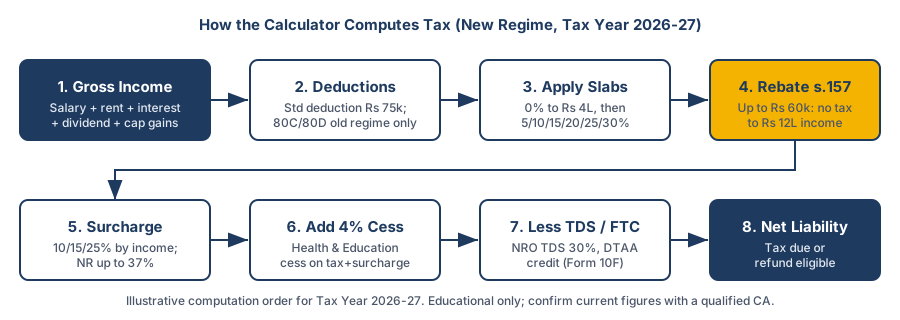
Step 1: Compute Gross Total Income (GTI)
GTI = Salary Income + House Property Income + Interest Income
      + Dividend Income + Capital Gains + Other Income
      + Business Income (if applicable)

Where:
- Salary Income = Basic + DA + Allowances + Bonus + Gratuity
                - HRA Exemption - Leave Encashment Exemption
- House Property = Annual Value - Deductions (Interest, Taxes, Repairs)
- Interest Income = All taxable interest sources
- Dividend Income = Taxable dividends from all sources
- Capital Gains = LTCG + STCG
Step 2: Compute Total Income (TI) - Old Regime
Total Income (Old Regime) = GTI - Deductions
  = GTI - 80C - 80D - 80CCD - 80E - 80G - 80EEA - 80TTB
        - Section 80TTA (₹10,000 for non-seniors)
        - Other Eligible Deductions

Deduction Limits:
- Section 80C: ₹1,50,000 (maximum)
- Section 80D: ₹25,000 or ₹50,000 (based on age)
- Section 80CCD(1B): ₹50,000 (additional NPS)
- Section 80E: No limit (education loan interest)
- Section 80TTB: ₹10,000 (interest on savings)
Step 3: Compute Total Income (TI) - New Regime
Total Income (New Regime) = GTI
(No deductions except:
 - Section 80CCD(1): Employee NPS contribution
 - Section 80EEA: Existing home loan interest (grandfathered))

Note: Most deductions are NOT available in New Regime
Step 4: Apply Tax Slabs (Tax Year 2026-27)
New Regime (default) — applies to Residents, NRs and RNOR:
| Income Range | Tax Rate | Cess (Health & Education) |
|---|---|---|
| ₹0 - ₹4,00,000 | 0% | - |
| ₹4,00,001 - ₹8,00,000 | 5% | 4% |
| ₹8,00,001 - ₹12,00,000 | 10% | 4% |
| ₹12,00,001 - ₹16,00,000 | 15% | 4% |
| ₹16,00,001 - ₹20,00,000 | 20% | 4% |
| ₹20,00,001 - ₹24,00,000 | 25% | 4% |
| Above ₹24,00,000 | 30% | 4% |
- Basic exemption (new regime): ₹4,00,000
- Rebate (Section 157, formerly 87A): ₹60,000 → effectively no tax up to ₹12,00,000 taxable income
- Standard deduction (new regime, salary/pension): ₹75,000
- New regime is the default; traditional 80C/PPF/ELSS deductions are NOT available in the new regime
At lower-to-middle incomes the FY 2026-27 new regime — with its ₹4L exemption and ₹60,000 rebate — typically wins; the gap narrows as deduction-heavy old-regime taxpayers climb the slabs. The chart below contrasts approximate total tax (income tax + 4% cess, before surcharge) at three taxable-income levels:
Old vs New Regime Total Tax (Illustrative, Tax Year 2026-27)
Illustrative; new regime assumes no old-regime deductions and the ₹60k rebate (nil tax to ₹12L). Excludes surcharge. Verify with the calculator.
For RNOR:
| Income Range | Rate |
|---|---|
| Domestic Income | Standard Slab (as above) |
| Foreign Income | Non-Resident Rate (slab rates above) |
4.2 Tax Computation Formula
Old Regime Tax Calculation:
Total Income (TI) = Gross Total Income - All Eligible Deductions

Tax Before Surcharge = f(TI) using applicable tax slab

Where f(TI) is the tax function based on tax slabs above

Surcharge on Income Tax:
- For Resident:
  * ₹50-1 Cr: 10%
  * ₹1-2 Cr: 15%
  * Above ₹2 Cr: 25%

- For Non-Resident/RNOR:
  * ₹50-1 Cr: 10%
  * ₹1-2 Cr: 15%
  * Above ₹2 Cr: 25%
  * Additional: If income from India >₹50L, surcharge up to 37%

Cess:
- 4% of (Income Tax + Surcharge)

Total Tax = Income Tax + Surcharge + Health & Education Cess
New Regime Tax Calculation:
Total Income (NR) = Gross Total Income
                    - Section 80CCD(1) [Employee NPS only]
                    - Section 80EEA [Grandfathered home loan interest]

Tax Before Surcharge = f(NR) using applicable tax slab

(Same surcharge and cess calculation as above)

Total Tax (New Regime) = Income Tax + Surcharge + 4% Cess
Regime Comparison:
Better Regime = Regime with Lower Total Tax

Tax Savings = |Tax (Old Regime) - Tax (New Regime)|

Recommendation:
- If Tax (Old Regime) < Tax (New Regime) → Choose Old Regime
- If Tax (New Regime) < Tax (Old Regime) → Choose New Regime
- If difference < ₹5,000 → Consider non-tax factors
4.3 Special Calculations for NRIs
Income Classification for Non-Residents:
Indian-Sourced Income (Taxable for NRs):
├── Salary from Indian employer (Worldwide)
├── Salary from foreign employer for Indian duties (Partially)
├── Rent from Indian properties (100%)
├── Interest on NRO accounts (100%)
├── Interest on NRE accounts (0% - Exempt)
├── Dividend from Indian companies (100%)
├── Capital gains from Indian securities (100%)
├── Business income from Indian business (100%)
├── Casual income from India (100%)
└── Income from Indian sources (General Rule)

Foreign Income (NOT taxable for NRs):
├── Foreign salary (even if from India-based foreign company)
├── Interest on foreign bank accounts
├── Dividend from foreign securities
├── Capital gains from foreign investments
└── Rental income from foreign properties
NRI-Specific Deductions:
Available Deductions for NRIs:
✓ Section 80C: LIP, PPF, ELSS (if investments made in India)
✓ Section 80D: Health insurance on India-sourced income
✓ Section 80E: Education loan interest
✓ Section 80G: Charitable donations (India-based)
✓ Section 80CCD: NPS contributions
✗ Section 80TTA: Savings account interest (NOT for NRs)
✗ Section 80EEA: Home loan interest (NOT for NRs typically)
✗ Section 80TTB: Senior citizen interest on deposits (NOT for NRs)

Deductions are allowed only to the extent of Indian-sourced income
5. Income Classification & Taxability
5.1 Detailed Income Classification Matrix
| Income Type | Resident | NR | RNOR | Notes |
|---|---|---|---|---|
| Salary from Indian Employer | Yes | Yes (Global) | Yes | Full tax on worldwide salary |
| Salary from Foreign Employer | Yes (Global) | If duties in India | Yes | Only India-source portion |
| Rental Income (India) | Yes | Yes | Yes | Full income taxable |
| Interest (NRO Account) | Yes | Yes (TDS @ 30%) | Yes | NRO interest taxable |
| Interest (NRE Account) | Yes | No (Exempt) | No | Special exemption for NRs |
| Dividend (India) | Yes | Yes (Surcharge 20%) | Yes | Higher surcharge for NRs |
| LTCG (India) | Yes | Yes | Yes | 12.5%; equity exempt up to ₹1.25L |
| STCG (India) | Yes | Yes | Yes | Equity (§111A) 20%; others at slab |
| Business Income | Yes (Global) | If from India | Yes | India-source only for NRs |
| Capital Gains (Foreign) | Yes | No | Yes (if received in India) | Foreign investments of NRs exempt |
5.2 Income Year Consideration
Tax Year: April 1, 20XX to March 31, 20XX+1 (e.g., Tax Year 2026-27)
(Under the Income Tax Act 2025, the separate "Assessment Year" concept is
 retired — a single "Tax Year" replaces the old Previous Year / Assessment Year.)

Income Recognition:
- Receipt Basis: Generally income recognized when received
- Exception: Business income on earnings basis
- TDS: Recognized when TDS certificate obtained
6. TDS (Tax Deducted at Source) Calculation
6.1 TDS Rates for Different Income Types
TDS on Salary Income:
Section 192 - TDS on Salaries
Standard Rates (for Residents):
- Based on estimated annual income
- Applied through salary payer's TDS calculation
- Monthly deduction to avoid year-end liability

NRI Special Rates:
- Standard rates apply on India-source salary
TDS on Interest Income:
Section 194A - TDS on Interest

For Residents:
- No TDS if interest < ₹40,000 (or ₹50,000 for senior citizens)
- TDS @ 10% if interest exceeds threshold
- Special provisions for small deposit accounts

For Non-Residents (Section 195, plus applicable surcharge and 4% cess):
- TDS @ 30% on interest from NRO accounts (no threshold)
- TDS @ 0% on NRE accounts (Exempt)
- TDS @ 5% on other interest (applicable rates)
- NRIs have no basic exemption for TDS; lower deduction available under DTAA (Form 10F) or a §197 certificate
TDS on Dividend:
Section 194 - TDS on Dividends

Current Regime (Post Oct 1, 2020):
- TDS @ 10% on dividend from companies (Indian)
- TDS @ 20% for NRs (No surcharge in TDS, but additional surcharge in tax)
- TDS on Mutual Fund Dividends @ 10% (non-NR) / 20% (NR)

No TDS on:
- Dividends from partnerships
- Distributions from investment funds
TDS on Rental Income:
Section 194IB - TDS on Rent

Standard Rates:
- TDS @ 5% on rent ≥ ₹50,000 per month or ₹2,00,000 per year
- Applicable only if annual rent > ₹2,40,000
- Deductible party (tenant) responsible

For NRIs:
- Same 5% rate applies
- TDS deductible by tenant/paying agent
TDS on Professional Fees/Freelance Income:
Section 194J - TDS on Professional Fees

Standard Rate:
- TDS @ 10% on professional/technical services fees
- Threshold: ₹30,000 per year
- Applied by payer
TDS on Capital Gains:
Section 195 - TDS on Capital Gains for NRIs

Rates (plus applicable surcharge and 4% cess):
- Equity/equity-MF STCG (§111A): 20%
- Equity/equity-MF LTCG (§112A): 12.5% (exempt up to ₹1,25,000 per Tax Year)
- Property/other-asset LTCG (24+ months): 12.5% without indexation
- Lower deduction available via DTAA (Form 10F) or §197 certificate

Property sale by NRI:
- Buyer deducts TDS under §195 on the capital gain (LTCG @ 12.5% + surcharge + cess)
- NRI can apply for a §197 lower-deduction certificate to limit TDS to actual gain
6.2 TDS Calculation for NRIs
Total TDS = TDS on Salary + TDS on Interest + TDS on Dividend
            + TDS on Rent + TDS on Other Income

TDS Credit Available in ITR:
- Can be adjusted against total tax liability
- If TDS > Tax Liability = Refund eligible
- Actual tax rate often lower than TDS rate

TDS Impact on Total Tax:
Tax Payable = Total Tax Liability - Total TDS Paid
If negative = Refund due to applicant
If positive = Additional payment due
For NRIs the headline issue is that flat-rate TDS (e.g. 30% on NRO interest) is deducted up front, regardless of the actual slab liability — so cash is locked up until a refund is claimed. Filing Form 10F to apply the lower DTAA rate front-loads less TDS. Using the Scenario 2 profile (₹20L NRO interest + ₹5L LTCG, final liability ₹6,57,800), the chart contrasts TDS deducted against the actual liability:
NRO TDS vs Final Liability — Effect of Form 10F (Tax Year 2026-27)
Illustrative, Scenario 2 (UAE NRI). Final liability is unchanged; Form 10F lowers up-front TDS so less cash is locked pending refund. Verify with the calculator.
6.3 Form 10F for Lower TDS
Purpose of Form 10F:
Form 10F: Certificate for Lower TDS/No TDS

Used by NRIs to obtain:
- Reduced TDS rate on interest income
- No TDS on NRE account interest
- Lower TDS on other Indian-source income
- Based on DTAA provisions or expected low tax liability

Filing Requirement:
- Can be filed with banks/financial institutions
- Valid for financial year
- Must provide by July 31 to be effective from June 1
When 10F is Beneficial:
Scenario 1: NRO Account Interest
- Without 10F: TDS @ 30% deducted
- With 10F: TDS @ DTAA rate (often 10-15%)
- Benefit: Reduce TDS to treaty rate

Scenario 2: Dividend Income in USA
- Without 10F: TDS @ 20%
- With 10F: TDS @ 15% (DTAA rate USA-India)
- Benefit: Reduced TDS by 5%

Scenario 3: Interest Income in UAE
- Without 10F: TDS @ 30%
- With 10F: TDS @ 12.5% (DTAA rate UAE-India)
- Benefit: Reduced TDS by ~17.5%

Scenario 4: Low Tax Liability Expected
- Without 10F: TDS @ standard rate
- With 10F: TDS @ lower rate or nil
- Benefit: Tax efficiency
7. DTAA Benefits & Foreign Tax Credits
7.1 Double Taxation Avoidance Agreement (DTAA)
Concept:
DTAA Principle:
Income should not be taxed twice on the same income
when earned in two different countries

India has DTAA with 90+ countries

Method of Relief:
1. Exemption Method: Income taxed in one country only
2. Credit Method: Full tax credit given in home country
   for India tax paid

Example (USA-India DTAA):
Income: $1,00,000 = ₹83 lakhs
USA Tax (at 25%): $25,000 = ₹20.75 lakhs
India Tax (at 30%): ₹24.9 lakhs
Total Tax Without DTAA: ₹45.65 lakhs (55%)

With DTAA:
USA Tax: $25,000 = ₹20.75 lakhs
India Tax: ₹24.9 lakhs
- Less: Foreign Tax Credit for USA tax: ₹20.75 lakhs
- Net India Tax: ₹4.15 lakhs
Total Tax: ₹24.9 lakhs (30%)
7.2 Key DTAA Provisions for Common Countries
USA-India DTAA:
Dividend Income:
- Rate: 15% (if recipient holds >25% of company)
- Rate: 20% (other cases)
- Treaty rate preferable to domestic rate (30%)

Interest Income:
- Rate: 10-15% (depending on type)
- FD interest typically: 15%
- Treaty rate preferable to domestic NR rate (30%)

Rental/Royalty Income:
- Rate: 15%

Capital Gains:
- LTCG: Generally taxable in India; equity LTCG (§112A) at 12.5% (exempt up to ₹1.25L)
- STCG: Indian equity STCG (§111A) at 20%; treaty may allocate taxing rights to country of residence

Salary:
- Taxed in country of employment (worldwide salary)
- Or country of residence if employment < 183 days

Pensions:
- Generally exempt in India for NRs
- Taxable in country of residence
UK-India DTAA:
Dividend Income:
- Rate: 15% (for dividends paid by Indian companies)
- Lower than domestic rate (30%)

Interest Income:
- Rate: 10-20% depending on type
- Bank interest: 20%

Capital Gains:
- Generally not covered by treaty
- Taxed in country of residence for UK citizens

Rental Income:
- Rate: 15%

Salary:
- Master/key employee: India tax applies if India-based
- Short-term visitors: UK tax applies
UAE-India DTAA:
Dividend Income:
- Rate: 15%
- Benefit: Reduced from standard 30%

Interest Income:
- Rate: 15% (most cases)
- Benefit: Reduced from 30% standard NR rate

Rental Income:
- Rate: 15%

Capital Gains:
- LTCG: 12.5% (applies)
- STCG: Equity (§111A) 20%; other assets at slab rates

Salary:
- India tax applies if employment in India
- Foreign salary of NR: No India tax
Singapore-India DTAA:
Dividend: 10% (beneficial)
Interest: 15%
Royalty: 15%
Capital Gains: Generally exempt
Salary: Employer country tax applies
Pensions: Exempt in India
7.3 DTAA Calculation for NRIs
Step 1: Calculate India Tax
India Tax = Tax as per India laws (30% surcharge for NRs typically)
Example: ₹24.9 lakhs on ₹83 lakhs income
Step 2: Calculate Foreign Tax Paid
Foreign Tax = Tax paid in home country on India-source income
Example (USA): $25,000 = ₹20.75 lakhs @ USD/INR 83
Step 3: Determine Applicable Treaty Rate
Treaty Rate = As per DTAA between India and home country
Example: USA-India DTAA on dividend = 15% (vs 30% domestic)
Reduced TDS = ₹83 lakh × 15% = ₹12.45 lakh
Step 4: Apply Credit Method
Net India Tax = Max of:
a) India Tax calculated at treaty rate
b) India Tax at domestic rate - Foreign Tax Credit

Foreign Tax Credit = Lesser of:
1. Foreign tax actually paid
2. India tax as computed

Example:
India Tax (domestic rate 30%): ₹24.9 lakhs
Foreign Tax Paid (USA): ₹20.75 lakhs

FTC = Min(₹20.75 lakhs, ₹24.9 lakhs) = ₹20.75 lakhs

Tax Due to India = ₹24.9 lakhs - ₹20.75 lakhs = ₹4.15 lakhs
7.4 DTAA Benefits Table
| Country | Dividend | Interest | Royalty | LTCG | NRE Interest |
|---|---|---|---|---|---|
| USA | 15% | 10-15% | 15% | Exempt | Exempt |
| UK | 15% | 10-20% | 10% | Exempt | Exempt |
| UAE | 15% | 15% | 20% | 20% | Exempt |
| Australia | 15% | 10% | 10% | Exempt | Exempt |
| Canada | 15-25% | 15% | 15% | Exempt | Exempt |
| Singapore | 10% | 15% | 15% | Exempt | Exempt |
| Germany | 15% | 0-10% | 10% | Exempt | Exempt |
| Mauritius | 10% | 7.5% | 10% | Exempt | Exempt |
8. Sample Scenarios & Case Studies
Scenario 1: NRI in USA with Rental Income
Profile:
- Name: Raj Patel
- Residential Status: Non-Resident
- Country: USA (California)
- Annual Income: ₹10 lakhs (rental from 1 property in Mumbai)
- Age: 45 years
- Deductions: None claimed
Input Data:
Gross Rental Income: ₹10,00,000
Less: Standard Deduction @ 30%: -₹3,00,000
Net House Property Income: ₹7,00,000

Other Deductions:
Municipal Taxes: ₹40,000
Interest on Housing Loan: ₹50,000
Repairs: ₹30,000
Insurance: ₹15,000
Net House Property (after deductions): ₹5,65,000

Gross Total Income: ₹5,65,000
Deductions (Old Regime): Nil
Total Income: ₹5,65,000

Country of Residence: USA
Foreign Tax Paid on India Income: Nil (assuming rent not taxed in USA)
Calculation:
Old Regime:
Taxable Income: ₹5,65,000

Tax Calculation:
0 - ₹5,00,000 @ 0%: ₹0
₹5,00,001 - ₹5,65,000 @ 20%: ₹13,000

Income Tax: ₹13,000
Surcharge (10% on ₹13,000): ₹1,300
Cess (4% on ₹14,300): ₹572

Total Tax: ₹13,000 + ₹1,300 + ₹572 = ₹14,872
New Regime:
Taxable Income: ₹5,65,000
(Same as old regime, no deductions allowed)

Total Tax: ₹14,872
(Same as old regime)
TDS & DTAA Analysis:
TDS on Rental Income (Section 194IB):
Annual Rent: ₹10,00,000 > ₹2,40,000
TDS @ 5%: ₹10,00,000 × 5% = ₹50,000

DTAA (USA-India):
Rental Income rate: 15%
Treaty Reduced TDS: ₹10,00,000 × 15% = ₹1,50,000

TDS Credit:
TDS Already Paid (by tenant): ₹50,000
Less: Foreign Tax Credit for USA tax: Nil
Potential Refund: ₹50,000 - ₹14,872 = ₹35,128
Recommendation:
✓ Old Regime = New Regime (Same tax)
✓ File ITR-2 (Non-Resident)
✓ Claim TDS credit of ₹50,000
✓ Expected Refund: ₹35,128
✓ File Form 10F for DTAA benefits (15% TDS instead of 5%)
Scenario 2: NRI in UAE with Interest & Capital Gains
Profile:
- Name: Priya Sharma
- Residential Status: Non-Resident
- Country: UAE (Dubai)
- Income Components:
- Interest from NRO FD: ₹20 lakhs
- Capital Gains (LTCG) from shares: ₹5 lakhs
- Age: 52 years
- Deductions Claimed: Health Insurance ₹50,000
Input Data:
Interest Income (NRO FD): ₹20,00,000
Capital Gains (LTCG):
  Sale Price: ₹50 lakhs
  Cost: ₹45 lakhs
  Holding Period: 3 years
  LTCG Amount: ₹5,00,000

Gross Total Income: ₹25,00,000

Deductions (Old Regime):
Health Insurance (Section 80D): ₹50,000
Less: Non-deductible for NRs on foreign-source: ₹0
(Deduction only on India-source income)

Total Income: ₹25,00,000
Calculation:
Old Regime:
Taxable Income: ₹25,00,000

Tax Calculation:
₹0 - ₹5,00,000 @ 0%: ₹0
₹5,00,001 - ₹10,00,000 @ 20%: ₹1,00,000
₹10,00,001 - ₹25,00,000 @ 30%: ₹4,50,000

Income Tax: ₹5,50,000
Surcharge (15% on ₹5,50,000): ₹82,500
Cess (4% on ₹6,32,500): ₹25,300

Total Tax: ₹5,50,000 + ₹82,500 + ₹25,300 = ₹6,57,800
New Regime:
Taxable Income: ₹25,00,000
(No deductions allowed in new regime)

Total Tax: ₹6,57,800
(Same as old regime for this income level)
TDS & DTAA Analysis:
TDS Calculation (Section 195, plus surcharge + 4% cess):
Interest (NRO) @ 30%: ₹20,00,000 × 30% = ₹6,00,000
Capital Gains: No TDS (assumes direct transaction)
Total TDS Paid: ₹6,00,000

DTAA (UAE-India):
Interest rate: 15%
Reduced TDS: ₹20,00,000 × 15% = ₹3,00,000
Benefit via Form 10F: ₹6,00,000 - ₹3,00,000 = ₹3,00,000 reduction

Foreign Tax Credit:
UAE has no personal income tax on investment income
Foreign Tax Paid: ₹0

Net Tax Due:
With standard TDS: ₹6,57,800 - ₹6,00,000 = ₹57,800 (DUE)
With DTAA/Form 10F: ₹6,57,800 - ₹3,00,000 = ₹3,57,800 (DUE)
Recommendation:
✓ Old Regime = New Regime (Same tax)
✓ File ITR-2 (Non-Resident)
✓ MANDATORY: File Form 10F immediately
  - Without Form 10F: ₹6 lakhs TDS (excess refunded later)
  - With Form 10F: Direct reduction to ₹3 lakhs TDS (immediate benefit)
  - Time Value Benefit: Save 10-12 months waiting for refund
✓ Tax Due: ₹3,57,800 (after DTAA benefit)
✓ Estimated Refund (if Form 10F filed): ₹0
✓ If standard TDS applied (₹6L), tax due in ITR-2: ₹57,800
Scenario 3: NRI in UK with Salary from Indian Office
Profile:
- Name: Amit Khanna
- Residential Status: Non-Resident
- Country: UK (London resident, but employed by Indian company)
- India-Source Salary: ₹15 lakhs per year
- Age: 38 years
- Deductions Claimed:
- LIC Premium (80C): ₹50,000
- Health Insurance (80D): ₹25,000
Input Data:
Salary from Indian Employer:
Basic Salary: ₹12,00,000
Dearness Allowance: ₹1,00,000
House Rent Allowance: ₹1,80,000 (Not claimed as exemption - UK resident)
Special Allowance: ₹20,000
Bonus: ₹50,000
Less: HRA Exemption: ₹0 (Not applicable for NR)

Gross Salary Income: ₹15,50,000

Deductions (Old Regime):
Section 80C (LIC): ₹50,000
Section 80D (Health Insurance): ₹25,000
Total Deductions: ₹75,000

Less: Limited to India-source income proportion: ₹75,000
(All salary is India-source)

Total Income: ₹15,50,000 - ₹75,000 = ₹14,75,000
Calculation:
Old Regime:
Taxable Income: ₹14,75,000

Tax Calculation:
₹0 - ₹5,00,000 @ 0%: ₹0
₹5,00,001 - ₹10,00,000 @ 20%: ₹1,00,000
₹10,00,001 - ₹14,75,000 @ 30%: ₹1,42,500

Income Tax: ₹2,42,500
Surcharge (10% on ₹2,42,500): ₹24,250
Cess (4% on ₹2,66,750): ₹10,670

Total Tax: ₹2,42,500 + ₹24,250 + ₹10,670 = ₹2,77,420
New Regime:
Taxable Income: ₹15,50,000
(Only 80CCD(1) allowed in new regime, not applicable here)

Tax Calculation:
₹0 - ₹5,00,000 @ 0%: ₹0
₹5,00,001 - ₹10,00,000 @ 20%: ₹1,00,000
₹10,00,001 - ₹15,50,000 @ 30%: ₹1,65,000

Income Tax: ₹2,65,000
Surcharge (10% on ₹2,65,000): ₹26,500
Cess (4% on ₹2,91,500): ₹11,660

Total Tax (New Regime): ₹2,65,000 + ₹26,500 + ₹11,660 = ₹3,03,160
Comparison & TDS:
Tax Comparison:
Old Regime: ₹2,77,420
New Regime: ₹3,03,160
Benefit of Old Regime: ₹25,740

TDS on Salary (Section 192):
Estimated TDS deducted by employer: ₹2,50,000
(Typical deduction based on salary structure)

Net Tax Due (Old Regime):
Tax Liability: ₹2,77,420
Less: TDS Credit: ₹2,50,000
Additional Tax Due: ₹27,420

DTAA (UK-India) - Salary Provision:
UK-based employee of Indian company:
Master/key personnel: India tax applies (as above)
Ordinary employee: Varies by contract
General provision: Salary taxed in country of employment (UK)

If employee is not key personnel:
- India tax may not apply fully
- UK tax would apply instead
- DTAA relief available in UK for India tax paid
Recommendation:
✓ Old Regime Better by ₹25,740
✓ File ITR-2 (Non-Resident)
✓ Check DTAA clause:
  - If Master/key employee: File in India (as calculated)
  - If ordinary employee: May not require India return
✓ Request employer to adjust TDS if needed
✓ Expected Net Tax: ₹27,420 due (if old regime with TDS credit)
✓ Claim all deductions (₹75,000) in old regime only
9. Tax-Saving Strategies
9.1 Income Structuring for NRIs
Strategy 1: Maximize NRE Account Interest
Concept: Interest from NRE accounts is exempt from tax in India

Implementation:
1. Maintain separate NRE account (Non-Resident External Account)
2. Route foreign income → NRE account
3. Deposit to FDs in NRE → Interest exempt in India

Advantage:
- NRE interest: 0% tax in India (vs 30% TDS on NRO)
- Can repatriate to foreign country
- No income tax liability on NRE interest
- Can keep earning without India tax

Example:
Deposit in NRE FD: ₹20 lakhs
Interest @7.5% p.a.: ₹1,50,000
India Tax: ₹0 (Completely exempt)
vs.
NRO FD Interest: ₹1,50,000 × 30% TDS = ₹45,000

Annual Savings: ₹45,000
Strategy 2: Defer India-Source Income
Concept: Defer receipt of income to reduce current year tax

Implementation:
For businesses/professionals:
1. Delay raising invoices by few days (before FY end)
2. Negotiate extended payment terms (Net 60-90)
3. Defer delivery of services to next FY
4. Defer capital gains realization

Caution: Only if genuinely possible, else shows income as accrued

Example:
Rental Income Scenario:
If rent ₹5 lakhs received on Mar 31, 20XX:
Tax FY 20XX-25: ₹5 lakhs income

If rent ₹5 lakhs received on Apr 1, 20XX:
Tax FY 20XX-25: ₹0
Tax FY 20XX-26: ₹5 lakhs income

Assumes: Different tax rates in two FYs or deferral reduces slab
Benefit: Tax deferral = 1-year interest-free loan from government
Strategy 3: Optimize Capital Gains Realization
Concept: Time capital gains realization to minimize tax

Implementation:
Short-Term Capital Gains (STCG < 2 years holding):
1. Calculate expected income for FY
2. If in higher slab, defer STCG realization to next FY
3. If in lower slab, realize STCG in current FY

Long-Term Capital Gains (LTCG > 2 years):
1. Realize in year when other income is lower
2. Utilize lower slab rates available for NRs
3. Benefit from 20% LTCG rate vs personal slab rate

Example:
Investor with ₹10L rental income (Year 1):
Option A: Realize LTCG ₹5L in Year 1
Tax on Rental: ₹1L (at 20%)
Tax on LTCG: ₹1L (at 20%)
Total: ₹2L

Option B: Defer LTCG to Year 2 (assume ₹0 other income)
Year 1 Tax on Rental: ₹1L
Year 2 Tax on LTCG: ₹1L (20% flat rate)
Total: ₹2L (but Year 1 liability lower, better cash flow)
9.2 Deduction Optimization
Strategy 4: Maximize Section 80C Investments
Concept: Utilize full ₹1.5 lakh 80C limit for tax-free growth

For NRIs: Can claim only if investments made in India

Common 80C-eligible options (illustrative, not recommendations):
1. PPF (Public Provident Fund) - ₹1.5L max, ~7.1% rate (govt-notified, subject to change)
2. NSC (National Savings Certificates) - Any amount, ~7.6% rate (govt-notified, subject to change)
3. LIC Policies - Premium under 80C
4. ELSS Mutual Funds - 3-year lock-in, market-linked (returns not assured)
5. Children's Tuition Fees - Educational expenses

Illustrative split of a ₹1.5L 80C budget (educational example only, not advice):
- PPF: ₹75,000 (fixed-rate, govt-notified)
- ELSS: ₹50,000 (market-linked; returns illustrative, not assured)
- LIC: ₹25,000 (insurance + 80C)

Annual Tax Benefit:
Old Regime: ₹1.5L × 30% = ₹45,000 tax savings
New Regime: ₹0 (Not allowed)

20-Year Cumulative:
Principal: ₹30 lakhs
Returns: ₹30 lakhs (approx.)
Tax Savings: ₹9 lakhs
Total Benefit: ₹69 lakhs
Strategy 5: Health Insurance Deduction
Concept: Maximize Section 80D health insurance deduction

Limits (Old Regime):
For self + family (< 60 years): ₹25,000
For self + family (≥ 60 years): ₹50,000
Parents health insurance (< 60 years): ₹25,000
Parents health insurance (≥ 60 years): ₹50,000
Max Combined: ₹1,00,000 (if all applicable)

Implementation:
1. Take comprehensive health insurance policies
2. Cover self, spouse, children
3. Separate policy for parents (if applicable)
4. Claim full premium as deduction

For NRIs:
- Can claim only if policy issued by Indian insurer
- Only on India-source income

Tax Benefit:
Premium ₹50,000 × 30% tax rate = ₹15,000 savings
Strategy 6: NPS Investment for Additional Benefit
Concept: Section 80CCD(1B) provides ₹50K additional deduction beyond 80C

Structure:
- Section 80C limit: ₹1.5 lakhs (includes NPS up to ₹1.5L)
- Section 80CCD(1B): Additional ₹50,000 (only NPS)
- Section 80CCD(2): Employer contribution (10% of salary)
- Max Total NPS Benefit: ₹1.5L + ₹50K + Employer contribution

Example (Employee with ₹15L salary):
- Employee NPS (80C): ₹1.5L
- Employee NPS (80CCD(1B)): ₹50,000
- Employer NPS (80CCD(2)): ₹1.5L (10% of salary)
- Total NPS Contribution: ₹3.5L per year

Total Deduction: ₹3.5L
Tax Benefit @ 30%: ₹1.05L per year
20-Year Accumulation: ₹70L deductions = ₹21L tax savings
Plus: NPS retirement corpus at low tax rates (30% on withdrawal)
9.3 DTAA Optimization
Strategy 7: Claim Form 10F for Reduced TDS
Concept: Use DTAA rates to reduce TDS on India income

Process:
1. Identify DTAA rate applicable between India and home country
2. File Form 10F with Indian bank/financial institution
3. Provide: PAN, TIN of home country, declaration of tax residency

Impact:
Standard TDS: 30% (on NRO interest for NRs, plus surcharge + cess)
DTAA TDS (USA): 15% (on interest)
DTAA TDS (UAE): 15% (on interest)

Filing Timeline:
- Can file any time during the Tax Year
- Effective from next day of filing
- Preferably file before earning interest income
- Valid for full Tax Year

Example:
FD Interest: ₹10L
Without Form 10F: TDS ₹3L (30%)
With Form 10F (USA): TDS ₹1.5L (15%)
Net Interest Received: ₹8.5L vs ₹7L
Benefit: ₹1.5L additional cash, tax payable later if at all
Strategy 8: Foreign Tax Credit Planning
Concept: Utilize foreign taxes paid to reduce India tax

Implementation:
1. Identify all taxes paid in home country
2. Compute India tax on same income at applicable rates
3. Credit = Min(Foreign Tax, India Tax)
4. Claim in ITR return

Example:
Income: ₹10L dividend from Indian company

Scenario A - USA Resident:
USA Tax (25%): ₹2.5L
India Tax (30%): ₹3L
FTC = Min(₹2.5L, ₹3L) = ₹2.5L
Net India Tax: ₹3L - ₹2.5L = ₹0.5L

Scenario B - UAE Resident (No income tax):
UAE Tax: ₹0
India Tax (30%): ₹3L
FTC = Min(₹0, ₹3L) = ₹0
Net India Tax: ₹3L (No benefit)

Strategy:
- If USA resident: Dividend income acceptable, can claim FTC
- If UAE resident: Avoid dividend, focus on exempt income
9.4 Entity Structure Planning
Strategy 9: Choose Right Residential Status
Concept: If planning to be NR, optimize fully for NR status

NR Advantages:
1. Not taxed on foreign-source income
2. Can invest globally without India tax
3. More flexible on compliance

NR Disadvantages:
1. Higher tax rates for India-source (30% vs 20-30%)
2. Limited deductions available
3. TDS deducted at higher rates

Example Comparison (₹25L rental income):
Resident:
- Tax: ₹3L (at slab rates 20-30%)
- Deductions available: ₹1.5L (80C) + ₹0.5L (80D) = ₹2L
- Net Tax: ₹1.5L

Non-Resident:
- Tax: ₹5L (at NR rates 20-30%)
- Deductions available: Only on India income = ₹0.5L
- Net Tax: ₹4.5L

Difference: ₹3L per year = ₹60L over 20 years

Decision: Become NR only if significant foreign income to offset
10. ITR Forms & Filing Recommendations
10.1 ITR Form Selection Guide for NRIs
ITR-2 (Non-Residents, Single Source Income)
When to File:
- Residential Status: Non-Resident or RNOR
- Income Sources: 1-2 simple income sources
- Business Income: Not more than ₹50L
Application:
NRI with:
✓ Rental income only
✓ Salary + Interest
✓ Dividend + Capital Gains
✓ Pension income only

Not Applicable:
✗ Business income >₹50L
✗ Multiple business sources
✗ Complex income structure
Key Schedules Required:
- Schedule 1: General Information
- Schedule IT-SA: Income from Salary
- Schedule IT-HP: Income from House Property
- Schedule IT-CG: Capital Gains
- Schedule IT-OI: Other Income
- Schedule IT-DT: Deductions
Filing Process:
1. Register on www.incometaxindiaefiling.gov.in
2. Download Form ITR-2 (Excel format)
3. Fill in details (automated calculation)
4. Validate using ITR Utility
5. Upload on e-filing portal
6. Verify using OTP/PIN/EVC
7. Print and file (if required)
ITR-3 (Self-Employed/Professionals)
When to File:
- Have business or professional income
- Income from multiple sources
- Complex deductions
Application:
NRI with:
✓ Professional services (consulting)
✓ Freelance income
✓ Partnership income
✓ Import/Export business
Key Schedules Required:
- Schedule 1: General Information
- Schedule IT-SA: Salary
- Schedule IT-BP: Profit & Loss
- Schedule IT-TP: Trade Receivables/Payables
- Schedule IT-SP: Share & Securities
- Schedule IT-CG: Capital Gains
- Schedule IT-OI: Other Income
ITR-4 (Presumptive Income)
When to File:
- Business turnover < ₹5 crores (Tax Year 2026-27)
- Eligible professionals (turnover < ₹50 lakhs)
Application:
NRI with small business can file ITR-4 if:
✓ Turnover < ₹5 Cr
✓ Normal profit rate: 6% (business) or 50% (professional)
✓ No separate books maintenance required
Advantages:
- Simpler calculation
- Fewer schedules
- No need for audit (below ₹10L)
- Presumptive income benefit
10.2 Filing Timeline & Deadlines
Tax Year: April 1, 20XX to March 31, 20XX+1

ITR Filing Dates:
Normal Deadline: July 31 of following year
Example: Tax Year 2026-27 → Deadline July 31, 2027

With Extension: August 31 (in case of request)

Consequences of Late Filing:
- ₹1,000 penalty if filed between Aug 1 - Dec 31 (or ₹10,000 if income >₹5L)
- Loss of carry forward of losses (only if filed within due date)
- No tax credit for TDS if filed after due date
- Deemed income provisions may trigger (Section 115BBE)

Tax Payment Dates:
Installment 1: June 15 (25% of estimated tax)
Installment 2: September 15 (50%)
Installment 3: December 15 (75%)
Final: March 31 (100%)

For NRIs:
- File ITR within due date even if abroad
- E-filing facility available 24/7
- Verification can be done online (OTP-based)
10.3 TDS Certificate Collection & ITR Filing
Documents Required for ITR Filing (For NRIs):

TDS Certificates:
1. Form 16 - Salary TDS (from employer) [renamed Form 130 under the Income Tax Act 2025]
2. Form 16A - Other TDS (banks, FDs, rent, etc.)
3. Form 1099-NEC or equivalent (if foreign income)

Investment Proof:
1. PPF receipts (for 80C)
2. LIC policy receipts (for 80C)
3. Health insurance premium receipts (for 80D)
4. Education fees (for 80C)
5. Home loan statement (for 24 deduction)

Income Documents:
1. Rent receipts (for rental income)
2. Bank statements (for interest income)
3. Dividend statements (for dividend income)
4. Capital gains statements (for gains)
5. Business books (for business income)

Banking Documents:
1. Form 15CA (if income >₹10L, translated by CA)
2. Form 15CB (for specific items)
3. Remittance proof (for NRI repatriation)
4. FEMA documentation (if foreign remittance)

Foreign Documents (for DTAA/FTC):
1. Foreign tax return copies
2. Tax paid certificates
3. DTAA benefits claimed
4. Passport copies (for residency proof)
5. TIN (Tax ID Number) of home country

Other Documents:
1. PAN card
2. Aadhaar card
3. Proof of foreign residency (visa, property lease)
4. Bank statements
5. Investment statements
10.4 Verification & Assessment
ITR Verification Options (for NRIs):

Option 1: Online Verification (OTP-Based)
- OTP sent to registered mobile/email
- Valid within 30 days of ITR filing
- Most convenient for NRIs

Option 2: Digital Signature (DS)
- E-Sign digital signature
- Cost: ₹100-500
- Valid immediately

Option 3: Physical Signature
- Print, sign, and courier to CPC
- Not practical for NRIs abroad

Option 4: Chartered Accountant Verification
- CA signs on behalf of assessee
- Form 10AB required
- Valid for ITRs requiring audit

For NRIs: Online verification via OTP is most practical
Verification must be completed within 30 days of filing

Post-Filing Scrutiny:
- CPC-automated processing checks ITR
- If defects found, intimation issued (Form 139)
- Assessee has 15 days to respond
- Compliance with intimation required for ITR acceptance
11. Mathematical Formulas for Developers
11.1 Basic Tax Calculation Functions
Function 1: Calculate Gross Total Income (GTI)
Function CalculateGTI(salaryIncome, rentalIncome, interestIncome,
                      dividendIncome, capitalGains, otherIncome):

    GTI = salaryIncome + rentalIncome + interestIncome
          + dividendIncome + capitalGains + otherIncome

    return GTI

Example:
Salary: ₹10L
Rental: ₹5L
Interest: ₹2L
Dividend: ₹1L
LTCG: ₹1.5L
GTI = ₹10L + ₹5L + ₹2L + ₹1L + ₹1.5L = ₹19.5L
Function 2: Calculate HRA Exemption
Function CalculateHRA_Exemption(hraReceived, basic, dearness,
                                 city_type, rentPaid, basicDA):

    // HRA exemption = Minimum of three amounts

    // Amount 1: HRA Received
    amount1 = hraReceived

    // Amount 2: Percentage of (Basic + DA)
    if city_type == "Metro": // Delhi, Mumbai, Chennai, Kolkata
        percentage = 0.50
    else:
        percentage = 0.40

    amount2 = (basic + dearness) * percentage

    // Amount 3: Rent - 10% of (Basic + DA)
    amount3 = rentPaid - (0.10 * (basic + dearness))

    // Exemption = Min of all three (but cannot be negative)
    exemption = Min(amount1, amount2, amount3)
    exemption = Max(exemption, 0)

    return exemption

Example:
HRA Received: ₹2L
Basic: ₹5L
DA: ₹50K
City: Mumbai (Metro)
Rent Paid: ₹2.5L

amount1 = ₹2L
amount2 = (₹5L + ₹50K) × 50% = ₹2.75L
amount3 = ₹2.5L - (₹5.5L × 10%) = ₹1.95L

Exemption = Min(₹2L, ₹2.75L, ₹1.95L) = ₹1.95L
Taxable HRA = ₹2L - ₹1.95L = ₹5,000
Function 3: Calculate House Property Income
Function CalculateHousePropertyIncome(annualRent, municipalTax,
                                       interestOnLoan, repairs,
                                       insurance, propertyTax,
                                       selfOccupied):

    // For Self-occupied property:
    if selfOccupied:
        rental_value = 0  // No income from self-occupied
        standard_deduction = 0
    else:
        rental_value = annualRent
        // Standard deduction of 30% for rental property
        standard_deduction = rental_value × 0.30

    // Calculate gross income after standard deduction
    after_standard = rental_value - standard_deduction

    // All actual expenses are deductible
    all_deductions = municipalTax + interestOnLoan + repairs
                   + insurance + propertyTax

    // For self-occupied, interest on loan is still deductible
    // (though no rental value)
    if selfOccupied:
        housePropertyIncome = -interestOnLoan  // Loss provision
        // Loss can be carried forward up to ₹2L
        carryForward = Min(housePropertyIncome, -200000)
        housePropertyIncome = Max(housePropertyIncome, -200000)
    else:
        housePropertyIncome = after_standard - all_deductions

    return housePropertyIncome

Example (Rental Property):
Annual Rent: ₹10L
Municipal Tax: ₹50K
Interest on Loan: ₹1L
Repairs: ₹30K
Insurance: ₹20K

Standard Deduction (30%): ₹3L
After Standard: ₹7L
Total Deductions: ₹50K + ₹1L + ₹30K + ₹20K = ₹2L
House Property Income: ₹7L - ₹2L = ₹5L
Function 4: Calculate Capital Gains
Function CalculateCapitalGains(salePrice, costOfAcquisition,
                                datePurchased, dateSold,
                                indexationAvailable):

    // Calculate holding period
    holdingDays = dateSold - datePurchased
    holdingMonths = holdingDays / 30.44
    holdingYears = holdingDays / 365.25

    // Gain before indexation
    gainBeforeIndexation = salePrice - costOfAcquisition

    // Determine LTCG vs STCG
    if assetType == "Equity_Share":
        ltcgPeriod = 365  // 1 year
    else:
        ltcgPeriod = 730  // 2 years

    if holdingDays > ltcgPeriod:
        // Long-term Capital Gain
        if indexationAvailable and assetType != "Equity_Share":
            indexationFactor = CPI_year_of_sale / CPI_year_of_purchase
            indexedCost = costOfAcquisition * indexationFactor
            capitalGains = salePrice - indexedCost
            type = "LTCG"
        else:
            capitalGains = gainBeforeIndexation
            type = "LTCG"
            if assetType == "Equity_Share":
                // 12.5% tax without indexation (§112A; exempt up to ₹1,25,000)
                taxRate = 0.125
            else:
                // 12.5% without indexation on other assets/property
                taxRate = 0.125
    else:
        // Short-term Capital Gain
        capitalGains = gainBeforeIndexation
        type = "STCG"
        // Added to income, taxed at slab rate

    return {
        capitalGains: capitalGains,
        type: type,
        holdingYears: holdingYears
    }

Example (LTCG on property, without indexation — Tax Year 2026-27):
Sale Price: ₹50L
Cost: ₹30L
Purchase: Jan 2022, Sale: Jan 2026
Holding: 4 years (LTCG)

LTCG: ₹50L - ₹30L = ₹20L
Tax @ 12.5% (without indexation): ₹2.5L
11.2 Deduction Calculation Functions
Function 5: Calculate Section 80C Deduction
Function CalculateSection80C(lifeInsurance, ppfContribution,
                             nscInvestment, ellsInvestment,
                             sukanyaScheme, postOfficeSchemes,
                             tuitionFees, lockInSecurities):

    // Sum all 80C eligible investments
    total80C = lifeInsurance + ppfContribution + nscInvestment
             + ellsInvestment + sukanyaScheme + postOfficeSchemes
             + tuitionFees + lockInSecurities

    // Cap at ₹1.5 lakhs
    maxLimit = 150000

    deduction80C = Min(total80C, maxLimit)

    // For NRIs, only eligible on Indian-source income
    if isNRI:
        deduction80C = Min(deduction80C, indianSourceIncome)

    return deduction80C

Example:
LIC Premium: ₹60K
PPF: ₹80K
ELSS: ₹50K
Total: ₹1.9L
Deduction (capped): ₹1.5L
Function 6: Calculate Section 80D Deduction (Health Insurance)
Function CalculateSection80D(age, healthInsuranceSelf,
                            healthInsuranceFamily,
                            parentHealthInsurance,
                            parentAge, medicalExpenditure):

    // Determine age category
    isBelow60 = age < 60
    is60to80 = age >= 60 AND age < 80
    isAbove80 = age >= 80

    parentIsAbove60 = parentAge >= 60

    // Deduction limits
    if isBelow60:
        limit_self_family = 25000
        limit_parent = 25000
    else if is60to80:
        limit_self_family = 50000
        if parentIsAbove60:
            limit_parent = 50000
        else:
            limit_parent = 25000
    else: // above 80
        limit_self_family = 50000
        limit_parent = 50000

    // Calculate deductions
    deduction_self = Min(healthInsuranceSelf, limit_self_family)
    deduction_parent = Min(parentHealthInsurance, limit_parent)

    // Medical expenditure (only for senior citizens)
    if is60to80 or isAbove80:
        deduction_medical = medicalExpenditure  // No limit for actual expense
    else:
        deduction_medical = 0

    total80D = deduction_self + deduction_parent + deduction_medical

    // Max limit across all sources
    if age >= 60:
        maxTotal = 100000
    else:
        maxTotal = 50000

    deduction80D = Min(total80D, maxTotal)

    // For NRIs, only on Indian-source income
    if isNRI:
        deduction80D = Min(deduction80D, indianSourceIncome)

    return deduction80D

Example (Age 65):
Health Insurance: ₹40K
Parent Health Insurance: ₹50K
Medical Expenditure: ₹100K
Total: ₹1.9L
Deduction (capped at ₹1L): ₹1L
11.3 Tax Calculation Functions
Function 7: Calculate Income Tax (Old Regime)
Function CalculateIncomeTax_OldRegime(totalIncome, residentStatus, age):

    // Apply tax slabs based on resident status

    if residentStatus == "RESIDENT":
        if age >= 60:
            if totalIncome <= 500000:
                tax = 0
            else if totalIncome <= 1000000:
                tax = (totalIncome - 500000) × 0.05
            else if totalIncome <= 1500000:
                tax = 25000 + (totalIncome - 1000000) × 0.20
            else if totalIncome <= 2500000:
                tax = 125000 + (totalIncome - 1500000) × 0.30
            else:
                tax = 425000 + (totalIncome - 2500000) × 0.30
        else:
            if totalIncome <= 300000:
                tax = 0
            else if totalIncome <= 600000:
                tax = (totalIncome - 300000) × 0.05
            else if totalIncome <= 900000:
                tax = 15000 + (totalIncome - 600000) × 0.10
            else if totalIncome <= 1200000:
                tax = 45000 + (totalIncome - 900000) × 0.15
            else if totalIncome <= 1500000:
                tax = 90000 + (totalIncome - 1200000) × 0.20
            else:
                tax = 150000 + (totalIncome - 1500000) × 0.30

    else if residentStatus == "NON_RESIDENT":
        // NR Special Rates
        if totalIncome <= 500000:
            tax = 0
        else if totalIncome <= 1000000:
            tax = (totalIncome - 500000) × 0.20
        else if totalIncome <= 2500000:
            tax = 100000 + (totalIncome - 1000000) × 0.30
        else:
            tax = 550000 + (totalIncome - 2500000) × 0.30

    else if residentStatus == "RNOR":
        // RNOR - partially like resident, partially like NR
        // Needs separate calculation for domestic vs foreign income
        tax = calculateRNORTax(domesticIncome, foreignIncome)

    return tax

Example (Non-Resident, ₹25L income):
₹5L @ 0% = ₹0
₹5L @ 20% = ₹1L
₹15L @ 30% = ₹4.5L
Total Tax = ₹5.5L
Function 8: Calculate Surcharge & Cess
Function CalculateSurchargeAndCess(incomeTax, totalIncome,
                                    residentStatus):

    // Surcharge calculation
    surcharge = 0

    if residentStatus == "RESIDENT":
        if totalIncome > 5000000:
            if totalIncome <= 10000000:
                surcharge = incomeTax × 0.10
            else if totalIncome <= 20000000:
                surcharge = incomeTax × 0.15
            else:
                surcharge = incomeTax × 0.25
        // Above ₹5 Cr: Additional surcharge rates
        if totalIncome > 50000000:
            additionalSurcharge = incomeTax × 0.37
            surcharge = Max(surcharge, additionalSurcharge)

    else if residentStatus == "NON_RESIDENT":
        // NR Surcharge
        if totalIncome > 5000000:
            if totalIncome <= 10000000:
                surcharge = incomeTax × 0.10
            else if totalIncome <= 20000000:
                surcharge = incomeTax × 0.15
            else:
                surcharge = incomeTax × 0.25

        // For NRs with high India-source income
        if indiaSourceIncome > 5000000:
            nrSurcharge = incomeTax × 0.37  // Special NR surcharge
            surcharge = Max(surcharge, nrSurcharge)

    // Health & Education Cess
    cess = (incomeTax + surcharge) × 0.04

    totalTax = incomeTax + surcharge + cess

    return {
        incomeTax: incomeTax,
        surcharge: surcharge,
        cess: cess,
        totalTax: totalTax
    }

Example:
Income Tax: ₹5.5L
Income: ₹25L
Status: Non-Resident

Surcharge (10%): ₹5.5L × 10% = ₹55K
Cess (4%): (₹5.5L + ₹55K) × 4% = ₹22.2K
Total Tax: ₹5.5L + ₹55K + ₹22.2K = ₹6.27.2K
11.4 TDS Calculation Functions
Function 9: Calculate TDS on Interest
Function CalculateTDS_Interest(interestAmount, accountType,
                               isDomestic, residentStatus):

    if isDomestic == false:
        // Foreign interest - if NRE account
        if accountType == "NRE":
            tdsRate = 0  // Exempt
        else:
            tdsRate = 0.30  // 30% for NRO (Section 195; add surcharge + cess)
    else:
        // Domestic interest
        if residentStatus == "RESIDENT":
            // Check threshold
            if interestAmount <= 40000:
                tds = 0  // No TDS
            else:
                tdsRate = 0.10
                tds = interestAmount × tdsRate
        else if residentStatus == "NON_RESIDENT":
            // No threshold (Section 195; add surcharge + cess)
            tdsRate = 0.30
            tds = interestAmount × tdsRate

    if tdsRate > 0:
        tds = interestAmount × tdsRate
    else:
        tds = 0

    return tds

Example:
NRO Interest: ₹10L, NRI
TDS = ₹10L × 30% = ₹3L (plus surcharge + cess)

NRE Interest: ₹10L, NRI
TDS = ₹10L × 0% = ₹0
Function 10: Calculate TDS on Dividend
Function CalculateTDS_Dividend(dividendAmount, companyType,
                               residentStatus):

    // Post Oct 1, 2020 - Dividends taxed in hands of shareholder

    if companyType == "DOMESTIC_COMPANY":
        // All residency categories
        if residentStatus == "NON_RESIDENT":
            tdsRate = 0.20  // 20% for NRs
        else:
            tdsRate = 0.10  // 10% for others

    else if companyType == "FOREIGN_COMPANY":
        tdsRate = 0.20  // 20% for all

    tds = dividendAmount × tdsRate

    return tds

Example:
Dividend from Indian Company: ₹5L, NRI
TDS = ₹5L × 20% = ₹1L
12. Implementation Checklist
Backend Implementation
- User registration & authentication module
- Input validation functions (PAN format, income limits, date ranges)
- Residential status determination logic
- GTI calculation engine
- Salary income processing (HRA, gratuity, leave encashment)
- House property income calculation
- Capital gains classification (LTCG/STCG) with indexation
- Section 80C deduction capping logic
- Section 80D deduction with age-based limits
- Tax slab tables for current FY
- Surcharge & cess calculation
- Old regime tax computation
- New regime tax computation
- Regime comparison logic
- TDS calculation for each income type
- DTAA rate database for 90+ countries
- Form 10F benefit integration
- Foreign tax credit calculation
- Tax-saving recommendation engine
- ITR form recommendation logic
- Database schema design
- API endpoint development
- Error handling & logging
Frontend Implementation
- Responsive UI design (mobile, tablet, desktop)
- Form validation (client-side)
- Real-time calculation display
- Income breakdown visualization (charts)
- Tax slab visualization
- Regime comparison table
- TDS summary report
- DTAA benefit highlight
- Tax-saving tips carousel
- PDF report generation
- Excel export functionality
- Currency formatter (₹ notation)
- Help tooltips for each field
- FAQ accordion
- Scenario templates (quick-fill)
- Dark mode support
- Accessibility compliance (WCAG)
Testing & QA
- Unit tests for all calculation functions
- Integration tests for complete workflows
- Edge case testing (high income, multiple sources)
- DTAA scenarios testing (all 90+ countries)
- Regression testing after updates
- Tax law compliance verification
- Performance testing (calculation speed)
- Security testing (PAN validation, data encryption)
- Browser compatibility testing
- Mobile responsiveness testing
Documentation & Deployment
- API documentation (Swagger/OpenAPI)
- User guide & tutorial
- FAQ section
- Video tutorials
- Legal disclaimers
- Privacy policy
- Terms of service
- Data retention policy
- Disaster recovery plan
- Deployment checklist
- Monitoring & alerting setup
- User feedback collection mechanism
13. FAQs
Q1: Who is considered a Non-Resident (NR) in India?
A: A person is classified as NR if in the relevant Tax Year:
- They stayed in India for less than 182 days AND did not stay in India for 365 days or more in the 4 preceding Tax Years
Example: If you left India on June 15, 2026, for relocation to USA, you will be classified as:
- Tax Year 2026-27: Resident (stayed >182 days in India)
- Tax Year 2027-28: Non-Resident (stayed <182 days, <365 in last 4 years)
Q2: Is NRE Account Interest Taxable in India?
A: No, NRE account interest is completely exempt from tax in India. This is a specific benefit for NRIs.
However:
- It may be taxable in your home country (depends on tax laws of that country)
- It is repatriable (can be sent out of India)
- No TDS is deducted in India (0% rate)
Strategy: If you are an NRI earning interest income, route it through NRE accounts to avoid India tax.
Q3: Can I Claim Section 80C Deduction as an NRI?
A: Section 80C deduction is available to NRIs, BUT only to the extent of Indian-source income.
For example, if you have:
- Rental Income: ₹5L (India-source)
- Foreign Salary: ₹20L (Not India-source)
- Total Income: ₹25L
Maximum 80C: ₹1.5L can be claimed only if total Indian-source ≥ ₹1.5L
In this case, you can claim full ₹1.5L since Indian-source is ₹5L.
Q4: What is the Benefit of DTAA, and Who Should Claim It?
A: DTAA prevents double taxation. You should claim DTAA if:
- You are resident of a country with DTAA with India
- You have paid taxes in your home country on India-source income
- India tax rate is higher than home country rate
Example: USA resident with ₹10L dividend income
- USA Tax rate: 20%
- India Tax rate: 30% (NR surcharge)
- DTAA rate: 15%
Benefit: Can reduce TDS to 15% via Form 10F (immediate benefit) vs claim credit later in ITR (delayed benefit)
Q5: What is Form 10F and When Should I File It?
A: Form 10F is a certificate to claim lower TDS under DTAA.
When to file:
- Before starting to earn the income (preferably before June 1 of FY)
- Can file anytime during FY, effective from next day
Where to file:
- With your bank/financial institution paying the income
Benefit:
- Reduces TDS immediately
- Avoids locked-up capital
- Otherwise, TDS is refunded after ITR filing (takes 10-12 months)
Example: Without Form 10F: ₹10L interest, TDS ₹4L, net received ₹6L, refund later With Form 10F: ₹10L interest, TDS ₹1.5L (DTAA), net received ₹8.5L, no refund needed
Q6: Old Regime vs New Regime - Which is Better for NRIs?
A: Old Regime is almost always better for NRIs because:
- New Regime does NOT allow most deductions (80C, 80D, 80E, 80G, etc.)
- NRIs typically have targeted deductions (health insurance, education)
- New Regime tax rates are lower, BUT savings from deductions in Old Regime offset this
Comparison Example (₹20L income):
Old Regime:
- GTI: ₹20L
- Deductions: ₹1.5L (80C) + ₹0.5L (80D) = ₹2L
- Taxable: ₹18L
- Tax: ~₹4.5L
New Regime:
- GTI: ₹20L
- No deductions
- Taxable: ₹20L
- Tax: ~₹5.5L
Savings with Old Regime: ₹1L
Q7: How is Rental Income Taxed for NRIs?
A: Rental income is fully taxable for NRIs at slab rates (0-30% for NRs).
Calculation:
Gross Rent: ₹10L
Less: Standard Deduction 30%: ₹3L
Net Rental Value: ₹7L

Less: Actual Deductions:
- Municipal Taxes: ₹40K
- Interest on Loan: ₹1L
- Repairs: ₹50K
- Insurance: ₹20K
Total: ₹2.1L

Taxable House Property: ₹4.9L
Tax @ 30% (NR rate): ₹1.47L
Key Points:
- Can claim actual expenses (interest, taxes, repairs)
- Can claim standard deduction of 30%
- TDS @ 5% deducted by tenant (₹5L rent = ₹25K TDS)
- Can file Form 10F for DTAA benefits (15% TDS for some countries)
Q8: If I Have Loss from House Property, Can I Carry It Forward as an NRI?
A: Yes, house property losses can be carried forward for up to 8 consecutive years.
But with limitations for NRIs:
- Loss can only be carried forward to next year if ITR is filed within due date
- Loss cannot be adjusted against other income (only against future house property income)
- Loss up to ₹2L per year can be carried forward indefinitely
Example: Tax Year 2026-27: House Property Loss ₹1.5L (due to high interest paid)
- File ITR by July 31, 2027
- Carry forward ₹1.5L to Tax Year 2027-28
- Adjust against rental income from other property or next year's rental
Q9: Can an NRI Claim Home Loan Interest Deduction Under Section 24?
A: Generally NO for NRIs. Standard home loan interest deduction (Section 24) is NOT available for NRIs.
Exception: Self-occupied property in India (limited cases) where property is deemed as income-producing.
For Rental Properties:
- Interest is deductible as house property expense
- Not under Section 24, but as general house property deduction
- Unlimited for first property, ₹30K limit for second property
Example: NRI with ₹20L interest on home loan:
- If self-occupied: NOT deductible (loss provision up to ₹2L)
- If rental property: Fully deductible as house property expense
Q10: What ITR Form Should an NRI File?
A: Depends on income sources:
| Income Type | ITR Form |
|---|---|
| Single source (salary OR rental) | ITR-2 |
| Multiple sources | ITR-2 |
| Self-employed/business | ITR-3 |
| Small business (<₹5Cr turnover) | ITR-4 |
| Foreign income with Indian | ITR-2 |
General Rule: Most NRIs file ITR-2 because:
- Accommodates multiple income sources
- Suitable for salaried NRIs with rental income
- Allows for deductions and TDS credits
Q11: When Should I File My ITR as an NRI?
A: Due Date: July 31 of the year following the Tax Year
Example:
- Tax Year 2026-27 ITR due by July 31, 2027
- Delayed filing: August 1 - December 31 attracts ₹1,000 penalty
Important:
- File before due date to claim TDS credit
- Late filing loses carry-forward of losses
- Late filing may trigger deemed income provisions
For NRIs: E-filing is most convenient:
- Available 24/7
- Can verify online using OTP
- No need to visit India
Q12: Do I Need to File ITR If My Income is Below Taxable Limit?
A: Yes, even if your income is below taxable limit, you should file ITR if:
- You have TDS deducted (TDS paid > 0)
- You want to claim refund (TDS > Tax liability)
- You have income from multiple sources (aggregate > limit)
- You want to carry forward losses
- You are a professional/self-employed
Why File:
- Claim TDS refund
- Carry forward business/house property loss
- Maintain ITR record for future years (beneficial for loans, visas)
Q13: How Much Time Does the Calculator Take to Show Results?
A: The calculator provides instant results (<2 seconds):
- Real-time calculation as you enter data
- Automatic regime comparison
- TDS summary generation
- PDF report available immediately
Q14: Is the Calculator Accurate for My Country?
A: Calculator includes DTAA provisions for 90+ countries:
- USA, UK, UAE, Australia, Canada, Singapore, Germany, France, Spain, Netherlands, Japan, Malaysia, Thailand, Vietnam, Bangladesh, Sri Lanka, Mauritius, Cyprus, Belgium, Poland, Turkey, South Korea, Indonesia, Philippines, Hong Kong, Israel, and more
If your country is not listed:
- Generic non-DTAA rates apply
- Consult with tax advisor for country-specific rates
- DTAA database updates regularly
Q15: Can I Download/Print the Tax Calculation Report?
A: Yes, multiple export options available:
- PDF Report - Formatted report with all calculations
- Excel Report - Detailed breakdown with formulas
- Email Report - Send to registered email
Report includes:
- Personal information summary
- Income breakup
- Deduction details
- Tax calculation (Old & New Regime)
- TDS summary
- DTAA benefits
- Tax-saving tips
- ITR recommendations
14. Appendices
Appendix A: Tax Slab Tables (Tax Year 2026-27)
New Regime (default) — all individuals, including NRs
| Income Range | Rate |
|---|---|
| ₹0 - ₹4,00,000 | 0% |
| ₹4,00,001 - ₹8,00,000 | 5% |
| ₹8,00,001 - ₹12,00,000 | 10% |
| ₹12,00,001 - ₹16,00,000 | 15% |
| ₹16,00,001 - ₹20,00,000 | 20% |
| ₹20,00,001 - ₹24,00,000 | 25% |
| Above ₹24,00,000 | 30% |
- Basic exemption: ₹4,00,000
- Standard deduction (salary/pension): ₹75,000
- Rebate (Section 157, formerly 87A): ₹60,000 → effectively no tax up to ₹12,00,000 taxable income
- New regime is the default; 80C/80D-type deductions are not available
- Old-regime slabs (with deductions) are unchanged from prior years; refer to latest IT rules.
Appendix B: DTAA Country Rates (Sample)
| Country | Dividend | Interest | Royalty | LTCG | NRE |
|---|---|---|---|---|---|
| USA | 15% | 10-15% | 15% | Exempt | 0% |
| UK | 15% | 10-20% | 10% | Exempt | 0% |
| UAE | 15% | 15% | 20% | 20% | 0% |
| Singapore | 10% | 15% | 15% | Exempt | 0% |
| Mauritius | 10% | 7.5% | 10% | Exempt | 0% |
| Germany | 15% | 0-10% | 10% | Exempt | 0% |
| Australia | 15% | 10% | 10% | Exempt | 0% |
| Canada | 15-25% | 15% | 15% | Exempt | 0% |
Appendix C: Calculation Glossary
GTI (Gross Total Income): Sum of all income sources before deductions
TI (Total Income): GTI minus eligible deductions (old regime)
Surcharge: Additional tax on higher incomes (10%-37%)
Cess: Health & Education Cess @4% on income tax + surcharge
TDS: Tax deducted by payer at specified rates
DTAA: Treaty to avoid double taxation between countries
Form 10F: Certificate for lower TDS under DTAA
FTC: Foreign Tax Credit - offset foreign tax against India tax
LTCG: Long-Term Capital Gain (>2 years or 1 year for equity)
STCG: Short-Term Capital Gain (<2 years or 1 year for equity)
HRA: House Rent Allowance (partly exempt for salaried)
Section 80C: Deduction for investments (up to ₹1.5L)
Section 80D: Deduction for health insurance (up to ₹25K-₹50K)
Summary
The NRI Tax Calculator is a comprehensive tool designed to simplify tax planning for Non-Resident Indians. By implementing the logic, formulas, and guidelines outlined in this document, you can create an intuitive platform that helps NRIs:
- Calculate accurate tax liability
- Compare tax regimes
- Optimize deductions
- Claim DTAA benefits
- Plan their taxes effectively
This implementation guide provides the technical and conceptual foundation for building a robust, accurate, and user-friendly NRI tax calculator.
Document Version: 1.0 Edition: FY 2026-27 (Tax Year 2026-27) Last Updated: June 2026 Prepared by: NRI Wealth Partners For: Implementation Team
This document is confidential and intended for authorized developers and architects only.