TDS Rates Guide for NRIs: Complete Reference for FY 2026-27 (Tax Year 2026-27)
Updated: June 2026 | Applicable for Tax Year 2026-27
Note (Income Tax Act 2025): Effective 1 April 2026, the Income Tax Act 2025 replaces the old "Previous Year / Assessment Year" framework with a single "Tax Year" concept (1 April–31 March, e.g. Tax Year 2026-27); the "Assessment Year" terminology is retired. NRI TDS continues to be governed by Section 195 of the Act. The TDS rates in this guide are unchanged vs FY 2025-26.
Executive Summary
Tax Deducted at Source (TDS) is a mechanism for collecting tax at the point of income generation. For NRIs, TDS rates are generally higher than for resident Indians, and understanding these rates is crucial for tax planning and avoiding unnecessary deductions.
Key Highlights for NRIs (FY 2026-27 / Tax Year 2026-27):
- Standard TDS rate for most NRI income: 30% (plus surcharge and cess = 30.9% to 42.744%)
- DTAA can reduce TDS rates significantly
- Form 15CA/15CB required for foreign remittances
- Lower/Nil TDS certificates available from Income Tax Department
- TDS refund possible by filing ITR
New for FY 2026-27 (Tax Year 2026-27):
- Updated TDS rate on sale of property: 20% (no change)
- TDS on rent: 30.9% for NRIs
- New compliance requirement for cryptocurrency transactions
- Enhanced reporting for high-value transactions
1. Understanding TDS for NRIs
1.1 What is TDS?
Tax Deducted at Source (TDS) is tax collected by the payer (bank, company, tenant, buyer) at the time of making payment to you. The payer deposits this with the government on your behalf.
Key Concepts:
- Deductor: Person/entity making payment and deducting TDS
- Deductee: Person/entity receiving payment (you, the NRI)
- TDS Rate: Percentage of payment deducted as tax
- TDS Certificate: Form 16/16A issued by deductor as proof of TDS
- TDS Credit: TDS shown in Form 26AS and can be claimed when filing ITR
1.2 Why Higher TDS for NRIs?
NRIs are subject to higher TDS rates because:
- Risk of non-filing: Government assumes NRIs may not file ITR
- Limited information: Harder to track NRI income
- Collection at source: Ensures tax collected before money leaves India
- Presumption: NRI may not have other deductions/exemptions
Important: Higher TDS ≠ Higher final tax liability. You can claim refund by filing ITR.
1.3 TDS vs Final Tax Liability
Example:
- Rental income: ₹10,00,000
- TDS deducted: ₹3,09,000 (30.9%)
- Actual tax liability (after standard deduction, exemptions): ₹2,50,000
- Refund due: ₹59,000
Action: Always file ITR to claim excess TDS as refund.
2. Comprehensive TDS Rate Chart (FY 2026-27 / Tax Year 2026-27)
The chart below summarises the headline NRI TDS rates (without DTAA relief) covered in this section. Note how interest and rent attract the full 30.9%, while professional fees stay at 10% — and NRE/FCNR interest is fully tax-free.
NRI TDS Rate by Income Type (No DTAA, FY 2026-27)
Headline rates without DTAA relief; FY 2026-27 / Tax Year 2026-27
2.1 Interest Income
| Income Type | Section | Resident Rate | NRI Rate (No DTAA) | DTAA Rate (Sample) | Threshold |
|---|---|---|---|---|---|
| Savings Account Interest | 194A | 10% | 30.9% | 10-15% (varies) | ₹40,000 |
| Fixed Deposit Interest | 194A | 10% | 30.9% | 10-15% (varies) | ₹40,000 |
| NRE FD Interest | - | NIL (Tax-Free) | NIL (Tax-Free) | NIL | - |
| FCNR FD Interest | - | NIL (Tax-Free) | NIL (Tax-Free) | NIL | - |
| NRO FD Interest | 194A | 10% | 30.9% | 10-15% (varies) | ₹40,000 |
| Income Tax Refund Interest | - | NIL | NIL | NIL | - |
| Corporate Bond Interest | 194A | 10% | 30.9% | 10-15% (varies) | ₹5,000 |
| Debenture Interest | 193 | 10% | 20% | 10-15% (varies) | - |
Key Notes:
- NRE and FCNR interest is completely tax-free (no TDS)
- NRO interest is taxable; TDS at 30.9%
- Threshold ₹40,000 is for residents; no threshold for NRIs (TDS from first rupee)
Effective Rate Calculation:
- Basic TDS: 30%
- Surcharge: 0% (if income < ₹50L), 10% (₹50L-₹1Cr), 15% (₹1Cr-₹2Cr), 25% (₹2Cr-₹5Cr), 37% (>₹5Cr)
- Health & Education Cess: 4% on (TDS + Surcharge)
- Most common effective rate: 30.9% (30% + 3% surcharge + 4% cess for income <₹50L)
2.2 Salary Income
| Income Type | Section | Resident Rate | NRI Rate | Notes |
|---|---|---|---|---|
| Salary (Employed in India) | 192 | As per slab | As per slab | Same as resident |
| Leave Encashment | 192 | As per slab | As per slab | Fully taxable for NRIs |
| Gratuity | 192 | Exempt (conditions apply) | Exempt (conditions apply) | Same rules as resident |
| Pension | 192 | As per slab | As per slab | Taxable |
| Provident Fund (Premature) | 192 | 10% | 30.9% | If withdrawn before 5 years |
Note: For salary, TDS is deducted based on income slabs after considering exemptions and deductions declared to employer.
2.3 Rental Income
| Income Type | Section | Resident Rate | NRI Rate (No DTAA) | DTAA Rate (Sample) | Threshold |
|---|---|---|---|---|---|
| Rent on Property | 194-IB | 5% | 30.9% | 10-15% (varies) | ₹50,000/month |
| Rent on Plant/Machinery | 194-I | 2% | 30.9% | 10% (typical) | ₹2,40,000/year |
Important Points:
- Tenant must deduct TDS if monthly rent > ₹50,000
- Tenant must have TAN (Tax Deduction Account Number)
- Many tenants don't deduct TDS (non-compliance); NRI must still pay tax
- TDS deposited by 7th of following month
- Quarterly TDS return filed by tenant
If Tenant Doesn't Deduct TDS:
- NRI must pay advance tax directly
- Failure can lead to interest under Section 234B/C
2.4 Capital Gains
| Transaction Type | Section | Resident Rate | NRI Rate (No DTAA) | DTAA Rate | Lock-in Period for LTCG |
|---|---|---|---|---|---|
| Sale of Property (Residential/Commercial) | 194-IA | 1% | 20% | 10-20% (varies) | N/A |
| Sale of Land | 194-IA | 1% | 20% | 10-20% (varies) | N/A |
| Sale of Listed Equity Shares | - | NIL | NIL | NIL | N/A |
| Sale of Unlisted Shares | - | NIL | NIL | NIL | N/A |
| Sale of Mutual Funds | - | NIL | NIL | NIL | N/A |
TDS on Property Sale (Section 194-IA):
- Buyer must deduct TDS if property value > ₹50 lakhs
- Rate: 1% for residents, 20% for NRIs
- TDS on sale consideration (not just gain)
- Applies to residential/commercial property and land
Example:
- Property sale price: ₹1 crore
- TDS: ₹20 lakhs (20% of ₹1 crore)
- Actual LTCG: ₹30 lakhs (assuming purchase price ₹70L)
- Tax on LTCG: ₹6 lakhs (20% with indexation)
- Refund: ₹14 lakhs (claim via ITR)
Capital Gains Tax Rates (Not TDS, but Final Tax):
| Asset | Holding Period | LTCG Rate | STCG Rate |
|---|---|---|---|
| Listed Equity/Equity MF | >12 months | 12.5% (>₹1.25L) | 20% |
| Debt MF | >36 months | 20% (with indexation) | As per slab |
| Property | >24 months | 20% (with indexation) | As per slab |
| Gold/Jewelry | >36 months | 12.5% (w/o indexation) | As per slab |
| Unlisted Shares | >24 months | 20% (with indexation) | As per slab |
These are the final tax rates on the gain (not the TDS withheld). The chart contrasts long-term vs short-term rates across the main asset classes for FY 2026-27.
Capital Gains Tax Rate by Asset Class (FY 2026-27)
LTCG per guide; STCG 20% for equity, slab-rate (shown as 30% NRI) for debt/property/gold. FY 2026-27
2.5 Dividend Income
| Income Type | Section | Resident Rate | NRI Rate (No DTAA) | DTAA Rate (Sample) | Threshold |
|---|---|---|---|---|---|
| Dividend from Indian Company | 194 | 10% | 20% | 10-15% (varies) | ₹5,000 |
| Dividend from Mutual Funds | 194K | 10% | 20% | 10-15% (varies) | ₹5,000 |
| Dividend from REITs/InvITs | 194 | 10% | 20% | 10-15% (varies) | ₹5,000 |
Key Changes:
- Dividend Distribution Tax (DDT) abolished from FY 2020-21
- Dividends now taxable in hands of recipient
- TDS at 20% for NRIs (10% for residents)
- No threshold for NRIs; TDS from first rupee
2.6 Professional & Contractual Income
| Income Type | Section | Resident Rate | NRI Rate | Threshold |
|---|---|---|---|---|
| Professional/Technical Fees | 194J | 10% | 10% | ₹30,000 |
| Contractual Payments | 194C | 1-2% | 30.9% | ₹30,000 |
| Commission/Brokerage | 194H | 5% | 5% | ₹15,000 |
| Director Fees | 194J | 10% | 10% | ₹30,000 |
| Royalty (Indian source) | 194J | 10% | 10% | ₹30,000 |
Note: For professional/technical fees, same rate for resident and NRI (10%) under Section 194J.
2.7 Winnings & Lottery
| Income Type | Section | Resident Rate | NRI Rate |
|---|---|---|---|
| Lottery/Crossword/Game Show | 194B | 30% | 30% |
| Horse Racing | 194BB | 30% | 30% |
| Online Gaming Winnings | 194BA | 30% | 30% |
No difference between resident and NRI rates. Flat 30% TDS.
2.8 Other Income Types
| Income Type | Section | Rate | Notes |
|---|---|---|---|
| Insurance Commission | 194D | 5% | If exceeds ₹15,000 |
| Compensation on Acquisition of Property | 194LA | 10% | Agricultural land/building |
| Payment to Contractor/Sub-contractor | 194C | 1-2% (Resident), 30.9% (NRI) | >₹30,000 single payment |
| Payment to Transporter | 194C | NIL (if PAN provided) | - |
| EPF Withdrawal (Premature) | 192A | 10% | Before 5 years of service |
3. DTAA (Double Taxation Avoidance Agreement)
3.1 What is DTAA?
DTAA is a treaty between India and another country to avoid double taxation of the same income. It allows lower TDS rates for NRIs.
Benefits:
- Lower TDS rates (typically 10-15% instead of 30%)
- Clarity on which country has taxing rights
- Tax credit for taxes paid in other country
India has DTAA with 90+ countries including USA, UK, Canada, UAE, Singapore, Australia, Germany, etc.
3.2 DTAA Rates for Common Countries
Interest Income:
| Country | Savings/FD Interest | Dividend | Royalty | Capital Gains (Property) |
|---|---|---|---|---|
| USA | 10-15% | 15-25% | 10-15% | Taxed in India |
| UK | 10-15% | 15% | 10-15% | Taxed in India |
| Canada | 15% | 15-25% | 10-15% | Taxed in India |
| UAE | 10% | 10% | 10% | Taxed in India |
| Singapore | 10-15% | 10% | 10% | Taxed in India |
| Australia | 15% | 15% | 10-15% | Taxed in India |
| Germany | 10% | 10% | 10% | Taxed in India |
| Saudi Arabia | 10% | 5% | 10% | Taxed in India |
Rental Income:
| Country | TDS Rate on Rent |
|---|---|
| USA | 15-25% |
| UK | 15-25% |
| UAE | 10% |
| Singapore | 10% |
Note: Rates vary by income type and specific DTAA provisions. Always refer to the specific treaty.
3.3 How to Claim DTAA Benefits
Step 1: Obtain Tax Residency Certificate (TRC)
- Apply to tax authority of your country of residence
- USA: IRS (takes 60-90 days)
- UK: HMRC
- UAE: Federal Tax Authority
- Singapore: IRAS
- TRC proves you're a tax resident of that country
Step 2: Submit Form 10F
- One-time submission to Indian payer (bank, company, tenant)
- Self-declaration of tax residency
- Details: Name, address, TIN (Tax Identification Number), country
Step 3: Submit TRC to Payer
- Along with Form 10F
- Payer will apply lower DTAA rate instead of 30%
Step 4: File ITR in India
- Claim credit for taxes paid in India (if any)
- Show income as per DTAA provisions
- Attach TRC and Form 10F
Timeline:
- Apply for TRC: 2-3 months before income payment
- Submit to payer: Before income payment or TDS deduction
- File ITR: By July 31 of the relevant Tax Year (or extended deadline)
3.4 Common DTAA Scenarios
Scenario 1: NRO FD Interest
- Without DTAA: TDS at 30.9%
- With DTAA (USA): TDS at 15%
- Savings: 15.9% of interest income
Scenario 2: Rental Income
- Without DTAA: TDS at 30.9%
- With DTAA (UAE): TDS at 10%
- Savings: 20.9% of rental income
Scenario 3: Dividend from Indian Company
- Without DTAA: TDS at 20%
- With DTAA (Singapore): TDS at 10%
- Savings: 10% of dividend income
4. Form 15CA/15CB: Foreign Remittances
4.1 When is Form 15CA/15CB Required?
Required when an NRI wants to repatriate funds abroad (send money from India to foreign country).
Applicable Transactions:
- Salary remittance
- Dividend repatriation
- Interest repatriation (NRO account)
- Capital gains from property sale
- Professional fees
- Rental income
- Loan repayment
- Any other payment to NRI that needs to be sent abroad
Exemptions (Form 15CA/15CB Not Required):
- NRE account funds (fully repatriable, no form needed)
- FCNR account funds (fully repatriable, no form needed)
- Remittance up to ₹5 lakhs per transaction (Form 15CA Part D only, no CA certificate)
4.2 Form 15CA Parts
Part A:
- Used when payment is NOT taxable in India (rare)
Part B:
- Used when CA certificate (Form 15CB) is required
- Transactions > ₹5 lakhs
- CA certifies tax has been deducted/paid
Part C:
- Used when payment is taxable but no CA certificate required
- Transactions < ₹5 lakhs
- Self-declaration by remitter
Part D:
- For specific exempted categories
- Remittances up to ₹5 lakhs per transaction
4.3 Form 15CB (CA Certificate)
When Required:
- Any remittance > ₹5 lakhs
- CA certifies:
- TDS has been deducted as per Act/DTAA
- Tax has been paid (if applicable)
- No TDS required (if exempt)
Documents Required for CA:
- PAN card
- Remittance details (amount, purpose, recipient)
- TDS certificate (Form 16A) if TDS deducted
- Tax payment challan if tax paid directly
- DTAA certificate (if claiming DTAA benefit)
- Bank statements
- Sale deed (if property sale)
CA Fees:
- Varies: ₹5,000-₹25,000 depending on complexity and amount
4.4 Process Flow
Step 1: Income is Earned
- E.g., Property sold for ₹1 crore
- TDS deducted: ₹20 lakhs (20%)
Step 2: Want to Repatriate Funds
- Remaining amount: ₹80 lakhs
- Want to transfer to USA account
Step 3: Engage CA
- CA reviews transaction
- Verifies TDS deduction
- Issues Form 15CB
Step 4: File Form 15CA
- Login to income tax portal
- Fill Form 15CA Part B (since > ₹5 lakhs)
- Attach Form 15CB
- Submit
Step 5: Submit to Bank
- Download Form 15CA acknowledgment
- Submit to bank with remittance instruction
- Bank processes foreign remittance
Timeline:
- CA certificate: 3-7 days
- Form 15CA filing: 1-2 days
- Bank remittance: 2-5 days
- Total: 1-2 weeks
5. Lower/Nil TDS Certificate (Section 197)
5.1 What is Section 197 Certificate?
A certificate from the Income Tax Department allowing lower or nil TDS deduction if your actual tax liability is lower than the TDS rate.
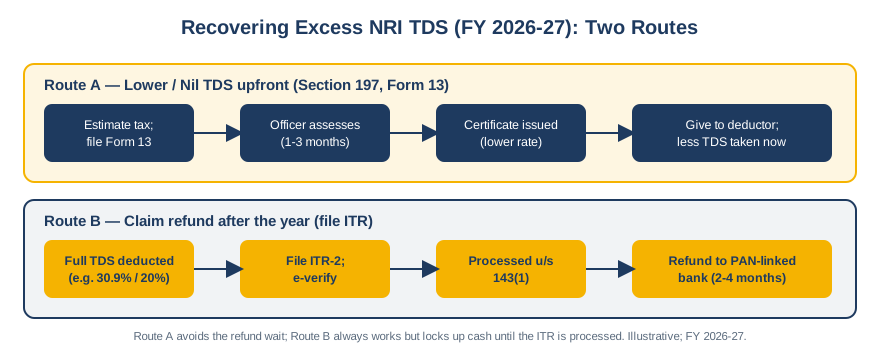
There are two ways to recover the gap between the TDS withheld (often 30.9% or 20%) and your real tax — fix it upfront with a Section 197 certificate, or claim it back later via your ITR:
When Useful:
- Your total income is below taxable limit
- You have losses to set off
- You have high deductions (80C, 80D, etc.)
- DTAA rate is lower than standard TDS rate
- You want to avoid refund cycle (immediate benefit)
5.2 Eligibility
You can apply if:
- Your estimated tax liability is NIL or lower than TDS
- You can justify with computation
- Valid reasons: No other income, high deductions, losses
Common Scenarios:
-
Senior citizen NRI with only FD income of ₹8 lakhs
- Normal TDS: 30.9% = ₹2.47 lakhs
- Actual tax: NIL (below basic exemption after standard deduction)
- Can get NIL TDS certificate
-
NRI with rental income but high interest on loan
- Rental income: ₹12 lakhs
- Interest on housing loan: ₹8 lakhs
- Net taxable: ₹4 lakhs (after standard deduction)
- Can apply for lower TDS (say 10% instead of 30%)
5.3 Application Process
Step 1: Calculate Estimated Tax Liability
- Total income from all sources
- Less: Deductions (80C, 80D, home loan interest, etc.)
- Tax on net taxable income
- Determine appropriate TDS rate
Step 2: File Form 13
- Online on income tax portal
- Details: Income sources, estimated income, deductions, proposed TDS rate
- Supporting documents: Last ITR, TDS certificates, bank statements
Step 3: Submit Documents
- Upload PDFs of supporting documents
- Self-attested copies
Step 4: Assessment by Tax Officer
- Officer reviews application
- May ask for clarifications
- Issues certificate if satisfied
Step 5: Receive Certificate
- Valid for financial year (or shorter period)
- Submit to deductor (bank, tenant, company)
- Deductor applies lower/nil TDS
Timeline:
- Processing: 1-3 months (can be longer)
- Apply by June/July for full-year benefit
Validity:
- Typically for one financial year
- Must renew annually
5.4 Sample Computation for Section 197
Example: Senior Citizen NRI with NRO FD
| Particulars | Amount (₹) |
|---|---|
| NRO FD Interest | 8,00,000 |
| Less: Standard Deduction | 50,000 |
| Net Income | 7,50,000 |
| Less: Section 80C (if any) | 1,50,000 |
| Less: Section 80D (Senior citizen) | 50,000 |
| Taxable Income | 5,50,000 |
| Tax on ₹5,50,000 (for senior citizen) | 20,000 |
| Add: Cess 4% | 800 |
| Total Tax Liability | 20,800 |
| Effective Tax Rate | 2.6% |
Conclusion: Can apply for TDS at 5% (instead of 30.9%)
6. TDS Certificates & Form 26AS
6.1 TDS Certificates
Form 16A (Non-Salary Income):
- Issued by bank, tenant, company (deductor)
- Quarterly certificate
- Shows: TDS amount, PAN, transaction details
- Download from TRACES portal
Form 16 (Salary Income):
- Issued by employer
- Annual certificate
- Shows: Salary, exemptions, deductions, TDS
- Issued by May 31 of the relevant Tax Year
6.2 Form 26AS (Annual Tax Statement)
What is Form 26AS?
- Consolidated tax statement
- Shows all TDS deducted on your PAN
- Also shows: Advance tax, self-assessment tax, refunds
- Updated regularly (monthly)
Where to Download:
- Income tax e-filing portal
- Using PAN and password
- Or via net banking (some banks offer)
Sections in Form 26AS:
- Part A: TDS on salary
- Part B: TDS on non-salary (interest, rent, dividend, etc.)
- Part C: Tax collected at source (TCS)
- Part D: Advance tax, self-assessment tax, refunds
- Part E: Pending refunds
- Part F: AIR (Annual Information Return) transactions
- Part G: TDS defaults
How to Use:
- Verify TDS credits before filing ITR
- Match with Form 16/16A
- Report discrepancies to deductor
6.3 What if TDS Not Reflected in Form 26AS?
Common Reasons:
- Deductor hasn't deposited TDS with government
- Wrong PAN quoted by deductor
- Delay in updating (wait 2-3 weeks after quarter end)
Action:
- Contact deductor
- Ask for proof of TDS payment (challan)
- If deductor failed to deposit: File complaint with I-T department
- You can still claim TDS in ITR if you have Form 16A (but may face scrutiny)
7. TDS Refund Process
7.1 When Do You Get TDS Refund?
TDS > Actual Tax Liability
Example:
- NRO FD interest: ₹5,00,000
- TDS deducted: ₹1,54,500 (30.9%)
- Actual tax liability: ₹1,00,000
- Refund: ₹54,500
Common Scenarios:
- High TDS on property sale (20%) but low capital gains
- TDS on salary but high deductions (80C, 80D, HRA)
- TDS on interest but total income below taxable limit
- Losses to set off against gains
7.2 How to Claim TDS Refund
Step 1: File Income Tax Return (ITR)
- Mandatory to claim refund
- Choose correct ITR form (ITR-2 for NRIs typically)
- Due date: July 31 (can be extended to December)
- E-filing is mandatory
Step 2: Report All Income & TDS
- Include all sources of income
- Report TDS as per Form 26AS
- Claim deductions (80C, 80D, etc.)
- Calculate tax liability
Step 3: Verify ITR
- E-verify using Aadhaar OTP, net banking, or
- Send signed ITR-V to CPC Bangalore within 120 days
- E-verification is faster (instant)
Step 4: Processing by I-T Department
- ITR processed within 1-3 months (typically)
- Intimation sent under Section 143(1)
- Shows: Tax computed, refund/demand
Step 5: Refund Credited
- Directly to bank account linked with PAN
- Time: 2-8 weeks after ITR processing
- Refund with interest (if delayed beyond 3 months)
Timeline:
- File ITR by July 31
- E-verify immediately
- Processing: August-October
- Refund: September-November
- Total: 2-4 months after filing
7.3 Tracking Refund Status
Online Tracking:
- Income tax e-filing portal
- Login > My Account > Refund Status
- Or https://tin.tin.nsdl.com/oltas/refundstatuslogin.html
Refund Status:
- Refund approved
- Refund paid
- Refund failed (wrong bank account)
- Refund adjusted (against outstanding demand)
If Refund Failed:
- Update bank account on portal
- Re-issue refund request
8. Common TDS Mistakes & How to Avoid
8.1 Mistake #1: Not Providing PAN to Deductor
Problem:
- If you don't provide PAN, TDS at highest rate (20% or 30%)
- For NRIs: 30% instead of DTAA rate
- No TDS credit in Form 26AS
Solution:
- Always provide PAN to bank, tenant, company
- Ensure PAN is active and linked with Aadhaar
8.2 Mistake #2: Not Claiming DTAA Benefits
Problem:
- TDS at 30% instead of DTAA rate (10-15%)
- Loss of 15-20% on income
- Example: ₹10L interest, loss of ₹1.5-2L
Solution:
- Obtain TRC from country of residence
- Submit Form 10F and TRC to deductor
- Do this before income is paid
8.3 Mistake #3: Not Filing ITR
Problem:
- Cannot claim TDS refund
- TDS gone forever (forfeited to government)
- Miss tax planning opportunities
Solution:
- Always file ITR, even if income is below taxable limit
- Deadline: July 31 (don't miss!)
- E-filing is mandatory
8.4 Mistake #4: Wrong ITR Form
Problem:
- ITR rejected or delayed processing
- Penalty for wrong form
Solution:
- NRIs with salary, house property, capital gains: ITR-2
- NRIs with business income: ITR-3
- NRIs cannot file ITR-1 (Sahaj)
8.5 Mistake #5: Not Reporting Foreign Assets
Problem:
- Penalty up to ₹10 lakh
- Scrutiny and prosecution
Solution:
- Always file Schedule FA (Foreign Assets)
- Disclose: Foreign bank accounts, property, investments
- Even if balance is zero
8.6 Mistake #6: Not Verifying Form 26AS
Problem:
- TDS shown in Form 16A not in Form 26AS (deductor fraud)
- Claiming wrong TDS (excess credit)
Solution:
- Download Form 26AS before filing ITR
- Match with TDS certificates (Form 16/16A)
- Report discrepancies
8.7 Mistake #7: Missing Form 15CA/15CB for Repatriation
Problem:
- Bank refuses to remit funds
- Penalty for non-compliance
Solution:
- File Form 15CA/15CB before requesting bank remittance
- Engage CA for amounts > ₹5 lakhs
- Keep documents ready
9. Special Cases & Scenarios
9.1 Sale of Property by NRI
TDS Scenario:
- Property sale: ₹2 crore
- Purchase price (10 years ago): ₹80 lakh
- Indexed cost: ₹1.30 crore
- LTCG: ₹70 lakh
- Tax on LTCG: ₹14 lakh (20% with indexation)
TDS Deduction:
- Buyer deducts TDS: ₹40 lakh (20% of ₹2 crore)
- But actual tax: ₹14 lakh
- Excess TDS: ₹26 lakh
How to Reduce TDS:
- Apply for Section 197 certificate (lower TDS)
- Show computation of actual LTCG and tax
- Get certificate for TDS at 10% or 15% (instead of 20%)
- OR claim refund via ITR (takes time)
Form 15CA/15CB:
- Required if repatriating sale proceeds abroad
- CA will certify tax has been paid (₹14 lakh)
- Remaining ₹1.86 crore (₹2 cr - ₹14 lakh tax) can be repatriated
9.2 NRI Receiving Rental Income
Scenario:
- Monthly rent: ₹60,000
- Annual rent: ₹7,20,000
- Tenant should deduct TDS: 30.9% = ₹2,22,480
Challenge:
- Many tenants don't have TAN or don't deduct TDS
Solution:
-
Include TDS clause in rent agreement
- Specify TDS to be deducted
- Give tenant your PAN
-
Help tenant get TAN
- Apply online: https://www.tin-nsdl.com
- Takes 2-3 weeks
-
If tenant won't deduct:
- You must pay advance tax
- Quarterly payments (June 15, Sep 15, Dec 15, Mar 15)
- 15%, 45%, 75%, 100% of tax
- Failure leads to interest penalty
-
Apply for Section 197 certificate
- Reduce TDS to 10-15% (if eligible)
- Tenant deducts lower amount
9.3 NRI Selling Mutual Funds
TDS:
- No TDS on mutual fund redemption (equity or debt)
- You must pay tax via ITR or advance tax
Tax Rates:
-
Equity MF:
- LTCG (>12 months): 12.5% on gains > ₹1.25 lakh
- STCG (<12 months): 20%
-
Debt MF:
- LTCG (>36 months): 20% with indexation
- STCG (<36 months): As per slab (30.9% for NRIs)
Tax Payment:
- Pay via advance tax or when filing ITR
- No TDS, so ensure you pay on time to avoid interest
9.4 NRI Receiving Dividend
Pre-April 2020: DDT deducted by company (NRI got net dividend) Post-April 2020: Dividend taxable in hands of NRI
TDS on Dividend:
- 20% (no DTAA) or 10-15% (with DTAA)
- No threshold (TDS from first rupee for NRIs)
Example:
- Dividend: ₹1,00,000
- TDS (no DTAA): ₹20,000
- TDS (USA DTAA): ₹15,000
- Net dividend: ₹80,000 or ₹85,000
Final Tax:
- Dividend added to income
- Taxed as per slab (but for NRIs, typically 30%)
- Claim TDS credit in ITR
10. Action Plan & Best Practices
10.1 Start of Financial Year (April)
- Review income sources for the year
- Estimate tax liability
- Apply for Section 197 certificate (if applicable)
- Obtain TRC (if claiming DTAA benefits)
- Submit Form 10F and TRC to deductors
- Update bank with PAN, contact details
10.2 During the Year (Ongoing)
- Track income and TDS deducted
- Collect TDS certificates (Form 16A) quarterly
- Pay advance tax (if applicable)
- Monitor Form 26AS quarterly
- Keep records of all income and expenses
10.3 End of Financial Year (March)
- Collect all TDS certificates
- Download final Form 26AS (after April 10)
- Compile investment proofs (80C, 80D)
- Calculate total income and tax liability
- Gather documents for ITR filing
10.4 ITR Filing (April-July)
- Choose correct ITR form (ITR-2 or ITR-3)
- Report all income sources
- Claim all deductions
- Report TDS as per Form 26AS
- Fill Schedule FA (foreign assets)
- E-verify ITR immediately
- File by July 31 (or extended deadline)
10.5 Post-Filing (August onwards)
- Track ITR processing status
- Respond to I-T notices (if any)
- Track refund status
- Update bank account if refund fails
- Keep ITR acknowledgment and tax records (7 years)
10.6 Best Practices
1. Maintain Records:
- All TDS certificates (Form 16/16A)
- Bank statements
- Investment proofs
- Form 26AS
- ITR acknowledgments
2. Plan Taxes:
- Estimate tax liability at start of year
- Use Section 197 to reduce TDS upfront
- Pay advance tax if no TDS
3. Claim DTAA:
- Get TRC early (takes 2-3 months)
- Submit to all deductors
- Save 15-20% on TDS
4. File ITR on Time:
- Don't miss July 31 deadline
- E-verify immediately
- Claim all refunds
5. Professional Help:
- Engage CA for complex cases
- Get help with Section 197, DTAA, property sale
- Cost: ₹5,000-₹25,000 (worth it for large refunds)
11. Quick Reference Tables
11.1 TDS Rates Summary
| Income Type | NRI Rate (No DTAA) | With DTAA (Typical) |
|---|---|---|
| NRO Interest | 30.9% | 10-15% |
| Rental Income | 30.9% | 10-15% |
| Dividend | 20% | 10-15% |
| Property Sale | 20% | 10-20% |
| Salary | As per slab | As per slab |
| Professional Fees | 10% | 10% |
11.2 Important Deadlines
| Event | Deadline |
|---|---|
| Advance Tax (Q1) | June 15 (15% of tax) |
| Advance Tax (Q2) | September 15 (45% cumulative) |
| Advance Tax (Q3) | December 15 (75% cumulative) |
| Advance Tax (Q4) | March 15 (100%) |
| ITR Filing | July 31 (can be extended) |
| Belated ITR | December 31 |
| Revised ITR | December 31 |
| ITR Verification | 120 days from filing |
11.3 Form Checklist
| Form | Purpose | When Required |
|---|---|---|
| Form 10F | DTAA claim | Claiming treaty benefits |
| Form 15CA | Foreign remittance | Repatriating funds abroad |
| Form 15CB | CA certificate | Remittance > ₹5 lakh |
| Form 13 | Lower/Nil TDS | Reducing TDS upfront |
| Form 16A | TDS certificate (non-salary) | Received from deductor |
| Form 16 | TDS certificate (salary) | Received from employer |
| Form 26AS | Annual tax statement | Download before ITR filing |
| ITR-2 | Tax return (for NRIs) | Annual filing |
12. Conclusion
TDS for NRIs is complex but manageable with proper planning and knowledge. Key takeaways:
- Higher TDS rates for NRIs (30%) but can be reduced via DTAA or Section 197
- Always file ITR to claim refunds and stay compliant
- DTAA is your friend: Save 15-20% by claiming treaty benefits
- Form 15CA/15CB required for foreign remittances
- Section 197 allows lower TDS upfront (avoid refund hassle)
- Keep meticulous records of all income, TDS, and investments
- Engage professionals for complex cases (property sale, business income)
With this guide, you should be well-equipped to handle TDS matters efficiently and optimize your tax outflow.
Disclaimer
This guide is for informational purposes only and is based on tax laws applicable for FY 2026-27 (Tax Year 2026-27), including the Income Tax Act 2025 effective 1 April 2026. Tax laws are subject to change. TDS rates and rules may vary based on specific circumstances and amendments.
This is not professional tax advice. Consult a qualified Chartered Accountant or tax advisor for personalized guidance on your specific situation.
The author and NRI Wealth Partners are not liable for any decisions made based on this guide.
Prepared by: NRI Wealth Partners Tax Team Updated: June 2026 Contact: tax@nriwealthpartners.com Website: www.nriwealthpartners.com
For personalized TDS planning, Section 197 applications, DTAA certificate assistance, and ITR filing support, contact our tax advisory team.