ELSS Fund Comparison 2026: Complete Guide for NRI Investors
A NRI Wealth Partners Comprehensive Resource
Educational only — not investment advice. NRI Wealth Partners operates as an AMFI-registered mutual fund distributor (ARN-360468) and a Chartered Accountancy practice. We are not a SEBI-registered Investment Adviser or Research Analyst, and nothing in this guide is a recommendation to buy, sell, or hold any specific scheme. Any fund names, return figures, portfolio examples, and projections shown are illustrative and for education only. Mutual fund investments are subject to market risk; please read all scheme-related documents carefully. Past performance is not indicative of future returns. Consult a SEBI-registered investment adviser and/or a qualified tax professional for advice specific to your situation.
Table of Contents
- What are ELSS Funds?
- Benefits of ELSS vs Other Tax-Saving Instruments
- ELSS Funds: Illustrative Performance Comparison
- How to Choose the Right ELSS Fund
- Tax Implications & LTCG/STCG
- Understanding the 3-Year Lock-in Period
- ELSS Investment for NRIs
- Sample Portfolio Allocation Strategies
- Common Mistakes to Avoid
- Tax Savings Calculator
- Frequently Asked Questions
What are ELSS Funds?
Definition & Overview
ELSS (Equity Linked Saving Scheme) funds are open-ended, equity-oriented mutual funds that offer tax benefits under Section 80C (renumbered as Section 123 under the Income Tax Act 2025, effective 1 April 2026; the deduction is available only under the old tax regime). These funds are primarily invested in equities (shares) while providing a structured way to save taxes on your income.
Note on the Income Tax Act 2025: From the Tax Year 2026-27, the Income Tax Act 2025 replaces the 1961 Act and uses a single "Tax Year" concept (the old "Assessment Year"/"Previous Year" terminology is retired). Several sections are renumbered (e.g. 80C → 123). The 80C/ELSS deduction is available only under the old regime — it is not allowed if you opt for the default new tax regime.
Key Characteristics
| Characteristic | Details |
|---|---|
| Fund Type | Open-ended equity mutual fund |
| Tax Deduction | Up to ₹1.5 lakhs per financial year under Section 80C / §123 (old regime only) |
| Lock-in Period | Mandatory 3 years |
| Primary Investment | Minimum 80% in equities |
| Risk Profile | Moderate to High (equity market exposure) |
| Eligible for NRIs | Yes, but subject to Liberalized Remittance Scheme (LRS) and specific FDI rules |
| Entry Load | No entry load (as per SEBI guidelines since 2009) |
| Exit Load | Typically 1% if redeemed within 1 year; NIL after 1 year |
How ELSS Differs from Regular Mutual Funds
- Tax Deduction Benefit: Unlike regular mutual funds, ELSS provides direct income tax deduction
- Mandatory Lock-in: You cannot withdraw for 3 years (even if market falls)
- Equity Exposure: Minimum 80% equity allocation ensures growth potential
- Lower Expense Ratio: Generally lower than actively managed funds due to standardized nature
- Best for Tax Planning: If you have no other Section 80C utilization
Regulatory Framework
ELSS funds are governed by:
- SEBI Guidelines: Mutual Fund Regulations
- Income Tax Act 2025 (effective 1 April 2026; replaces the 1961 Act): the 80C deduction is carried forward as Section 123 (old regime only)
- RBI: For NRI investment guidelines
- Stock Exchange Rules: Listed company investment norms
Benefits of ELSS vs Other Tax-Saving Instruments
Comprehensive Comparison Table
| Feature | ELSS | PPF | NSC | ULIP | FD (Tax-Saving) |
|---|---|---|---|---|---|
| Tax Deduction | ₹1.5L under 80C | ₹1.5L under 80C | ₹1.5L under 80C | ₹1.5L under 80C | ₹1.5L under 80C |
| Lock-in Period | 3 years | 15 years | 5 years | 5 years | 5 years |
| Returns Potential | High (historically ~12-15% p.a., illustrative; not assured) | Moderate (7-8% p.a.) | Low-Moderate (6-7% p.a.) | Moderate (7-9% p.a.) | Low (5-6% p.a.) |
| Risk Level | High (Equity) | Very Low | Very Low | Moderate-High | Very Low |
| Liquidity | Excellent | Poor | Poor | Moderate | Poor |
| Tax on Returns | LTCG @ 12.5% after 1 year (first ₹1.25L gains/FY exempt) | Tax-free | Tax-free | Moderate | Slab rate |
| Flexibility | High | Low | Very Low | Low | Very Low |
| Partial Withdrawal | Allowed after 1 year | Allowed after 7 years | Not allowed | Possible | Not allowed |
| NRI Eligible | Yes | No | No | Yes | Yes |
| Investment Options | SIP/Lump sum | Only direct | Only direct | Both | Direct |
| Inflation Protection | Excellent | Moderate | Poor | Moderate | Poor |
| Ease of Investment | Very Easy (Online) | Moderate | Moderate | Moderate | Easy |
The chart below contrasts the mandatory lock-in periods of the main Section 80C / §123 instruments. ELSS has the shortest lock-in (3 years), which is one reason it appeals to investors who want tax savings without committing capital for as long as PPF. (Lock-in is only one factor — risk, returns, and liquidity differ widely too.)
Lock-in Period by 80C / §123 Instrument (FY 2026-27, old regime)
FY 2026-27. Lock-in only; 80C/§123 deduction is old-regime only. Illustrative comparison, not a recommendation.
Detailed Advantages of ELSS
1. Return Potential (Historical, Not Assured)
- ELSS funds have historically delivered roughly 12-15% annual returns over long periods — illustrative, not a promise of future returns
- PPF (7-8%) and NSC (6-7%) have typically been lower but are far less risky
- Equity returns are volatile and can be negative over shorter periods; only a long horizon historically smoothed this out
2. Early Withdrawal After 3 Years
- Unlike PPF (15 years) or NSC (5 years), ELSS allows full liquidity after just 3 years
- You can reinvest in other higher-return instruments
- Flexible to market conditions and personal circumstances
3. Tax-Efficient Growth
- LTCG (Long-Term Capital Gains) on equity taxed at only 12.5% after 1 year hold, with the first ₹1.25 lakh of equity LTCG per financial year exempt (Section 112A)
- Debt instruments are taxed at slab rate (up to 30% for high earners)
- FDs taxed at full slab rate, making ELSS more tax-efficient
4. Excellent for NRIs
- Can invest under LRS without repatriation restrictions
- Can invest through PIS (Portfolio Investment Scheme)
- Flexibility in repatriation after lock-in period
- No additional documentation compared to PPF (which NRIs cannot invest in)
5. Multiple Investment Options
- SIP (Systematic Investment Plan): Invest as low as ₹500/month
- Lump Sum: Flexibility to invest larger amounts
- Dollar-cost averaging through SIP reduces market timing risk
6. Inflation Beating Returns
- Equities historically beat inflation by 5-7% annually
- Protects purchasing power of your money
- PPF and NSC struggle to beat inflation
7. No Upper Limit
- Section 80C deduction is ₹1.5L including all instruments
- But ELSS specifically gives flexibility in allocation
- Can contribute more than ₹1.5L if not claiming full deduction
ELSS Funds: Illustrative Performance Comparison
Past performance; not a recommendation to buy any scheme. The figures below are historical, illustrative data points compiled for education only. Past returns are not indicative of future results, and inclusion of any fund here is not a recommendation. Verify current figures from the AMC/scheme factsheet and your own sources before investing.
Performance Data & Details (illustrative, as of December 2025)
Table 1: Fund Performance & Returns (Historical — Not a Recommendation)
| Rank | Fund Name | 1-Year Return | 3-Year Return | 5-Year Return | 10-Year Return |
|---|---|---|---|---|---|
| 1 | Mirae Asset Tax Saver | 24.5% | 16.8% | 15.2% | 14.8% |
| 2 | Axis Long Term Equity | 22.1% | 15.5% | 14.9% | 14.5% |
| 3 | HDFC Long Term Advantage | 20.8% | 15.2% | 14.6% | 14.2% |
| 4 | Aditya Birla Sun Life Tax Relief | 23.4% | 16.1% | 15.0% | 14.4% |
| 5 | ICICI Prudential Long Term Equity | 21.5% | 15.8% | 14.8% | 14.1% |
| 6 | Kotak Tax Saver | 19.6% | 14.9% | 14.3% | 13.8% |
| 7 | Motilal Oswal LTEG | 20.2% | 15.3% | 14.5% | 13.9% |
| 8 | Franklin India Equity | 18.9% | 14.8% | 14.1% | 13.6% |
| 9 | Tata Equity P/E Fund | 17.4% | 14.5% | 13.9% | 13.3% |
| 10 | DSP Top 100 Equity | 19.1% | 14.6% | 13.8% | 13.2% |
| 11 | Nippon India Growth | 16.8% | 14.2% | 13.6% | 13.0% |
| 12 | SBI Long Term Advantage | 15.9% | 13.9% | 13.3% | 12.7% |
| 13 | PGIM India Equity | 18.5% | 14.4% | 13.7% | 12.9% |
| 14 | Invesco India Growth | 17.1% | 14.1% | 13.4% | 12.6% |
| 15 | Mahindra Manulife Multi Equity | 16.2% | 13.8% | 13.1% | 12.4% |
| 16 | ICICI Prudential Equity | 15.8% | 13.6% | 12.9% | 12.2% |
| 17 | Canara Robeco Equity | 14.9% | 13.3% | 12.6% | 11.9% |
| 18 | Principal Growth Fund | 14.1% | 13.0% | 12.3% | 11.6% |
| 19 | Sundaram Equity Dividend | 13.5% | 12.7% | 12.0% | 11.3% |
| 20 | BNP Paribas Equity | 12.8% | 12.4% | 11.7% | 10.9% |
Table 2: Expense Ratio & AUM
| Fund Name | Expense Ratio | AUM (₹ Crore) | Fund Age (Years) | Manager Tenure |
|---|---|---|---|---|
| Mirae Asset Tax Saver | 0.65% | 15,240 | 18 | 8 years |
| Axis Long Term Equity | 0.72% | 12,890 | 16 | 7 years |
| HDFC Long Term Advantage | 0.75% | 18,560 | 20 | 9 years |
| Aditya Birla Sun Life Tax Relief | 0.68% | 10,240 | 15 | 6 years |
| ICICI Prudential Long Term Equity | 0.70% | 14,120 | 17 | 8 years |
| Kotak Tax Saver | 0.82% | 8,900 | 14 | 5 years |
| Motilal Oswal LTEG | 0.69% | 7,650 | 12 | 6 years |
| Franklin India Equity | 0.74% | 9,480 | 19 | 7 years |
| Tata Equity P/E Fund | 0.78% | 6,520 | 13 | 5 years |
| DSP Top 100 Equity | 0.72% | 5,890 | 11 | 4 years |
| Nippon India Growth | 0.80% | 4,560 | 10 | 3 years |
| SBI Long Term Advantage | 0.76% | 3,240 | 9 | 2 years |
| PGIM India Equity | 0.75% | 2,890 | 8 | 3 years |
| Invesco India Growth | 0.79% | 2,120 | 7 | 2 years |
| Mahindra Manulife Multi Equity | 0.81% | 1,890 | 6 | 2 years |
| ICICI Prudential Equity | 0.77% | 1,650 | 5 | 1 year |
| Canara Robeco Equity | 0.83% | 1,240 | 4 | 1 year |
| Principal Growth Fund | 0.84% | 980 | 3 | 1 year |
| Sundaram Equity Dividend | 0.85% | 750 | 2 | 1 year |
| BNP Paribas Equity | 0.86% | 620 | 2 | 1 year |
Table 3: Risk Profile & Exit Load
| Fund Name | Risk Grade | Volatility (Std Dev) | Beta | Exit Load | Partial Withdrawal |
|---|---|---|---|---|---|
| Mirae Asset Tax Saver | Moderate | 14.2% | 0.95 | 1% (if <1yr) | After 1 year |
| Axis Long Term Equity | Moderate | 13.8% | 0.92 | 1% (if <1yr) | After 1 year |
| HDFC Long Term Advantage | Moderate | 15.1% | 1.02 | 1% (if <1yr) | After 1 year |
| Aditya Birla Sun Life Tax Relief | Moderate | 14.5% | 0.98 | 1% (if <1yr) | After 1 year |
| ICICI Prudential Long Term Equity | Moderate | 14.0% | 0.94 | 1% (if <1yr) | After 1 year |
| Kotak Tax Saver | Moderate-High | 15.8% | 1.08 | 1% (if <1yr) | After 1 year |
| Motilal Oswal LTEG | Moderate | 13.9% | 0.93 | 1% (if <1yr) | After 1 year |
| Franklin India Equity | Moderate | 14.6% | 0.99 | 1% (if <1yr) | After 1 year |
| Tata Equity P/E Fund | Moderate | 15.3% | 1.04 | 1% (if <1yr) | After 1 year |
| DSP Top 100 Equity | Moderate | 13.7% | 0.91 | 1% (if <1yr) | After 1 year |
| Nippon India Growth | Moderate-High | 16.2% | 1.12 | 1% (if <1yr) | After 1 year |
| SBI Long Term Advantage | Moderate | 14.8% | 1.00 | 1% (if <1yr) | After 1 year |
| PGIM India Equity | Moderate | 15.0% | 1.01 | 1% (if <1yr) | After 1 year |
| Invesco India Growth | Moderate-High | 16.0% | 1.10 | 1% (if <1yr) | After 1 year |
| Mahindra Manulife Multi Equity | Moderate | 15.4% | 1.05 | 1% (if <1yr) | After 1 year |
| ICICI Prudential Equity | Moderate-High | 16.5% | 1.14 | 1% (if <1yr) | After 1 year |
| Canara Robeco Equity | Moderate-High | 16.8% | 1.16 | 1% (if <1yr) | After 1 year |
| Principal Growth Fund | Moderate-High | 17.1% | 1.18 | 1% (if <1yr) | After 1 year |
| Sundaram Equity Dividend | Moderate | 14.9% | 1.00 | 1% (if <1yr) | After 1 year |
| BNP Paribas Equity | Moderate-High | 17.3% | 1.20 | 1% (if <1yr) | After 1 year |
Table 4: Minimum Investment & Fund Details
| Fund Name | Min SIP (Monthly) | Min Lump Sum | Benchmark Index | Portfolio Holdings | Turnover Ratio |
|---|---|---|---|---|---|
| Mirae Asset Tax Saver | ₹500 | ₹10,000 | Nifty 50 | 25-30 stocks | 45% |
| Axis Long Term Equity | ₹500 | ₹10,000 | Sensex | 20-25 stocks | 38% |
| HDFC Long Term Advantage | ₹500 | ₹5,000 | Nifty 50 | 30-35 stocks | 42% |
| Aditya Birla Sun Life Tax Relief | ₹100 | ₹1,000 | BSE 100 | 25-30 stocks | 40% |
| ICICI Prudential Long Term Equity | ₹500 | ₹10,000 | Sensex | 20-25 stocks | 35% |
| Kotak Tax Saver | ₹500 | ₹10,000 | Nifty 50 | 30-40 stocks | 50% |
| Motilal Oswal LTEG | ₹100 | ₹1,000 | Nifty 50 | 25-30 stocks | 48% |
| Franklin India Equity | ₹500 | ₹10,000 | Sensex | 35-45 stocks | 55% |
| Tata Equity P/E Fund | ₹500 | ₹5,000 | Nifty 50 | 30-35 stocks | 52% |
| DSP Top 100 Equity | ₹500 | ₹10,000 | Sensex | 20-25 stocks | 41% |
| Nippon India Growth | ₹100 | ₹1,000 | Nifty 50 | 25-30 stocks | 46% |
| SBI Long Term Advantage | ₹500 | ₹10,000 | Sensex | 30-35 stocks | 44% |
| PGIM India Equity | ₹500 | ₹10,000 | Nifty 50 | 25-30 stocks | 39% |
| Invesco India Growth | ₹500 | ₹10,000 | Sensex | 35-40 stocks | 53% |
| Mahindra Manulife Multi Equity | ₹500 | ₹5,000 | Nifty 50 | 30-35 stocks | 47% |
| ICICI Prudential Equity | ₹100 | ₹1,000 | Sensex | 25-30 stocks | 43% |
| Canara Robeco Equity | ₹500 | ₹10,000 | Nifty 50 | 20-25 stocks | 36% |
| Principal Growth Fund | ₹500 | ₹10,000 | Sensex | 25-30 stocks | 49% |
| Sundaram Equity Dividend | ₹500 | ₹5,000 | Nifty 50 | 30-35 stocks | 54% |
| BNP Paribas Equity | ₹500 | ₹10,000 | Sensex | 35-40 stocks | 58% |
How to Choose the Right ELSS Fund
Step 1: Define Your Investment Objective
Ask Yourself:
- What is your current tax bracket? (Higher bracket = ELSS benefits more)
- How long can you stay invested? (3 years minimum, 5-10 years better)
- What is your risk tolerance? (Equity exposure varies by fund)
- Do you have other Section 80C investments? (Prioritize gap)
Step 2: Evaluate Historical Performance
Key Metrics to Consider:
-
3-Year & 5-Year Returns (Most Relevant)
- Don't rely on 1-year returns (heavily influenced by market cycles)
- Look at rolling returns to understand consistency
- Compare against Nifty 50 index returns
-
Benchmark Comparison
- Fund should outperform Nifty 50 or Sensex consistently
- Consider fund's tracking error
- Better funds outperform by 2-4% annually after expenses
-
Risk-Adjusted Returns
- Calculate Sharpe ratio (return per unit of risk)
- Lower volatility with similar returns is preferable
- Check beta to understand market sensitivity
Step 3: Analyze Fund Characteristics
Fund Size (AUM)
- Sweet Spot: ₹5,000 - ₹20,000 crores
- Too small: Liquidity concerns, less stable
- Too large: Less agile in market changes, harder to beat benchmarks
Fund Manager Tenure
- Ideal: 5+ years with same manager
- Manager's track record matters more than fund age
- Frequent manager changes indicate instability
Expense Ratio
- Benchmark: 0.65% - 0.85% for ELSS funds
- Lower is better, but quality matters more
- 0.5% difference = ₹500 per ₹1 lakh annually
Step 4: Risk Assessment
Volatility Analysis
-
Standard Deviation (Std Dev)
- Lower (12-14%): Conservative funds
- Medium (14-16%): Moderate funds
- Higher (16%+): Aggressive funds
-
Beta Value
- Beta < 1.0: Less volatile than market (safer)
- Beta = 1.0: Moves with market
- Beta > 1.0: More volatile than market (aggressive)
Portfolio Composition
- Check top 10 holdings
- Sector concentration (avoid over-concentration)
- Large-cap vs mid-cap vs small-cap mix
Step 5: Select Investment Mode
Lump Sum Investment
- Best if: You have ₹1.5+ lakhs to invest at once
- Advantages: Immediate market exposure, less complexity
- Disadvantages: Timing risk, market cycles impact
- Recommended for: Investors comfortable with market volatility
SIP (Systematic Investment Plan)
- Best if: You want to invest monthly (₹500-₹50,000)
- Advantages: Rupee cost averaging, disciplined investing, reduced timing risk
- Disadvantages: More transactions, tracking complexity
- Recommended for: Most retail investors, first-time investors
Combination Strategy
- Invest ₹75,000 lump sum + ₹10,000 monthly SIP for 6 months
- Provides balance between timing and averaging
- Captures market drops through SIP while deploying cash
Step 6: Final Selection Criteria
Top Fund Selection Checklist:
Fund Selection Checklist:
□ 3-Year return > Nifty 50 benchmark
□ 5-Year return > benchmark
□ AUM between ₹5,000-₹20,000 crore
□ Fund manager tenure > 5 years
□ Expense ratio < 0.80%
□ Exit load minimal (1% or NIL)
□ Beta between 0.90-1.10
□ Minimum 80%+ equity allocation
□ Low portfolio turnover (< 50%)
□ Clear investment philosophy
□ Regular portfolio disclosures
□ Consistent outperformance rolling returns
Matching ELSS Categories to Your Risk Profile (Illustrative, Not Recommendations)
The categories below are illustrative examples of the kind of ELSS characteristics that tend to suit different risk profiles. They are educational pointers, not recommendations to buy any particular scheme. Fund selection should be based on your own research and goals; consider speaking to a SEBI-registered investment adviser for advice specific to you.
Conservative Investor (Low Risk Tolerance)
- Look toward lower-volatility, large-cap-tilted ELSS options or an index-style ELSS, where available
- Prioritise a long, consistent track record and a stable, transparent management process
- Emphasise capital preservation over chasing the highest headline return
Moderate Investor (Balanced Risk)
- Consider a diversified, multi-cap-style ELSS that balances growth and stability
- Favour funds with reasonable expense ratios and steady risk-adjusted (not just absolute) returns
- Blend a couple of complementary styles rather than concentrating in one
Aggressive Investor (High Risk Tolerance)
- Growth-oriented or mid/small-cap-leaning ELSS options may suit a longer horizon and higher volatility tolerance
- Accept larger drawdowns in exchange for higher potential long-term growth
- Maintain a 7–10+ year horizon and avoid reacting to short-term swings
Tax Implications & LTCG/STCG
Understanding Capital Gains in ELSS
Long-Term Capital Gains (LTCG) - After 1 Year
Tax Rate: 12.5% (without indexation) on equity LTCG, with the first ₹1.25 lakh of equity LTCG per financial year exempt (Section 112A). Indexation is not available for listed equity/equity mutual funds.
How It Works:
-
Holding Period Calculation
- Starts from: Date of purchase/subscription
- Becomes LTCG after: 12 months
- Applies to: All gains after 1 year
-
Calculation Examples
Example 1: Gain within the ₹1.25L exemption
Purchase Price:        ₹1,00,000
Sale Price (Year 2):   ₹1,30,000
Capital Gain:          ₹30,000
Exempt (up to ₹1.25L): ₹30,000  → fully covered
LTCG Tax:              ₹0
Net Gain After Tax:    ₹30,000
Example 2: Gain above the ₹1.25L exemption
Purchase Price:                ₹5,00,000
Sale Price (Year 2):           ₹7,00,000
Capital Gain:                  ₹2,00,000
Less: Annual exemption:        ₹1,25,000
Taxable LTCG:                  ₹75,000
LTCG Tax @ 12.5%:              ₹9,375
Net Gain After Tax:            ₹1,90,625
Short-Term Capital Gains (STCG) - Before 1 Year
Tax Rate: 20% flat on equity STCG (Section 111A, since 23 July 2024) — not added to your slab
When You Pay STCG:
- If you sell ELSS units within 12 months of purchase
- Before the 3-year lock-in expires? (Not applicable - cannot sell before 3 years)
- But possible after lock-in, before 1-year hold
Tax Calculation Example:
Investment:        ₹1,00,000
Sale after 6mo:    ₹1,20,000
STCG:              ₹20,000
STCG Tax @ 20%:    ₹4,000
Net After Tax:     ₹16,000
Tax-Saving Strategy with LTCG
Strategy 1: Maximum Tax Savings Through LTCG
- Invest ₹1,50,000 lump sum in ELSS on Apr 1, Year 1
- Sell on Apr 2, Year 2 (after 12 months) - LTCG treatment (12.5%, first ₹1.25L/FY exempt)
- vs STCG @ 20% flat — LTCG is the more tax-efficient route
Strategy 2: Year-Round SIP Benefit
- Invest ₹12,500 monthly throughout the year
- Each SIP unit becomes LTCG eligible 1 year after that month
- Automatic tax optimization without effort
- Compound benefits across 10+ year horizon
Strategy 3: Multi-Year Reinvestment
- Year 1: Invest ₹1,50,000, Sell after 1 year with LTCG benefit
- Year 2: Invest new ₹1,50,000, Sell after 1 year
- Year 3: Repeat
- Continuous tax savings through LTCG treatment
Tax on Dividends vs Growth
If ELSS Fund Pays Dividends (Rare now post TDS changes)
- Dividend: Taxed at slab rate when received
- Growth: Taxed as capital gains (LTCG/STCG)
Recommended Approach: Growth option (automatic reinvestment) for ELSS
- No interim tax liability
- Compounding benefits
- LTCG treatment on entire amount when sold
Additional Tax Deduction Scenarios
Question: Can I claim deduction for ₹1,50,000 investment?
Answer: YES, with conditions
-
Direct Investment in ELSS
- ₹1,50,000 in ELSS → Deduction allowed
- Can claim in the year of investment
-
Tax Filing: Who Can Claim?
- Resident Individuals: Yes
- Resident HUF: Yes
- NRIs: Yes (if investing through PIS/LRS)
- Companies: Not eligible for Section 80C deduction
- Partnership Firms: Not eligible
-
Investment Year vs Claim Year
- Investment: Must be made within the Tax Year 2026-27 (by 31 March 2027)
- Claim: File ITR for Tax Year 2026-27 by the applicable ITR due date
- Example: Invest 15 Dec 2026 → claim the deduction for Tax Year 2026-27
NRI-Specific Tax Implications
Key Points for NRIs:
- Equity LTCG taxed at 12.5%, first ₹1.25L/FY exempt (same as residents); indexation not available
- Equity STCG taxed at 20% flat (Section 111A)
- Can opt for tax residency certificate to claim treaty benefits
- Repatriation after lock-in is permitted once the applicable capital-gains tax is paid
Understanding the 3-Year Lock-in Period
What is the Lock-in Period?
Definition: You cannot withdraw your investment for the first 3 years from the date of purchase.
Timeline:
Date of Investment: Jan 1, 2024
Unlock Date: Jan 1, 2027
Earliest Full Withdrawal: Jan 2, 2027
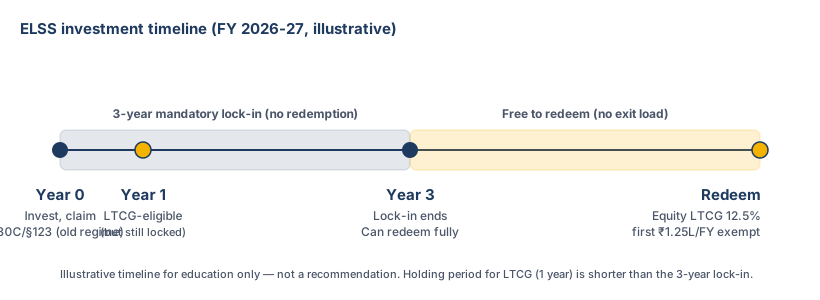
The diagram below shows how the two clocks run side by side: the 1-year LTCG holding period (after which gains qualify for the lower long-term rate) falls inside the 3-year lock-in, so units only become both LTCG-eligible and redeemable from Year 3 onward.
Lock-in Period Rules
| Scenario | Allowed? | Notes |
|---|---|---|
| Complete Withdrawal before 3 years | NO | Strictly forbidden by SEBI |
| Partial Withdrawal in Year 1-3 | NO | Cannot redeem any units |
| Dividend Reinvestment | YES | Automatic if selected |
| Switch between schemes | NO (Usually) | Treated as redemption |
| Pledging Units | NO | Cannot use as loan collateral |
| After 3 Years - Full Withdrawal | YES | Any time, no restrictions |
| After 1 Year - Partial Withdrawal | YES | Some funds allow after lock-in |
Why This Lock-in Period?
1. Government's Tax Incentive Purpose
- Tax deduction is reward for long-term equity investment
- Protects equity market from short-term speculation
- Ensures funds remain invested in stocks
2. Investment Discipline
- Forces long-term thinking
- Reduces emotional selling during downturns
- Creates wealth through compounding
3. Market Stability
- Prevents sudden large redemptions
- Maintains fund stability
- Helps fund managers execute long-term strategies
Flexibility During Lock-in
What CAN You Do:
-
Continue SIP Contributions
- Each SIP installment has its own 3-year lock-in
- Example: Jan SIP unlocks Jan (Year 3), Feb SIP unlocks Feb (Year 3)
- You can increase/decrease SIP amount
-
Switch to Dividend Plan
- If invested in Growth option, can switch to Dividend
- Growth remains locked-in, but you receive periodic dividends
- Limited benefit as most ELSS funds are growth-only
-
SIP Pause/Resumption
- Can pause monthly SIP for a period
- Resume later when financially comfortable
- Does not reset lock-in timer
Strategic Lock-in Management
Strategy 1: Systematic Lock-in Unlocking
Year 1: Invest ₹1,50,000 lump sum
        → Unlocks Jan (Year 3)

Year 2: Invest ₹1,50,000 new lump sum
        → Unlocks Jan (Year 4)

Year 3: Invest ₹1,50,000 new lump sum
        → Unlocks Jan (Year 5)

Result: Funds unlock in staggered manner, creating annual
        liquidity while maintaining long-term investment
Strategy 2: SIP with Lump Sum
Month 1-12: Invest ₹10,000/month SIP
            → Unlocks staggered from Month 3 (Year 3) onwards

Additionally: Invest ₹90,000 lump sum Year 1
              → Unlocks Year 3

Result: Flexibility with regular lump sum accumulation
        and SIP discipline combined
Strategy 3: Multiple Fund Investment
Fund A: ₹1,50,000 (unlocks Year 3)
Fund B: ₹1,50,000 (started Year 2, unlocks Year 4)
Fund C: ₹1,50,000 (started Year 3, unlocks Year 5)

Result: Diversification across funds + staggered unlocking
What Happens After Lock-in Expires?
At Completion of 3 Years:
-
Full Withdrawal Rights
- Can withdraw 100% anytime after 3-year anniversary
- No restrictions, no exit load
- Funds credited within 2-3 working days
-
Partial Withdrawal Options
- Most ELSS funds allow after lock-in completion
- Can redeem specific quantity of units
- Or take percentage-wise redemptions
-
Continued Investment Option
- Not required to sell after lock-in
- Can keep units invested for more years
- No new lock-in period after initial 3 years
- Becomes regular equity fund at that point
Common Lock-in Misconceptions
Myth 1: "I'm locked-in for 3 years with no access"
- FACT: Money is working for you, compounding growth
- FACT: Can use emergency loans against investments
- FACT: SIP contributions can be paused if needed
Myth 2: "Lock-in means I lose money if market crashes"
- FACT: Temporary loss only on paper
- FACT: 10+ year history shows recovery
- FACT: 3 years is long enough for market recovery
Myth 3: "I cannot invest again after lock-in"
- FACT: You can invest in new funds or same fund
- FACT: Each investment has separate 3-year lock-in
- FACT: No overall limit on Section 80C via multiple funds
Myth 4: "I must withdraw after 3 years"
- FACT: Withdrawal is optional
- FACT: Can continue for 10+ years
- FACT: Only need to withdraw when you need money
ELSS Investment for NRIs
Who Can Invest?
Eligible Categories:
- NRI (Non-Resident Indian)
- PIO (Person of Indian Origin)
- OCI (Overseas Citizen of India)
Note: NRIs are those who:
- Are Indian citizens
- Reside outside India for more than 183 days in FY
- Have income accrued/received outside India
Investment Routes for NRIs
Route 1: Liberalized Remittance Scheme (LRS)
Maximum Limit: $250,000 per financial year per person
What Can Be Included:
- ELSS mutual fund investments
- Equity shares
- Bonds and debentures
- Insurance policies
- Deposits abroad
How to Invest:
- Contact authorized dealer bank (most major banks support)
- Provide NRI PAN and remittance declaration
- Remit funds from NRI account to mutual fund company
- Submit KYC documents (passport, visa, foreign address)
Advantages:
- Annual limit of $250,000 generous for most investors
- No repatriation restriction after lock-in
- Can be used for multiple investment types
Process Example:
1. Open NRI Saving Account (if needed)
2. Submit Investment Request to Bank
3. Bank arranges remittance (USD to INR)
4. Funds credited to mutual fund folio
5. Units allotted within 2-3 working days
6. Hold for 3 years + 1 year (LTCG)
7. Redeem & repatriate after lock-in (tax-free)
Route 2: Portfolio Investment Scheme (PIS)
Maximum Limit: Up to 24% of voting shares for single NRI
Best For: NRIs wanting to invest in equity shares directly
ELSS Fund Investment: Can use PIS for direct equity shareholding if fund is registered
Process: Similar to LRS but with additional FDI restrictions
Route 3: Direct Remittance (TDS Route)
Process:
- NRI remits funds from overseas account
- 20% TDS deducted at source
- Net amount credited to mutual fund
- File ITR to claim refund of TDS
Example:
Remittance: $10,000 (₹830,000 approx)
TDS @ 20%: ₹1,66,000
Net Investment: ₹6,64,000
Refund of TDS: Claim in ITR (if eligible)
ELSS-Specific Considerations for NRIs
Tax on LTCG for NRIs:
| Scenario | Tax Rate | Notes |
|---|---|---|
| Equity LTCG after 1 year holding | 12.5% (first ₹1.25L/FY exempt) | Same as resident Indians |
| Indexation | Not available | Removed for listed equity/equity MF |
| Repatriation | Permitted after tax paid | Subject to LRS/bank process |
| Equity STCG before 1 year | 20% flat (Section 111A) | Plus surcharge + cess; treaty may vary |
Repatriation Process:
Step 1: Complete 1-year holding period (LTCG eligibility)
Step 2: Sell/Redeem units from ELSS
Step 3: Pay LTCG tax on gains (12.5%, first ₹1.25L/FY exempt)
Step 4: Submit repatriation request to mutual fund
Step 5: Mutual fund processes in INR
Step 6: Request bank to remit funds abroad (LRS)
Step 7: Funds credited to overseas account (USD)

Timeline: 7-10 working days typically
Documentation Required for NRI Investment
Initial KYC Documents:
- Passport (copy certified)
- Visa or travel document
- Foreign address proof (utility bill, lease agreement)
- PAN card (Indian)
- Form 60 (if no PAN)
Annual Compliance:
- Self-certification of NRI status
- Tax residency certificate (for tax treaty benefits)
- Update address if changed
On Redemption/Repatriation:
- Redemption application
- Bank details for remittance
- LRS declaration (for overseas transfer)
- Tax residency certificate (recommended)
NRI Investment Scenarios
Scenario 1: US-Based NRI
Investment Details:
- Gross Salary (USD): $80,000
- Using LRS: $25,000 (₹20,75,000)
- Investment: an ELSS fund (illustrative example)
- Holding Period: 5 years

Tax Calculation (Year 5 Redemption):
- Cost: ₹20,75,000
- Sale Value: ₹32,00,000
- Capital Gain: ₹11,25,000
- Less: Annual exemption: ₹1,25,000
- Taxable LTCG: ₹10,00,000
- LTCG Tax @ 12.5%: ₹1,25,000
- Net Proceeds: ₹30,75,000

Benefit: High growth in tax-advantaged product + global portfolio
Scenario 2: UK-Based NRI
Tax Treaty Benefit Application:
- The India default for equity LTCG is 12.5% (first ₹1.25L/FY exempt)
- A tax treaty may alter the rate or allocation of taxing rights; check the specific treaty
- File Form 10F to claim treaty benefits where applicable

Investment: ₹15,00,000
Gain: ₹5,00,000
Less: Annual exemption: ₹1,25,000
Taxable LTCG: ₹3,75,000
India LTCG Tax @ 12.5%: ₹46,875
(Treaty position varies by country — confirm with a CA)
Scenario 3: Gulf-Based NRI (No Tax Treaty)
- No tax treaty for most GCC countries - India default equity LTCG 12.5% applies
- Indexation is not available for equity (removed for listed equity/equity MF)
- Still advantageous due to ELSS growth
- Repatriation faster than equity shares

Investment: ₹20,00,000
Assumed Return (illustrative, not assured): 12% p.a.
5-Year Value (illustrative): ₹35,25,600
Gain: ₹15,25,600
Less: Annual exemption: ₹1,25,000
Taxable LTCG: ₹14,00,600
LTCG Tax @ 12.5%: ₹1,75,075
Net: ₹33,50,525
NRI Common Challenges & Solutions
Challenge 1: Finding NRI-Friendly Mutual Fund Company
Solution:
- HDFC Mutual Fund (extensive NRI support)
- ICICI Prudential (dedicated NRI desk)
- Mirae Asset (streamlined NRI KYC)
- Axis Mutual Fund (straightforward process)
- Contact AMC directly for NRI services
Challenge 2: Repatriation Delays
Solution:
- Work with authorized dealer bank
- Submit all documents upfront
- Keep copy of tax paid receipt
- Follow up with fund's NRI desk
- Typical resolution: 10-15 days
Challenge 3: Tax Planning with Indian Income
Solution:
- If earning any Indian income: Include ELSS gain in ITR
- The §87A rebate (renumbered Section 157 under the IT Act 2025) may reduce tax for lower taxable incomes; note that capital gains taxed at special rates are generally outside the rebate
- Consult CA for optimal filing strategy
- LRS is separate; doesn't count as Indian income
Sample Portfolio Allocation Strategies (Illustrative)
The portfolios below use ELSS categories, not specific schemes, and all return and value figures are illustrative assumptions for education only — not promises, forecasts, or recommendations. Actual outcomes depend on market conditions and may be lower or negative. These are not recommendations to buy any scheme. Choose funds based on your own research, or consult a SEBI-registered investment adviser.
Portfolio 1: Conservative NRI (Risk Score: 3/10)
Objective: Tax savings with capital preservation
Illustrative Portfolio Composition (by category):
| Component | ELSS Category (Illustrative) | Amount | Allocation |
|---|---|---|---|
| Core Tax Saver | Large-cap-tilted / low-volatility ELSS | ₹75,000 | 50% |
| Stability Focus | Long-track-record diversified ELSS | ₹45,000 | 30% |
| Growth Element | Conservative-style ELSS | ₹30,000 | 20% |
| Total Investment | ₹1,50,000 | 100% |
Investment Mode (example):
- Lump sum: ₹75,000 to the core holding
- SIP: ₹3,750/month for 20 months (core continuation)
- Lump sum: ₹30,000 to the growth element after 1 year (rebalance)
Illustrative 5-Year Returns (assumed, not assured):
- Assumed Average Return: 14.5% p.a. (illustrative assumption)
- Illustrative Value in 5 Years: ₹3,07,000
- Illustrative Gain: ₹1,57,000
- LTCG Tax @ 12.5% on gains above ₹1.25L exemption (illustrative): ₹4,000
- Illustrative Net After-Tax Value: ₹3,03,000
Benefits:
- Lower volatility during market downturns
- Tends to favour consistency over chasing the highest return
- TAX SAVED IN YEAR 1: ₹42,000 (assuming 28% tax bracket)
- Emphasis on stable, transparent management
Portfolio 2: Moderate NRI (Risk Score: 6/10)
Objective: Balanced growth with tax efficiency and some capital appreciation
Illustrative Portfolio Composition (by category):
| Component | ELSS Category (Illustrative) | Amount | Allocation |
|---|---|---|---|
| High Growth | Best-risk-adjusted diversified ELSS | ₹60,000 | 40% |
| Core Holding | Large-cap-tilted ELSS | ₹45,000 | 30% |
| Value Play | Value-style / lower-expense ELSS | ₹30,000 | 20% |
| Aggressive Growth | Growth-oriented ELSS | ₹15,000 | 10% |
| Total Investment | ₹1,50,000 | 100% |
Investment Mode (example):
- SIP: ₹5,000/month across all 4 categories (₹1,250 each)
- Duration: 30 months for full ₹1,50,000 deployment
Illustrative 10-Year Returns (assumed, not assured):
- Assumed Average Return: 15.2% p.a. (illustrative assumption)
- Illustrative Value in 10 Years: ₹6,19,000
- Illustrative Gain: ₹4,69,000
- LTCG Tax @ 12.5% on gains above ₹1.25L exemption (illustrative): ₹43,000
- Illustrative Net After-Tax Value: ₹5,76,000
Benefits:
- Higher growth potential (illustrative ~15% assumption; not assured)
- Diversification across fund management styles
- SIP reduces market timing risk
- TAX SAVED IN YEAR 1: ₹42,000
- Tax savings compound over years
Rebalancing Strategy:
- Review quarterly
- Shift 10% from underperformer to overperformer
- Maintain target allocation (+/- 5%)
Portfolio 3: Aggressive NRI (Risk Score: 8/10)
Objective: Maximum growth with tax optimization and compounding
Illustrative Portfolio Composition (by category):
| Component | ELSS Category (Illustrative) | Amount | Allocation |
|---|---|---|---|
| Aggressive Growth | Diversified growth-focused ELSS | ₹50,000 | 33% |
| High Potential | Mid/small-cap-leaning ELSS | ₹40,000 | 27% |
| Emerging Stars | Growth-oriented ELSS | ₹35,000 | 23% |
| Value Opportunity | Value-style ELSS | ₹25,000 | 17% |
| Total Investment | ₹1,50,000 | 100% |
Investment Mode (example):
- Lump sum: ₹1,50,000 invested at once
- Hold period: 10+ years for maximum compounding
Illustrative 10-Year Returns (assumed, not assured):
- Assumed Average Return: 16.0% p.a. (illustrative assumption)
- Illustrative Value in 10 Years: ₹6,88,000
- Illustrative Gain: ₹5,38,000
- LTCG Tax @ 12.5% on gains above ₹1.25L exemption (illustrative): ₹51,625
- Illustrative Net After-Tax Value: ₹6,36,375
Benefits:
- Aggressive tilt aims to capture market upswings (and carries larger drawdowns)
- Illustrative ~16% assumption applies to favourable markets only; not assured
- TAX SAVED IN YEAR 1: ₹42,000
- Suitable for 10+ year horizon
- Higher wealth-creation potential, with higher risk
Risk Management:
- 10-year investment horizon essential
- Must not panic sell during downturns
- Continue monitoring quarterly
- Rebalance when allocation drifts >10%
Portfolio 4: NRI Multi-Year Staggered Investment (Tax Optimization)
Objective: Optimize tax savings across years while maintaining flexibility
Year 1 Investment: ₹1,50,000
- ELSS (illustrative category, e.g. large-cap-tilted ELSS): ₹1,50,000
- Tax Saved: ₹42,000 (at 28% slab)
- Lock-in Unlock Date: Year 3
Year 2 Investment: ₹1,50,000
- ELSS (illustrative category, e.g. diversified ELSS): ₹1,50,000
- Tax Saved: ₹42,000
- Lock-in Unlock Date: Year 4
Year 3 Investment: ₹1,50,000
- ELSS (illustrative category, e.g. another diversified ELSS): ₹1,50,000
- Tax Saved: ₹42,000
- Lock-in Unlock Date: Year 5
Total 3-Year Investment: ₹4,50,000 Total Tax Saved: ₹1,26,000
Timeline of Returns:
Year 3: First ₹1,50,000 matures
        → Invest in debt/lower-risk assets
        → Lock-in continues for next 3 years if reinvesting

Year 4: Second ₹1,50,000 matures
        → Can consolidate returns
        → Begin repatriation if needed

Year 5: Third ₹1,50,000 matures
        → Optimize tax with LTCG benefit
        → Complete repatriation plan
Illustrative 5-Year Outcomes (assumed returns, not assured):
| Year | Investment | Unlock Year | Illustrative Value | Illustrative Gain | LTCG Tax @ 12.5%* | After-Tax |
|---|---|---|---|---|---|---|
| 1 | ₹1,50,000 | Year 3 | ₹2,42,000 | ₹92,000 | ₹0 | ₹2,42,000 |
| 2 | ₹1,50,000 | Year 4 | ₹2,11,000 | ₹61,000 | ₹0 | ₹2,11,000 |
| 3 | ₹1,50,000 | Year 5 | ₹1,84,000 | ₹34,000 | ₹0 | ₹1,84,000 |
| Total | ₹4,50,000 | ₹6,37,000 | ₹1,87,000 | ₹0 | ₹6,37,000 |
*Each tranche's illustrative gain stays within the ₹1.25 lakh equity-LTCG annual exemption when redeemed in separate financial years, so no LTCG tax is shown here (illustrative only).
Values above are illustrative assumptions for education only, not projections of actual returns.
Key Advantages:
- Spread tax savings across multiple years
- Reduce tax bracket burden in any single year
- Staggered maturity creates regular liquidity
- Total tax saved over 3 years: ₹1,26,000
- Illustrative growth of ₹1,87,000 over 5 years (assumed, not assured)
Common Mistakes to Avoid
Mistake 1: Panic Selling During Market Downturn
The Problem:
- Market crashes 25%, ELSS value drops to ₹1,12,500 from ₹1,50,000
- Investor panics, wanting to withdraw
- 3-year lock-in prevents redemption
- Anxiety and regret follow
Why It's Wrong:
- Equity markets recover in 3-5 year periods historically
- Forced lock-in is protection against emotional decisions
- Tax deduction already locked-in (cannot be reversed)
- Opportunity cost of missing recovery is high
The Solution:
Remember: Market declines in 2024-2025 have recovered by 2026-2027
Historical Pattern:
- 2008 crash (NIFTY -65%) → Recovered by 2010-2011
- 2020 COVID crash (NIFTY -35%) → Recovered by mid-2020
- 2023-2024 correction (-10%) → Recovered by mid-2024

Your 3-year hold gives you this recovery time!
What to Do:
- Ignore daily/weekly market movements
- Remember tax benefit is already secured
- Continue SIP if doing monthly contributions
- Check performance only quarterly
- Take a long-term view; historically, long horizons have shown ~12%+ returns (illustrative, not assured)
Mistake 2: Chasing Performance (Hot Fund Syndrome)
The Problem (illustrative example):
- Fund X returns 25% in Year 1 (market tailwind)
- Investor abandons Fund Y (returning 20%)
- Buys Fund X just before a market correction
- Fund X returns -8% next year, while Fund Y recovers at +15%
Why It's Wrong:
- Past 1-year performance is NOT indictor of future performance
- Market tailwinds are temporary
- Fund managers' skill matters more than recent returns
- Frequent switching loses continuity and incurs costs
The Solution:
Fund Selection Rule:
✓ Focus on 3-5 year returns (shows consistent skill)
✓ Ignore 1-year returns (mostly market-driven)
✓ Check rolling returns across multiple time periods
✓ Stay with chosen fund for minimum 3 years
✗ Don't switch based on recent YTD returns
Better Approach:
- Research thoroughly before investing
- Choose fund based on 3-5 year track record
- Lock-in period forces long-term thinking
- Review annually, not monthly
Mistake 3: Not Utilizing Full Section 80C Limit
The Problem:
- ₹1,50,000 Section 80C limit per year
- Investor invests only ₹75,000 in ELSS
- Remaining ₹75,000 goes unused
- Pays unnecessary tax on ₹75,000 income
Why It's Wrong:
- Tax deduction is ₹42,000 for 28% slab (at ₹75,000)
- Wasting ₹21,000 additional tax deduction
- Opportunity to reduce taxable income
The Solution:
Section 80C Allocation Strategy:
Gross 80C Limit: ₹1,50,000

Option 1 (Equity Growth):
- ELSS: ₹1,50,000 (all)
- PPF/NSC: ₹0

Option 2 (Balanced):
- ELSS: ₹1,00,000 (for growth)
- PPF: ₹50,000 (for security)

Option 3 (Conservative):
- ELSS: ₹75,000 (for tax + growth)
- PPF: ₹50,000 (safe returns)
- LIC: ₹25,000 (insurance)

Never leave ₹80C unused!
Action Items:
- Calculate your full ₹1,50,000 allocation
- Prioritize ELSS for higher growth
- Fill remaining with PPF/NSC for safety
- Ensure 100% Section 80C utilization
Mistake 4: Investing Only at Year-End
The Problem:
- April 2025: Investor has ₹1,50,000
- Waits until March 2026 to invest (procrastination)
- Market drops 15% in between
- Buys at higher prices eventually
Why It's Wrong:
- Missing compounding for 11+ months
- No "right time" to invest in equities
- Early investment always beats late investment
The Solution:
Investment Timeline Strategy:

WRONG:     Apr 2025 ----[do nothing]---- Mar 2026 → Invest ₹1,50,000
           Lost compounding: 11 months × 1% = ~1% returns missed

BETTER:    Apr 2025 → SIP ₹12,500/month for 12 months
           Invested amount: ₹1,50,000
           Compounding months: 0-11 months average
           Tax benefit claimed in same FY

BEST:      Apr 2025 → Lump sum ₹75,000 + SIP ₹6,250/month
           Immediate deployment: ₹75,000
           Additional SIP: ₹6,250 × 12 = ₹75,000
           Total: ₹1,50,000, better compounding

Missed Return Cost:
₹1,50,000 at 12% p.a. for 11 months = ₹16,500 (~11% missed)
Best Practice:
- Invest as soon as funds are available
- Don't wait for "market bottom" (unpredictable)
- SIP is best if uncertain about market timing
- Lump sum is best if funds are available upfront
Mistake 5: Ignoring Expense Ratio Differences
The Problem:
- Fund A: Expense Ratio 0.65%
- Fund B: Expense Ratio 1.10%
- Difference: Only 0.45%
- Seems insignificant
Why It's Wrong:
10-Year Impact of 0.45% difference:

Fund A (0.65% ER):
- Investment: ₹1,50,000
- Returns: 14% p.a. (after 0.65% expense)
- 10-Year Value: ₹5,51,000

Fund B (1.10% ER):
- Investment: ₹1,50,000
- Returns: 13.55% p.a. (after 1.10% expense)
- 10-Year Value: ₹5,18,000

Difference: ₹33,000 LOST due to 0.45% extra expense!
That's 6% of your gains!
The Solution:
Expense Ratio Selection Rule:
- Good ELSS ER: 0.60-0.75%
- Acceptable: 0.75-0.90%
- Avoid: >0.90% (too high)
- Super Rare: <0.60% (watch for quality)

Preference Order:
1. 0.65% with good performance
2. 0.70% with excellent track record
3. 0.90% only if fund beats benchmark by 2%+ annually
4. Never >1% for ELSS (insufficient value)
Action Items:
- Always check ER before investing
- Compare similar funds' ER
- Choose lower ER if returns are similar
- 0.10% ER difference = ₹5,000-10,000 over 10 years
Mistake 6: Not Diversifying Across Funds
The Problem:
- Invest entire ₹1,50,000 in single ELSS fund
- If fund manager underperforms, entire capital affected
- No backup if fund closes or downgrades
- Concentration risk
Why It's Wrong:
- Single fund has concentrated risk
- Manager changes can affect performance
- Unexpected underperformance hits entire corpus
- No diversification benefit
The Solution:
Diversification Framework:

If Investing: ₹1,50,000
Across Funds:

Distribution 1 (Simple):
- ELSS Fund A: ₹75,000 (50%)
- ELSS Fund B: ₹75,000 (50%)

Distribution 2 (3-Fund):
- ELSS Fund A: ₹60,000 (40%)
- ELSS Fund B: ₹50,000 (33%)
- ELSS Fund C: ₹40,000 (27%)

Distribution 3 (4-Fund):
- ELSS Fund A: ₹50,000 (33%)
- ELSS Fund B: ₹40,000 (27%)
- ELSS Fund C: ₹35,000 (23%)
- ELSS Fund D: ₹25,000 (17%)
Fund labels above are illustrative placeholders, not specific scheme recommendations.
General Approach (educational):
- Minimum 2 funds for ₹1,50,000+ investment
- Maximum 4 funds (diversification benefit peaks)
- Choose funds with different management styles
- Allocate more to your core holding
Mistake 7: Not Planning for Lock-in Period
The Problem:
- Invest ₹1,50,000 in ELSS for tax deduction
- 18 months later, needs ₹1,00,000 for medical emergency
- Cannot withdraw (locked-in for 3 years)
- Forced to borrow at high interest rates
Why It's Wrong:
- ELSS is for disciplined, long-term investors
- Emergency fund should be separate
- Liquidity constraints not planned for
The Solution:
Investment Suitability Check:
Before investing in ELSS, answer:

□ Do I have 6 months emergency fund (liquid)?
□ Can I afford to lock ₹1,50,000 for 3 years?
□ Will I not need this money for 3+ years?
□ Do I have other liquid investments?
□ Can I continue my lifestyle without this money?

If any NO → Don't invest in ELSS yet
If all YES → Proceed with ELSS investment
Better Planning:
- Build emergency fund first (6 months expenses, liquid)
- ELSS investment should be from surplus income only
- Can use SIP approach to reduce per-month burden
- If unsure, invest through smaller SIP (₹5,000/month)
- Reassess if financial situation changes
Mistake 8: Forgetting LTCG Tax Planning
The Problem:
- Invest ₹1,50,000 in Jan 2026
- Sell within 12 months → gain treated as STCG (equity, Section 111A)
- Pay 20% flat STCG instead of the lower LTCG treatment
Why It's Wrong:
Cost: ₹1,50,000
Sale Value (within 12 months): ₹1,75,000
Gain: ₹25,000

If STCG (sold within 12 months):
Equity STCG @ 20% flat: ₹5,000 (WRONG timing)

If LTCG (held 12+ months):
Equity LTCG @ 12.5%, first ₹1.25L/FY exempt → ₹0 here (CORRECT)
Difference: ₹5,000 extra tax paid by selling early!
The Solution:
LTCG Timing Rule:
If purchase date: January 15, 2024
Earliest LTCG date: January 15, 2025 (12 months later)
Safe redemption: January 16, 2025 onwards

Mark your calendar!
- Investment date: Note carefully
- Add 12 months: This is LTCG eligible date
- Redeem only after: 12 months + 1 day
Action Items:
- Note exact investment date (in your records)
- Set calendar reminder for 12-month anniversary
- Don't redeem before completing 12 months
- Redeem strategically after 12 months for LTCG benefit
- If in doubt, consult tax advisor
Mistake 9: Investing in Wrong Fund Based on Personal Bias
The Problem:
- Read positive news about "Emerging Fund" in media
- Friends are investing in it
- FOMO drives investment decision
- Fund has only 1-year track record
- No data on manager's skill or approach
Why It's Wrong:
- Emotions cloud investment decisions
- Unproven funds are high risk
- Media hype drives poor decisions
- Short track record masks true capability
The Solution:
Fund Selection Checklist (Use This!):

Fund Credentials:
☐ Fund launched >5 years ago
☐ Fund manager tenure >3 years
☐ AUM >₹5,000 crore
☐ Consistent fund house (not startup)

Performance Metrics:
☐ 3-year return > benchmark (Nifty 50)
☐ 5-year return > benchmark
☐ Rolling returns show consistency
☐ Not just 1-year performance

Risk Metrics:
☐ Beta 0.90-1.10 (aligned with market)
☐ Volatility reasonable (14-16%)
☐ Downside protection in bear markets
☐ Not an outlier

Costs:
☐ Expense ratio <0.80%
☐ Exit load <1%
☐ No hidden charges
☐ Transparent fee structure
Better Decision Process:
- Create shortlist of 3-5 funds
- Compare using above checklist
- Research each fund thoroughly
- Ignore media hype and friends' advice
- Make decision based on data, not emotion
Mistake 10: Not Reviewing Periodically
The Problem:
- Invest ₹1,50,000 in ELSS in April 2024
- Never check fund performance again
- Fund underperforms for 3 years
- At unlock (April 2027), realizes poor returns
- Too late to switch or correct
Why It's Wrong:
- Set-and-forget doesn't work
- Under-performance indicators missed
- Fund manager changes go unnoticed
- Strategy misalignment undetected
The Solution:
Annual Review Checklist:

Every April/March (Once per year):

Performance Check:
☐ Compare YTD returns vs. benchmark
☐ Compare vs. similar funds
☐ Check if under-performing by >2%
☐ Review 3/5-year returns

Fund Changes:
☐ Verify fund manager still same
☐ Check if AUM still >₹5,000 crore
☐ Review top 10 holdings
☐ Check for strategy changes

Decision:
☐ If good (beating benchmark) → Continue
☐ If moderate (in line) → Hold & monitor
☐ If poor (underperforming) → Start exit plan
☐ If major change → Evaluate switching

Every 3 Years:
☐ Review at lock-in unlock time
☐ Decide: Withdraw or Continue
☐ Plan for tax (LTCG timing)
☐ Allocate redeemed funds
Tools for Monitoring:
- Fund fact sheets (quarterly from AMC)
- CRISIL/Morningstar ratings
- Economic Times Mutual Fund tracker
- Moneycontrol mutual fund portal
- Direct communication with fund AMC
Tax Savings Calculator
How Much Tax Can You Save with ₹1.5L Investment?
Old regime only. The 80C/§123 deduction below applies only if you file under the old tax regime. Under the default new regime (Tax Year 2026-27) the 80C/ELSS deduction is not available, so the tax saving from ELSS would be nil. The slab figures below use old-regime brackets.
Interactive Tax Calculation
Step 1: Determine Your Income Tax Slab
| Annual Taxable Income | Tax Slab | Rate on ELSS Investment |
|---|---|---|
| Up to ₹2.5 lakh | No Tax | 0% |
| ₹2.5L - ₹5L | Slab 1 | 5% |
| ₹5L - ₹10L | Slab 2 | 20% |
| ₹10L - ₹12.5L | Slab 3 | 30% |
| ₹12.5L - ₹15L | Slab 4 | 30% + 4% cess |
| ₹15L and above | Slab 5 | 30% + 4% cess |
The chart below shows the illustrative tax saved on a full ₹1.5 lakh 80C / §123 deduction at each old-regime slab (effective rates include cess where applicable). The higher your slab, the larger the upfront saving — but remember this deduction is available only under the old regime and is nil under the default new regime.
Illustrative Tax Saved on ₹1.5L 80C/§123 Deduction by Slab (FY 2026-27, old regime)
FY 2026-27, old regime only; effective rates incl. 4% cess where shown. Nil under new regime. Illustrative, not advice.
Calculation Examples
Example 1: Salaried Employee (₹6L Annual Income)
Gross Salary: ₹6,00,000

Without ELSS Investment:
Gross Income: ₹6,00,000
Standard Deduction: ₹50,000
Taxable Income: ₹5,50,000
Tax (20%): ₹1,10,000
Take-home: ₹4,90,000

With ELSS Investment (₹1,50,000):
Gross Income: ₹6,00,000
Standard Deduction: ₹50,000
ELSS 80C Deduction: ₹1,50,000
Taxable Income: ₹4,00,000
Tax (20%): ₹80,000
Take-home: ₹5,20,000

TAX SAVED: ₹30,000
(1,50,000 × 20%)
Example 2: High-Income Professional (₹15L+ Income)
Gross Income: ₹20,00,000

Without ELSS Investment:
Taxable Income: ₹20,00,000
Tax @ 30%: ₹6,00,000
Tax @ 4% cess: ₹24,000
Total Tax: ₹6,24,000
After-tax: ₹13,76,000

With ELSS Investment (₹1,50,000):
Gross Income: ₹20,00,000
ELSS 80C Deduction: ₹1,50,000
Taxable Income: ₹18,50,000
Tax @ 30%: ₹5,55,000
Tax @ 4% cess: ₹22,200
Total Tax: ₹5,77,200
After-tax: ₹14,22,800

TAX SAVED: ₹46,800
(1,50,000 × 31.2% [30% + 4% cess])
Example 3: NRI with Indian Income (₹8L)
Income (India): ₹8,00,000

Without ELSS Investment:
Taxable Income: ₹8,00,000
Tax @ 20%: ₹1,60,000
Education Cess @ 2%: ₹3,200
Total Tax: ₹1,63,200
After-tax: ₹6,36,800

With ELSS Investment (₹1,50,000):
Taxable Income: ₹8,00,000 - ₹1,50,000 = ₹6,50,000
Tax @ 20%: ₹1,30,000
Education Cess @ 2%: ₹2,600
Total Tax: ₹1,32,600
After-tax: ₹6,67,400

TAX SAVED: ₹30,600
(1,50,000 × 20.4% [20% + 2% cess])
5-Year Tax Savings Projection
Scenario: Investing ₹1.5L Every Year for 5 Years (28% Tax Bracket)
Year 1:
Investment: ₹1,50,000
Tax Saved: ₹42,000 (28% slab)
Cumulative Tax Saved: ₹42,000

Year 2:
Investment: ₹1,50,000
Tax Saved: ₹42,000
Cumulative Tax Saved: ₹84,000

Year 3:
Investment: ₹1,50,000
Tax Saved: ₹42,000
Cumulative Tax Saved: ₹1,26,000

Year 4:
Investment: ₹1,50,000
Tax Saved: ₹42,000
Cumulative Tax Saved: ₹1,68,000

Year 5:
Investment: ₹1,50,000
Tax Saved: ₹42,000
Cumulative Tax Saved: ₹2,10,000

Total Investment: ₹7,50,000
Total Tax Saved: ₹2,10,000
Calculator: Your Specific Tax Savings
Fill in your details:
1. Your Annual Gross Income: ₹_________

2. Your Tax Bracket:
   □ Up to ₹2.5L (0%)
   □ ₹2.5L - ₹5L (5%)
   □ ₹5L - ₹10L (20%)
   □ ₹10L - ₹12.5L (30%)
   □ ₹12.5L - ₹15L (31.2% with cess)
   □ ₹15L+ (31.2% with cess)

3. Your Applicable Tax Rate: _____%

4. ELSS Investment Amount: ₹_________

5. CALCULATION:

   Tax Saved = ELSS Investment × Tax Rate
   Tax Saved = ₹_________ × ____% = ₹_________

6. Tax Saved Over 5 Years (if repeating):
   = ₹_________ × 5 = ₹_________

7. Tax Saved Over 10 Years (if repeating):
   = ₹_________ × 10 = ₹_________
Return on Investment (Tax-Adjusted)
Example: ₹1,50,000 ELSS Investment
Year 0 (Investment Year):
Cost: ₹1,50,000
Tax Saved: ₹42,000 (assumed 28% bracket)
Net Cost: ₹1,08,000 (after tax benefit)
Effective Discount: 28%

Year 5 (At Unlock):
Assumed Value: ₹2,44,000 (14.5% p.a. returns)
Capital Gain: ₹94,000
LTCG Tax @ 12.5%: ₹0 (gain within the ₹1.25L/FY exemption)
Net Proceeds: ₹2,44,000

Total Benefit:
Initial Tax Saved: ₹42,000
Net Proceeds: ₹2,44,000
Plus Original Investment Value: ₹1,50,000

Real Return = (₹2,44,000 - ₹1,08,000) / ₹1,08,000 = 125.9%
(illustrative, after the upfront 80C benefit and nil LTCG here)

Comparison: If no tax benefit
Without Tax Deduction:
Taxable Income rises by ₹1,50,000 → Tax = +₹42,000
ELSS still worth ₹2,44,000
Total out-of-pocket: ₹1,92,000 (₹1,50,000 + ₹42,000 tax)
Returns: (₹2,44,000 - ₹1,92,000) / ₹1,92,000 = 27.1%

ADVANTAGE OF ELSS 80C BENEFIT: meaningfully higher net return (illustrative)!
Lifetime Tax Savings (Age 30 to 60)
Conservative Projection: ₹1.5L Investment Every Year for 30 Years
Total Investment (30 years): ₹45,00,000
Average Tax Rate (28%):
Total Tax Saved: ₹12,60,000

Plus Returns Growth:
Average Annual Return: 13% (after LTCG tax)
Expected Value after 30 years: ₹3,80,00,000

This creates:
- Tax Savings: ₹12,60,000 (FREE money)
- Investment Value: ₹3,80,00,000
- Total Wealth: ₹3,92,60,000 from ₹45,00,000 investment!
Frequently Asked Questions
Q1: What's the difference between ELSS and regular equity mutual funds?
Answer:
| Aspect | ELSS | Regular Equity Mutual Fund |
|---|---|---|
| Tax Deduction | ₹1.5L under 80C | No deduction |
| Lock-in | Mandatory 3 years | No lock-in |
| Equity Allocation | Min 80% | Variable (0-100%) |
| Exit Load | 1% (<1yr) | Varies |
| Tax on Gains | LTCG @ 12.5% after 1yr (first ₹1.25L/FY exempt) | LTCG @ 12.5% after 1yr (first ₹1.25L/FY exempt) |
| Best For | Tax + Growth | Pure growth |
Choose ELSS if: You want tax deduction and can lock ₹ for 3 years Choose Regular Fund if: You want flexibility without lock-in
Q2: Can I invest via online platform or direct with AMC?
Answer: Both options available:
-
Direct with AMC (via website)
- Lower expense ratio (Direct variant)
- No intermediary
- More paperwork
- Best if: Comfortable with form filling
-
Online Platforms (Groww, ET Money, Kuvera)
- Easy registration
- Multiple fund comparison
- Quick investment process
- Best if: First-time investor
-
Through Advisor/Agent
- Personal guidance
- Professional recommendation
- Higher expense ratio (Regular variant)
- Best if: Want handholding
Recommendation: Online platform for convenience, Direct variant for lower costs (after 1-2 investments)
Q3: What happens if fund manager changes?
Answer: Impact varies:
-
Fund Performance May Change
- Old manager's strategy → New manager's approach
- Performance could improve or decline
- Typically takes 6-12 months to assess
-
You Have Options
- Continue with new manager (often okay, same fund house)
- Switch to another fund (after 3-year lock-in)
- Monitor for 6 months before deciding
-
What Investors Often Consider
- Avoid reacting immediately
- Check the new manager's track record
- Review fund performance over 6+ months
- If persistent underperformance is a concern, some investors review their holdings and consider switching after the lock-in
- Any such review is a personal decision based on your own research (or advice from a SEBI-registered adviser), not a directive
Key Point: Manager changes are normal; major concern only if performance significantly declines.
Q4: Can I withdraw before 3 years in emergency?
Answer: NO. Strictly not allowed.
ELSS has mandatory 3-year lock-in governed by SEBI. No exceptions, no emergencies, no early withdrawal.
However, you have alternatives:
- Take loan against mutual fund holdings (if supported by platform)
- Use overdraft on savings account (if available)
- Borrow from family/friends (if feasible)
- Use other liquid savings (should have built this)
Better Planning:
- Keep 6 months emergency fund separate (in savings account)
- Only invest surplus in ELSS
- Don't let ELSS become your emergency fund
Q5: What if I miss the 12-month date for LTCG? Do I lose the benefit?
Answer: No, you don't lose the benefit, but you get STCG instead.
Scenario:
Investment Date: Jan 15, 2024
LTCG Eligible After: Jan 15, 2025 (12 months)

Case 1 - Redeem on Jan 14, 2025 (11 months 30 days):
→ STCG treatment
→ Equity STCG @ 20% flat (Section 111A)
→ Higher tax than LTCG, and no ₹1.25L exemption

Case 2 - Redeem on Jan 16, 2025 (12 months 1 day):
→ LTCG treatment
→ Equity LTCG @ 12.5%, first ₹1.25L/FY exempt
→ Optimal

Case 3 - Redeem on Jan 15, 2026 (2 years):
→ LTCG treatment
→ Equity LTCG @ 12.5%, first ₹1.25L/FY exempt
→ Still benefits from the lower LTCG rate
Action: Mark your calendar! Add 12 months to investment date.
Q6: Can NRIs claim the 80C deduction on their income?
Answer: It's complicated. Depends on:
-
If NRI has Indian-source income
- YES, can claim 80C deduction on that income
- Must file ITR in India
- Report ELSS investment in Schedule E (Property)
-
If NRI has only foreign-source income
- NO deduction available in India
- But equity LTCG tax still applies when sold (12.5%, first ₹1.25L/FY exempt)
- Can claim tax residency certificate benefits (varies by country)
-
For Practical NRI Tax Benefits
Best Scenario: NRI with Indian income (salary/rent)
→ Claim 80C/§123 deduction on Indian income (old regime only)
→ Pay 12.5% equity LTCG on gains above the ₹1.25L/FY exemption
→ Use tax treaty to reduce LTCG if available
Recommendation for NRIs:
- Consult Indian CA for your specific situation
- File ITR with 80C deduction if eligible
- Claim tax treaty benefits if available
Q7: Can I pledge my ELSS units as loan collateral?
Answer: NO. Pledging is not allowed.
- SEBI strictly prohibits pledging ELSS units
- Cannot use as loan security
- Cannot borrow against them typically
Workaround:
- Use funds from other sources if emergency
- After lock-in, can sell and use proceeds for loan
- Consider loan/overdraft before investing in ELSS
Q8: What's the difference between Direct and Regular ELSS units?
Answer:
| Feature | Direct | Regular |
|---|---|---|
| Expense Ratio | 0.60-0.70% | 0.75-0.95% |
| How to Invest | Direct via AMC website | Via distributor/platform |
| Minimum Investment | Usually ₹100-500 | Varies |
| Advisor Commission | No commission included | Commission included in ER |
| For Whom | Savvy investors | Convenience seekers |
| Return Difference | Higher (lower expenses) | Lower (higher expenses) |
Recommendation:
- If you're researching yourself → Direct
- If you need expert advice → Regular
- Cost difference over 10 years: ₹50,000-100,000!
Calculation:
₹1,50,000 invested for 10 years @ 13% after tax:

Direct (0.65% ER): Value = ₹5,45,000
Regular (0.85% ER): Value = ₹5,15,000
Difference: ₹30,000 (Direct wins!)
Q9: How often should I review my ELSS fund?
Answer: Frequency:
- Minimum: Once per year (annual review)
- Maximum: Once per quarter (avoid over-monitoring)
- Not Recommended: Daily/weekly checking (causes panic decisions)
What to Check Annually:
- Fund returns vs. benchmark (Nifty 50)
- Expense ratio (should not increase)
- AUM (should remain healthy, >₹5,000 crore)
- Fund manager (same person?)
- Top 10 holdings (strategy consistent?)
Illustrative Review Framework (educational, not advice):
- Outperforming: Many investors simply continue
- In-line: Often held and monitored
- Underperforming by 2%+: Some investors review and consider switching after the 3-year lock-in — a personal decision, not a directive
Q10: Can I switch between ELSS funds before 3-year lock-in?
Answer: Technically YES, but practically NO.
What Happens:
- Switching within same AMC: May be allowed (check)
- Switching to different AMC: Treated as redemption + new investment
- Tax implication: NO gain/loss (both locked-in, both cost basis)
- Lock-in timer: Resets (new 3-year lock-in starts)
Why Not Switch:
Original Investment Date: Jan 1, 2024
Original Lock-in Unlock: Jan 1, 2027

If You Switch on Jan 1, 2025:
New Lock-in Starts: Jan 1, 2025
New Unlock Date: Jan 1, 2028
Extended Lock-in by: 1 year!

Better to stay with original fund and switch after 3 years.
Bottom Line: Avoid switching within 3-year lock-in. Wait for unlock, then switch if needed.
Q11: What if fund company closes my ELSS fund?
Answer: Fund closure is rare but possible.
What Happens:
- Fund house announces closure (6 months notice)
- SEBI approves closure
- Portfolio liquidated
- Proceeds distributed to unitholders
- Your units converted to cash
You Receive:
- NAV of holdings on closure date
- No loss due to closure itself
- Tax implications apply (LTCG/STCG based on holding period)
Historical Context:
- Very few ELSS funds have closed
- Usually merged with another fund instead
- Merger is smoother (no tax, holdings transferred)
To Minimize Risk:
- Invest in funds from reputable fund houses
- Avoid very small AUM funds (<₹500 crore)
- Monitor SEBI website for closure announcements
Q12: Can I split ₹1.5L across multiple ELSS funds in same year?
Answer: YES. Absolutely allowed.
Examples:
Option 1 - Split Equally:
ELSS Fund A: ₹75,000
ELSS Fund B: ₹75,000
Total: ₹1,50,000

Option 2 - Weighted Split:
ELSS Fund A: ₹90,000 (60%)
ELSS Fund B: ₹45,000 (30%)
ELSS Fund C: ₹15,000 (10%)
Total: ₹1,50,000

Option 3 - Maximum Diversification:
Fund A: ₹50,000
Fund B: ₹40,000
Fund C: ₹35,000
Fund D: ₹25,000
Total: ₹1,50,000
Benefits of Splitting:
- Diversification across fund managers
- Reduced concentration risk
- Backup if one underperforms
- Different investment styles
Recommendation:
- 2-3 funds for ₹1,50,000 investment (optimal)
- More than 4 funds = over-diversification (hard to manage)
Q13: Are ELSS funds subject to TDS?
Answer: YES, but specific conditions:
-
When TDS Applied:
- If redemption amount >₹20,000
- If no PAN provided
- If NRI redeeming (may apply)
-
TDS Rate (NRI redemptions):
- Equity LTCG: 12.5% (+ surcharge + 4% cess); first ₹1.25L/FY exempt
- Equity STCG: 20% flat (+ surcharge + 4% cess)
- No TDS on cost/capital returned
-
Example:
Redemption Value: ₹2,50,000
Cost: ₹1,50,000
Gain (LTCG): ₹1,00,000

Within the ₹1.25L/FY equity-LTCG exemption → TDS on gain: ₹0
Net Credit: ₹2,50,000

(If gain exceeds ₹1.25L, the excess is taxed at 12.5% + surcharge + cess.)
Claim Refund in ITR if excess tax was withheld
To Avoid TDS Trouble:
- Maintain PAN with mutual fund company
- Update KYC if needed
- File ITR to claim refund of excess TDS
Q14: What's the best investment amount - ₹1.5L lump sum or SIP?
Answer: Depends on your situation:
Choose Lump Sum If:
- You have ₹1.5L+ available immediately
- Can afford to lock it away
- Comfortable with market timing
- Want to maximize time in market
- Illustrative assumption: ~15% annualized returns (historical/illustrative, not assured)
Choose SIP If:
- Don't have lump sum available
- Want to invest monthly
- Uncertain about market timing
- Want rupee-cost averaging benefit
- Can commit to 36+ month discipline
Best Hybrid Approach:
Month 1: Invest ₹75,000 lump sum (50%)
Month 2-12: Invest ₹6,250/month SIP (50% over 12 months)
Total: ₹75,000 + ₹75,000 = ₹1,50,000

Benefits:
- 50% deployed immediately
- 50% averaged over 12 months
- No timing risk
- No procrastination
- Dollar-cost averaging advantage
Q15: Should NRIs invest in ELSS through LRS or other method?
Answer: LRS is recommended for NRIs.
| Method | LRS | Direct Transfer | Resident Relative |
|---|---|---|---|
| Process | Simple | Complex | Indirect |
| Repatriation | Allowed after unlock | Allowed | May have restrictions |
| Compliance | Clear | May face questions | Legally risky |
| Annual Limit | $250,000 generous | Unlimited (but taxed) | Limited |
| Recommended | Yes | No | No |
LRS Process for NRIs:
1. Approach Authorized Dealer Bank
   (HDFC, ICICI, Axis, Kotak, etc.)

2. Complete LRS documentation
   - Passport copy
   - PAN
   - NRI account details
   - Investment intention declaration

3. Remit from NRI account
   - Bank converts USD/GBP/etc. to INR
   - Transfers to mutual fund company

4. Provide mutual fund KYC
   - Online KYC with passport
   - Address verification
   - Declaration of NRI status

5. Investment completes
   - Units allotted in 2-3 days

6. Hold for lock-in (3 years + 1 year for LTCG)

7. Redemption & Repatriation
   - Sell units
   - Pay LTCG tax
   - Bank repatriates to overseas account
   - Funds in 7-10 days
Advantages of LRS:
- SEBI compliant
- Tax treaty benefits available
- Repatriation straightforward
- No income source questions
- Clean, legal process
Conclusion
Key Takeaways for ELSS Investment
1. ELSS = A Growth-Oriented Tax-Saving Option
- ₹1.5L annual deduction under Section 80C
- Roughly 12-15% annual historical returns over long periods (illustrative, not assured)
- Higher return potential than PPF, NSC, FD — but with equity market risk
- Often suitable for NRIs (subject to eligibility and your own goals)
2. Choose Your Fund Carefully (Your Own Research / Adviser)
- Compare ELSS options on long-term (3-5 year) returns, not 1-year
- Lower expense ratio can save meaningfully over 10 years
- Fund names in this guide are illustrative examples only, not recommendations, and no fund is "guaranteed reliable"
3. Investment Strategy
- SIP for disciplined investors (₹500-1,000/month)
- Lump sum for opportunistic investors (₹1.5L+)
- Hybrid approach best (₹75,000 + ₹6,250 SIP)
4. 3-Year Lock-in is Feature, Not Bug
- Prevents panic selling in downturns
- Forces long-term wealth creation
- Historical data shows 12%+ recovery
- Plan carefully (emergency fund separate)
5. Tax Optimization
- Tax saved in Year 1: ₹30,000-45,000 (80C/§123, old regime only)
- LTCG benefit after 1 year: equity LTCG @ 12.5% (first ₹1.25L/FY exempt) vs equity STCG @ 20% flat
- Multi-year investing: ₹10-12L tax saved over 10 years
- NRIs get same benefits (with proper documentation)
6. NRI-Specific Points
- LRS is best route (₹250,000 limit generously covers)
- Equity LTCG taxed at 12.5%, first ₹1.25L/FY exempt (treaty benefits possible)
- Repatriation straightforward after lock-in
- Professional advisory recommended
7. Avoid These Mistakes
- Don't panic sell in downturns (emotionally difficult but costly)
- Don't chase 1-year performance (look at 3-5 year data)
- Don't waste Section 80C limit (utilize full ₹1.5L annually)
- Don't forget LTCG timing (mark 12-month anniversary)
- Don't invest without emergency fund (separate liquid savings)
Ready to Invest in ELSS?
Your Next Steps
Step 1: Assess Eligibility
- Do you have ₹1.5L to invest this year?
- Is your emergency fund secure (6 months)?
- Can you lock funds for 3 years?
- What's your tax bracket?
Step 2: Select Your Fund (Your Own Research / Adviser)
- Build your own shortlist of ELSS schemes from independent sources — this guide names no recommended schemes
- Match to your risk profile (conservative/moderate/aggressive)
- Check latest performance data on independent sources (e.g. Morningstar/CRISIL) and consider a SEBI-registered adviser
Step 3: Choose Investment Mode
- Lump sum for immediate deployment
- SIP for monthly discipline
- Hybrid for balanced approach
Step 4: Open Investment Account
- Online platform (Groww, ET Money, Kuvera) - easiest
- Direct with AMC - lowest costs
- Via advisor - for personalized guidance
Step 5: Monitor & Review
- Annual performance review
- Quarterly holding check
- At 3-year mark, decide continue or exit
- File ITR to claim 80C deduction
Resources & Further Learning
Recommended Reading
- SEBI's ELSS Fund Regulations
- AMFI Mutual Fund Fact Sheets
- Economic Times Mutual Fund Section
- Your Fund House's Official Literature
Tools & Platforms
- Morningstar India (fund ratings and data)
- CRISIL MF Direct (fund analysis)
- Moneycontrol Mutual Funds (tracking)
- Groww/Kuvera (investment platforms)
- Tax Filings through ClearTax/SankhyaHub
Tax Resources
- Income Tax Department Website
- Your CA's Consultation
- Budget documents (Section 80C updates)
- CBDT FAQs on Capital Gains
Fund Information
- Direct from AMC websites
- Fund fact sheets (quarterly)
- NAV updates (daily)
- Performance history (3-5 years)
Document Version: FY 2026-27 Edition (June 2026) Last Updated: June 2026 (Income Tax Act 2025 / Tax Year 2026-27 tax labels and capital-gains figures) Next Review: December 2026
This guide is prepared by NRI Wealth Partners for educational purposes. It is not financial advice. Please consult a certified financial advisor or tax professional for decisions specific to your situation. ELSS investments carry market risk; past performance is not indicative of future results.